Switching Business Energy Supplier: The 2026 Strategic Guide to Cutting Overheads

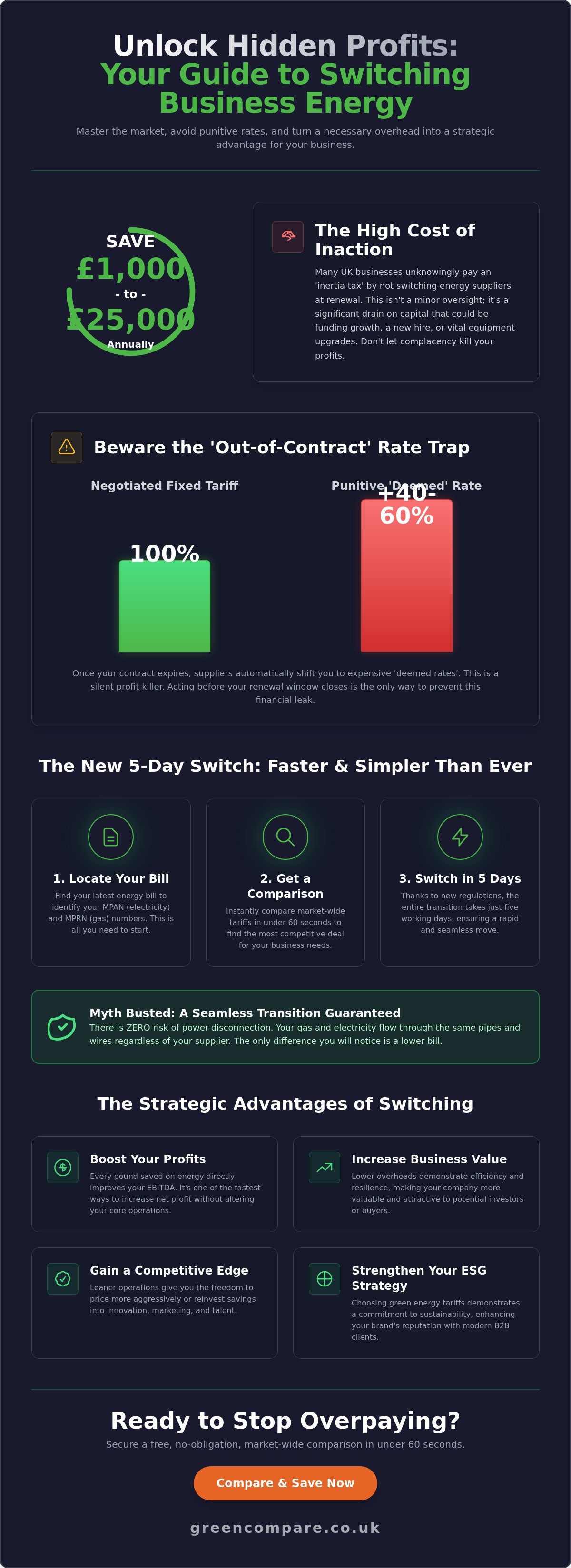
Did you know that UK businesses actively switching their energy contracts at renewal save between £1,000 and £25,000 every single year? It is a staggering figure that highlights just how much capital is currently being swallowed by outdated tariffs. If you feel that high standing charges are eating into your hard-earned profits, you aren't alone. Many directors find themselves stuck in a cycle of expensive, long-term deals simply because the process of switching business energy supplier feels like an unnecessary administrative headache.
We believe that managing your overheads should be a catalyst for growth, not a source of stress. This strategic guide empowers you to master the commercial energy market and secure the most competitive gas and electricity rates for your business in minutes. We will show you how to cut through the noise of the 2026 market, avoid the 60% price hike of out-of-contract rates, and turn a mundane task into a powerful lever for professional advancement. Let's streamline your costs and fuel your next phase of progress together.
Key Takeaways
- Identify why sticking with your current provider could be costing you thousands in out-of-contract rates and how to use 2026 market trends to your advantage.
- Master the new five-day regulatory landscape for switching business energy supplier to ensure a seamless transition with zero service interruption.
- Decipher the hidden costs of commercial tariffs by identifying the critical balance between daily standing charges and unit rates.
- Protect your cash flow from the "rollover trap" and learn how new commission disclosure rules guarantee a more transparent deal.
- Find out how to secure a market-wide comparison in under 60 seconds to optimise your utility management and gain a competitive edge.
The Financial Impact of Business Energy Inertia
Inertia is a silent profit killer. Many directors view energy as an unavoidable fixed cost, but this perspective is a costly mistake. Sticking with your current supplier without reviewing your options often leads to an "inertia tax" that drains your liquid capital. UK businesses that actively engage in switching business energy supplier at the end of their contract save between £1,000 and £25,000 per year on average. This is not just pocket change; it is capital that could fund a new hire, a marketing campaign, or a vital piece of equipment.
Think of your energy bill as a direct lever for your business valuation. High overheads reduce your EBITDA, which in turn lowers the overall market value of your company. Every pound you save on business electricity or gas is a pound of pure profit. By streamlining your utilities, you aren't just tidying up your accounts; you are actively building a more valuable, resilient enterprise. It's a simple financial move that yields immediate, recurring results.
The 2026 market landscape is defined by transition and lingering sensitivity. Whilst prices have stabilised from previous historic highs, volatility remains a constant threat to your bottom line. Gaining a clear perspective on how the energy market works helps you realise why securing a long-term fixed rate now is a brilliant defensive move. Proactive procurement allows you to lock in certainty whilst your competitors remain exposed to unpredictable market swings.
The biggest barrier to these savings isn't the paperwork. It is the psychological belief that switching is a "hassle." In reality, most SMEs overpay for years simply to avoid fifteen minutes of admin. Don't let a quarter-hour of administrative work stand between you and significant financial progress. The process is faster and more transparent than ever before.
The "Out-of-Contract" Rate Trap
Deemed rates are the default tariffs suppliers apply when your contract expires and you haven't negotiated a new one. These rates are punitive. Research indicates that deemed or out-of-contract rates can be 40% to 60% higher than a negotiated fixed tariff. Suppliers transition you to these expensive rates automatically the moment your term ends. Initiating the process of switching business energy supplier before your renewal window closes is the quickest way to stop this financial leak and protect your cash flow.
Energy Efficiency as a Competitive Advantage
Leaner businesses are naturally more competitive. When you lower your overheads, you gain the freedom to price your products or services more aggressively. Furthermore, opting for green energy tariffs helps you organise your ESG strategy. This makes your brand more attractive to modern B2B clients who prioritise environmental responsibility amongst their partners. Reinvest these savings into your core growth areas to widen the gap between you and your competition.
Navigating the 5-Day Business Energy Switch
The 2026 regulatory landscape has transformed the speed of the market. Previously, transitions could drag on for weeks, leaving firms in a state of administrative limbo. Now, thanks to updated mandates, the process of switching business energy supplier takes just five working days. This rapid turnaround ensures your business maintains momentum without being bogged down by legacy delays. It's a significant win for agility, allowing you to react to market shifts almost instantly.
To start, you need two critical identifiers: your MPAN for electricity and your MPRN for gas. These numbers are unique to your premises and are found on your latest bill. You will also likely encounter a Letter of Authority (LOA). This document is a simple, standard industry requirement that allows your chosen partner to communicate with suppliers on your behalf. It doesn't give away control; it merely streamlines the data-gathering process so you can focus on running your company whilst we handle the technicalities.
Fear of losing power is a common myth that prevents many from seeking better deals. There is absolutely zero risk of physical disconnection during a supplier transition. The gas and electricity reach your building through the same pipes and wires regardless of who sends the bill. You can find more official guidance from Ofgem regarding your rights and the protections in place during this period. The only difference you will notice is a more favourable figure on your monthly statement.
Gathering Your Energy Data
Your latest utility bill is a goldmine of information. Look for your Estimated Annual Consumption (EAC), which is the total amount of energy your business is expected to use over a year based on historical data. Having your meter serial number ready also speeds up the validation process significantly. Your EAC is the primary metric suppliers use to calculate an accurate, bespoke quote for your specific needs. Accuracy here ensures you don't overpay for capacity you don't use.
The 5-Step Switching Timeline
- Step 1: Market comparison. Use a trusted platform to compare live rates across the entire 2026 market in seconds.
- Step 2: Termination. Notify your current supplier that you intend to leave within your allowed contract window to avoid rollover.
- Step 3: Validation. Your new supplier will perform standard contract checks and credit assessments to finalise the agreement.
- Step 4: Meter readings. Provide opening readings on the day of the switch to ensure your first bill is 100% accurate.
- Step 5: Final settlement. Pay your closing bill to your outgoing provider to complete the transition and start your new contract.
By proactively switching business energy supplier, you take control of your financial future and ensure your overheads remain lean. If you are ready to see what's available, you can start your comparison here to secure a better rate in under 60 seconds.
Beyond the Unit Rate: How to Compare Commercial Tariffs
Look beyond the headline figure. A low unit rate is often a shiny distraction from a high daily standing charge. When switching business energy supplier, you must calculate the total annual cost to see the true picture. Your business model dictates which tariff structure wins. A high-energy manufacturing plant has different needs than a boutique retail unit. One prioritises the cost per kilowatt-hour; the other focuses on the fixed daily fee. Don't let a single number dictate your strategy.
Flexible tariffs might seem appealing during periods of market calm, but 2026 conditions reward certainty. Fixed-rate deals protect your cash flow from sudden price hikes. You should also watch for "pass-through" charges. These allow suppliers to add extra costs for network maintenance or regulatory changes mid-contract. For total peace of mind, seek a "fully fixed" agreement that locks in every element of your bill. You can find more details on your rights in Ofgem's official guidance regarding contract transparency.
Green energy is no longer a niche choice. With renewables providing over half of the UK's electricity in 2026, green tariffs are highly competitive. Choosing a sustainable option doesn't just help the planet; it enhances your brand reputation amongst ethically conscious B2B partners. Balance your environmental goals with your bottom line by comparing green rates alongside standard ones. It is a powerful way to align your operational costs with your corporate values.
Standing Charges vs. Unit Rates
High-usage businesses, such as those in the industrial sector, should prioritise the lowest possible unit rates. even a fraction of a penny difference can save thousands over a year. Conversely, small offices or shops with low consumption should hunt for minimal standing charges. The mathematical trade-off is simple: the more energy you use, the more the unit rate influences your total bill, whilst low users are more sensitive to the fixed daily cost.
Evaluating Contract Lengths
Choosing between a 12, 24, or 36-month deal is a matter of risk appetite. Short-term contracts offer flexibility but leave you exposed to future market volatility. Given the current sensitivity of the 2026 market, many firms are opting for 24 or 36-month deals to secure long-term price certainty. Always ensure your contract includes a relocation clause. This allows you to move premises without facing heavy exit fees, keeping your business agile as it grows.
Avoiding Hidden Clauses and Rollover Pitfalls
Transparency is the bedrock of a successful partnership. Too many firms fall victim to the "Rollover" trap, where a supplier automatically extends a contract at significantly higher rates because a notice period was missed. This often happens without active consent, locking you into expensive terms for another twelve months. Avoiding this pitfall is a critical step in switching business energy supplier and protecting your bottom line. You must treat your contract end date as a hard deadline for strategic action.
The 2026 regulatory shift has brought much-needed clarity to the market. Ofgem now mandates that energy brokers and third-party intermediaries must provide a transparent disclosure of their commission and fee structures. This means you can finally see the exact cost of the service you are receiving. Use this newfound transparency to ensure you are getting a fair deal. If a provider is hesitant to show you the numbers, it is a clear signal to look elsewhere for a more reliable partner.
Smaller firms benefit from specific micro-business protections. If your business uses less than 33 kWh of electricity or 145 kWh of gas per day, you are often eligible for a reduced VAT rate of 5%. You also have clearer paths to dispute unfair terms. Regardless of your size, the most effective way to stay safe is to mark your termination window in your calendar at least six months in advance. Serving a valid notice of termination early gives you the leverage needed to negotiate from a position of strength.
Spotting Unfair Contract Terms
Keep a sharp eye out for "volume tolerance" clauses. These terms can penalise your business if your energy consumption drops below a certain threshold, effectively taxing you for being energy efficient. You should also scrutinise the fine print for mid-contract price adjustments. A truly fixed deal should remain stable. Always serve your notice of termination via a recorded method to ensure you have proof of your intent to move when the time is right.
The Importance of Transparency
Demand a full breakdown of all non-commodity costs, such as distribution and transmission fees. It is vital to remember that B2B energy contracts rarely offer a "cooling-off" period. Once you agree to the terms, you are legally bound. Using a professional comparison service allows you to bypass aggressive direct-sales tactics and view the entire market objectively. This approach ensures you choose a tariff based on data rather than high-pressure sales pitches.
If you want to ensure your next contract is free from hidden surprises, you can compare transparent business energy rates in under 60 seconds and secure your business's financial future today.
Streamlining Your Business Utilities with Green Compare
Execution is everything in commercial finance. You have identified the risks of inertia and the complexity of 2026 tariffs. Now, you need a partner to translate that knowledge into measurable savings. Green Compare is built on the principle that switching business energy supplier should be a catalyst for growth, not a drain on your resources. Our platform delivers a comprehensive, market-wide comparison of Business Electricity and Business Gas rates in under 60 seconds. We replace hours of manual research with a single, streamlined dashboard.
We provide more than just a list of prices. Our team offers expert guidance that spans the entire journey from procurement to long-term financial planning. We view every utility switch as a step towards professional advancement. By optimising your overheads, we help you build a more resilient and sustainable enterprise. This isn't just about a cheaper bill; it's about collective progress and ensuring your business is positioned to lead in a modern, ethically conscious economy.
A Partnership Built on Efficiency
Delegate the heavy lifting to us. We manage the entire switching process on your behalf, coordinating with suppliers to ensure your transition adheres to the new five-day regulatory standard. Our "Speed of Service" benchmark is our signature of efficiency. We aim to move you from an initial quote to a validated contract today. Businesses trust us because we navigate the complexities of the 2026 market with regional pragmatism and modern entrepreneurial energy. Focus on your core operations whilst we secure your energy future.
Beyond Utilities: Supporting Your Financial Future
Strategic cost-cutting is the first step toward significant capital investment. We help you scale your savings by linking energy efficiency directly to our Business Loans solutions. The capital you reclaim from switching business energy supplier can be leveraged to fund larger projects. Many of our clients use an unsecured business loan to invest in energy-saving infrastructure, such as solar arrays or high-efficiency HVAC systems, creating a virtuous cycle of reduced costs and increased valuation.
Take the first step towards a leaner, more profitable operation. You can start your 60-second business energy comparison now and join thousands of UK firms that are already thriving through smarter utility management.
Take Command of Your Business Overheads
The 2026 energy landscape rewards the proactive. By mastering the five-day switch and looking beyond deceptive unit rates, you've already taken the first step toward significant overhead reduction. Don't let inertia dictate your profit margins. Active switching business energy supplier is no longer a chore; it's a strategic advantage that fuels your company's growth and professional advancement.
Our platform's designed to move you from uncertainty to clarity in seconds. We provide a full market comparison with total commission transparency and expert UK-based support to guide you through every step. It's time to stop overpaying and start reinvesting in your business's future. We're ready to act as your knowledgeable ally in this journey.
Secure your competitive business energy quote today and compare the entire market in just 60 seconds. We're here to ensure your transition is seamless, transparent, and profitable. Let's build a more resilient, cost-effective business together.
Frequently Asked Questions
How long does it take to switch business energy suppliers?
It takes exactly five working days to complete the transition under the 2026 regulatory framework. This rapid turnaround ensures that switching business energy supplier is a streamlined process that doesn't disrupt your daily operations. Once you have agreed to a new contract, the technical handover happens behind the scenes with peak efficiency.
Will my business lose power during the energy switch?
No, your business will not experience any loss of power during the transition. The physical supply of gas and electricity remains constant because the same infrastructure of pipes and wires serves your premises regardless of your provider. The switch is purely administrative, meaning your lights stay on whilst you benefit from more competitive rates.
What is a Letter of Authority (LOA) in business energy?
A Letter of Authority (LOA) is a standard industry document that permits a third-party intermediary to act on your behalf in the energy market. It empowers your chosen partner to gather data, manage tenders, and handle the administrative burden of procurement. This ensures you remain in control whilst delegating the complex task of market analysis to experts.
Can I switch business energy if I am in debt to my current supplier?
Most suppliers will block a switch if there is an outstanding debt on your account. To ensure a smooth transition, you should clear any arrears before initiating the process of switching business energy supplier. If you are in a dispute over a bill, you may still be able to switch, but it is best to resolve financial issues first to avoid delays.
What qualifies as a micro-business for energy contracts?
You qualify as a micro-business if your company employs fewer than ten people and has an annual turnover under €2 million. Alternatively, using less than 100,000 kWh of electricity or 293,000 kWh of gas per year also places you in this category. Micro-businesses enjoy enhanced Ofgem protections, such as clearer contract terms and specific rules regarding how commissions are disclosed.
What happens if my business moves premises during a contract?
Moving premises triggers a "Change of Tenancy" (CoT) process, which usually allows you to terminate your current contract without exit fees. You must provide your supplier with proof of the move and a final meter reading for your old site. This flexibility ensures your utilities can scale and move alongside your professional advancement without punitive charges.
Are there cooling-off periods for business energy contracts?
No, business energy contracts do not typically include a cooling-off period. Unlike residential agreements, B2B contracts are legally binding the moment you agree to the terms, whether verbally or in writing. It is vital to review all clauses and ensure the tariff aligns with your financial goals before finalising the deal.
What information do I need to get an accurate business energy quote?
You need your most recent utility bill to provide an accurate Estimated Annual Consumption (EAC) figure. Having your MPAN for electricity or MPRN for gas ready is also essential for identifying your specific meters. These details allow us to generate a bespoke market comparison in under 60 seconds, ensuring your quote reflects your actual usage patterns.