Fixed vs Variable Business Energy Tariffs: A 2026 Comparison Guide for UK Firms

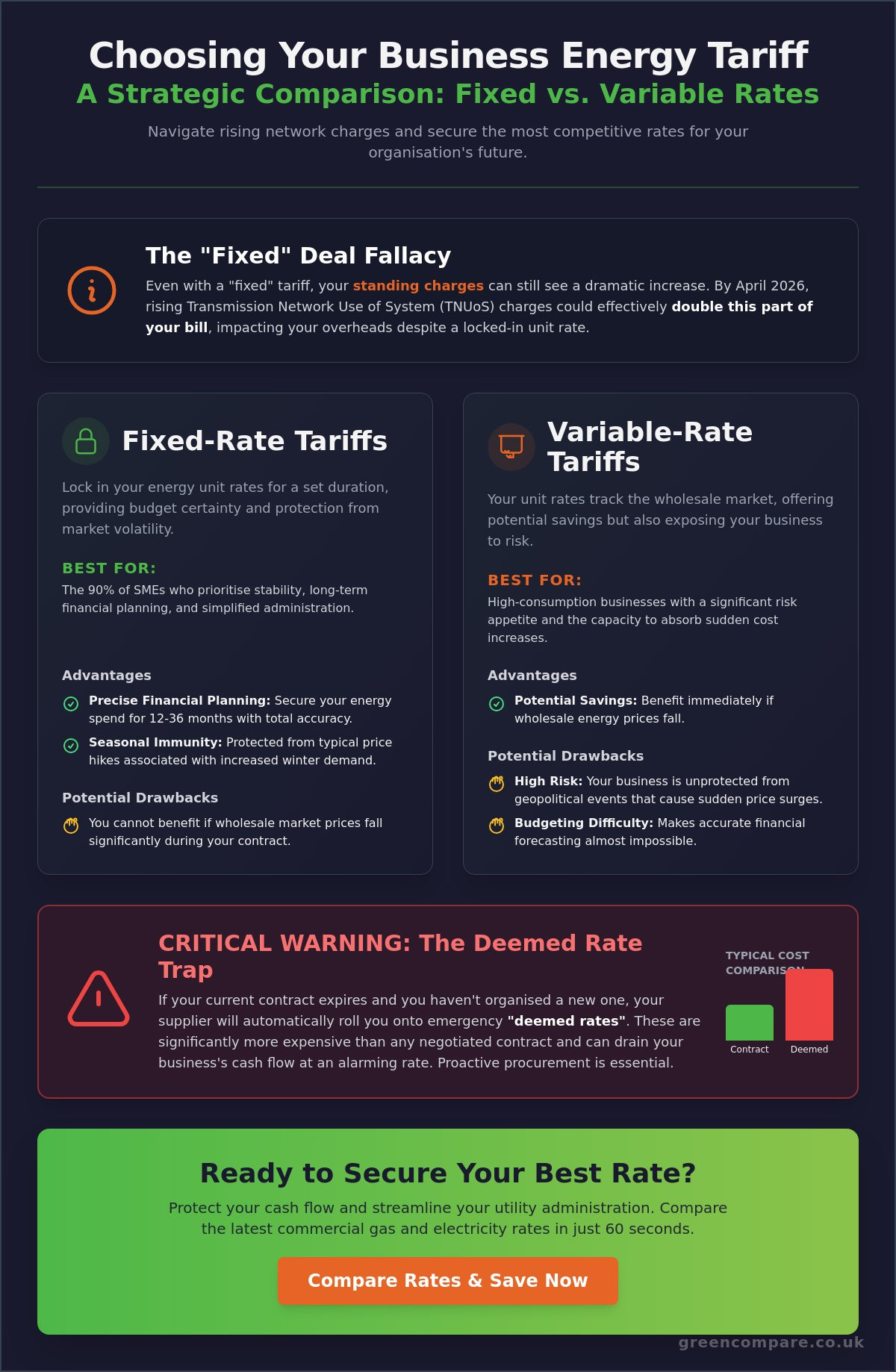
Choosing a "fixed" energy deal might actually lead to a 100% increase in your standing charges this year. Whilst the term suggests total stability, the April 2026 surge in Transmission Network Use of System (TNUoS) charges means many firms are seeing their overheads climb despite being under contract. It's a frustrating reality for UK leaders weighing up fixed vs variable business energy tariffs as domestic price cap news creates unnecessary confusion. Since 90% of SMEs rely on fixed deals to manage their outgoings, you need a strategy that prioritises your bottom line without the administrative headache.
We agree that managing commercial utilities should be simple and transparent, not a source of constant stress. This guide clarifies the strategic differences between these contract types to help you secure the most competitive rates for your organisation. You'll discover how to protect your cash flow from market volatility and avoid the trap of expensive deemed rates. We'll provide a clear, linear comparison of your options so you can return your focus to growing your business with absolute confidence.
Key Takeaways
- Clarify the distinction between unit rates and standing charges to navigate the impact of rising non-commodity costs on your 2026 energy budget.
- Evaluate fixed vs variable business energy tariffs to decide whether long-term price certainty or market-linked flexibility better supports your organisational growth.
- Protect your cash flow from expensive deemed rates by identifying the critical timelines for renewing your commercial energy contracts.
- Use our decision framework to match your energy strategy with your specific business model, comparing the needs of small retail units against high-consumption manufactories.
- Streamline your utility administration by learning how to compare the latest commercial gas and electricity rates in just 60 seconds.
Understanding the Core Differences in Commercial Energy Contracts
Stop comparing your office energy bill to your home statement. It's a common mistake that leads to costly assumptions. In the commercial sector, the Ofgem price cap simply doesn't exist. Whilst domestic users have a regulatory safety net, your organisation must navigate a competitive landscape where prices are dictated by wholesale volatility and contractual precision. Choosing between fixed vs variable business energy tariffs requires a firm grasp of how suppliers calculate your bill. You are essentially managing a financial risk, not just paying for a utility.
Every commercial contract breaks down into two primary costs. First, the unit rate is what you pay for every kilowatt-hour (kWh) of gas or electricity you consume. Second, the standing charge is a daily fee that covers the cost of maintaining the national grid and supplying energy to your premises. In 2026, standing charges have become a focal point for UK firms due to a 64% average rise in Transmission Network Use of System (TNUoS) charges. Understanding these components is the first step toward collaborative growth and long-term overhead reduction.
Fixed-Rate Tariffs: Stability in a Volatile Market
Locking in your energy costs is the most popular choice for UK SMEs for a reason. A fixed-rate tariff secures your unit rates for a set duration, typically between one and three years. This provides immediate budget certainty, allowing you to forecast your operational spend without fearing sudden geopolitical spikes. It's a pragmatic tool for professional advancement. However, be aware that suppliers will almost always conduct a credit check before offering these terms. They are committing to a price today, regardless of how the market shifts tomorrow, so they need to ensure your business is a reliable partner. It's also vital to remember that "fixed" often refers only to the wholesale energy portion; non-commodity costs like TNUoS can still cause your total bill to fluctuate.
Variable-Rate Tariffs: Flexibility vs. Risk
Variable-rate contracts track the rhythm of the wholesale market. If energy prices drop, your organisation benefits from lower rates almost immediately. This flexibility appeals to opportunity-seekers who believe the market is on a downward trend. The trade-off is a lack of protection. If wholesale prices climb, your overheads will follow suit without warning. The greatest danger here is the "deemed rate." If your current contract expires and you haven't organised a new deal, your supplier will roll you onto these emergency rates. Deemed rates are significantly more expensive than standard contracts and can drain your capital rapidly. Don't leave your business exposed; proactive procurement is the only way to safeguard your progress.
The Strategic Case for Fixed-Rate Business Energy Tariffs
For most UK directors, the primary appeal of a fixed-rate contract is the ability to neutralise market noise. By locking in unit prices, you transform a volatile variable cost into a predictable line item. This is particularly vital in 2026, as global supply chains remain sensitive to geopolitical shifts that can trigger overnight price surges. When comparing business energy tariffs, you'll find that fixed deals act as a hedge against these unpredictable spikes, ensuring your operational budget remains intact regardless of external pressures.
Beyond price protection, fixed tariffs simplify your back-office operations. Consistent unit rates mean your VAT calculations and Climate Change Levy (CCL) obligations are easier to track. You won't spend hours unpicking why your tax liabilities shifted because of a mid-month price hike. This efficiency allows you to focus on professional advancement rather than administrative firefighting. Understanding the nuances of fixed vs variable business energy tariffs is essential for any leader aiming for long-term stability and collaborative growth. You can quickly view available fixed rates to see how they align with your current cash flow.
Advantages of Locking in Your Rates
- Precise financial planning: Secure your energy outgoings for the next 12 to 36 months with total accuracy.
- Seasonal immunity: Stay protected from the typical price hikes associated with increased winter demand.
- Administrative ease: Standardise your utility spend, making it simpler to report on overheads and profitability.
Potential Drawbacks of Fixed Contracts
While the security of a fixed contract is compelling, it isn't without trade-offs. If wholesale prices drop significantly during your term, you'll remain tied to your higher agreed rate until the contract expires. This "missing out" factor is the price you pay for certainty. Furthermore, these contracts often include restrictive exit fees, meaning you lack the agility to switch providers if your circumstances change suddenly. It's also possible to find yourself "over-hedged" if your business energy use fluctuates; you might be paying a premium for capacity you don't fully utilise. Ultimately, the choice between fixed vs variable business energy tariffs depends on your appetite for risk and your need for budget precision.
Navigating Variable and Deemed Rates in the Commercial Market
Variable tariffs offer a different kind of strategic advantage. Unlike the rigid structure of a fixed deal, a planned variable contract allows your business to move in rhythm with the wholesale market. You aren't tied down by long-term commitments or punitive exit fees. This agility is a powerful tool for leaders who anticipate a downward trend in energy prices. However, the decision between fixed vs variable business energy tariffs requires a clear understanding of the current regulatory environment. The 2025 Budget introduced significant shifts in energy levies, including the finalisation of the British Industrial Competitiveness Scheme (BICS). Whilst BICS offers up to 25% relief for 10,000 eligible manufacturers, other firms must contend with the 64% average rise in TNUoS charges that took effect in April 2026.
Don't confuse a flexible variable plan with the "Rollover Trap." If your current contract expires without a new agreement in place, your supplier will move you onto deemed rates. This is an unplanned, expensive transition that can stall your professional advancement. Some industry professionals report that businesses pay up to 80% more on these emergency rates compared to negotiated contracts. It is a drain on your capital that provides no additional value. Proactive management ensures you stay in control of your overheads rather than being at the mercy of a supplier's default pricing.
When Variable Rates Make Sense
- Short-term premises leases: Avoid long-term "lock-ins" if your occupancy is temporary or uncertain.
- Strategic transitions: Maintain flexibility if you plan to move, sell, or close your organisation in the near future.
- High cash reserves: Absorbing market spikes is easier if your business has the liquidity to handle temporary price surges in exchange for potential long-term savings.
The High Cost of Inaction: Out-of-Contract Rates
Deemed and out-of-contract rates serve as the supplier's safety net, not yours. Deemed rates represent the highest possible price point for commercial energy. With typical SME electricity rates currently sitting between 22p and 30p per kWh, falling onto a deemed rate can instantly devastate your margins. These prices are designed to be punitive to encourage businesses back into a formal contract. If you find your organisation on one of these tariffs, you must act with speed. Transitioning from a deemed rate to a competitive fixed deal can be organised in minutes, immediately protecting your cash flow and supporting collective growth. Secure a formal agreement today to ensure your energy spend contributes to your business empowerment rather than hindering it.
Decision Framework: Which Tariff Type Suits Your Business Model?
Selecting the right energy path depends entirely on your operational goals and your tolerance for financial uncertainty. It isn't a one-size-fits-all calculation; it's a strategic choice that aligns your utility spend with your growth trajectory. Risk-averse organisations, such as those in the charity or healthcare sectors, usually value predictability above all else. In contrast, opportunity-seekers with significant cash reserves might tolerate short-term volatility to potentially capture lower average costs over time. Evaluating fixed vs variable business energy tariffs requires you to look beyond the headline rate and consider how each structure impacts your monthly cash flow.
Your industry type dictates your priorities. A small retail shop with steady, low-volume usage should focus on securing the lowest daily standing charge. Because their consumption is limited, the daily fee often represents a larger percentage of their total bill. Conversely, a high-consumption manufactory must prioritise the unit rate. For these energy-intensive firms, even a fraction of a penny difference per kWh can result in thousands of pounds in annual savings. The introduction of Market-wide Half-hourly Settlement (MHHS) in 2026 has made this data even more critical. By using smart meter data to monitor usage patterns, you can see exactly when your organisation draws the most power, allowing for a more informed choice between a fixed or variable structure.
The SME Perspective: Prioritising Cash Flow
Cash flow is the lifeblood of any small business. Fixed rates provide the peace of mind needed to reinvest profits into professional advancement rather than worrying about energy market fluctuations. When using comparison tools, look for the most competitive standing charges to keep your fixed costs low. Always check the small print for "pass-through" clauses. Some contracts are marketed as fixed but allow suppliers to increase prices if green levies or regulatory costs, like the recent TNUoS increases, shift significantly. To find a deal that offers genuine protection for your budget, compare SME energy rates now and secure your organisation's future.
The Large Enterprise Approach: Market Timing
Larger organisations often move away from simple "off-the-shelf" contracts in favour of flexible procurement. This approach allows multi-site organisations to balance their portfolio with a mix of fixed and variable elements. You might choose to fix 70% of your anticipated load to guarantee a baseline cost whilst leaving the remaining 30% on a flexible plan to capitalise on wholesale price dips. This level of sophistication usually requires proactive monitoring of wholesale trends. By treating energy as a tradable commodity rather than a static bill, large firms can turn utility management into a competitive advantage, supporting collective growth and long-term sustainability.
Securing Your Next Business Energy Contract with Green Compare
Managing your organisation's utility portfolio doesn't have to be a drain on your time or resources. We've streamlined the procurement process into a highly efficient 60-second comparison, allowing you to move from a complex financial problem to a cost-effective solution almost instantly. Whether you're finalising the debate between fixed vs variable business energy tariffs or simply seeking to escape expensive deemed rates, our platform acts as your expert guide. We view every client as a long-term partner in collaborative growth. By reducing your overheads, we empower you to reinvest those savings back into your core operations, driving professional advancement across your sector.
Our "Switch and Forget" service is designed for the proactive leader who values time above all else. Once you've selected your ideal contract, we handle the entire administrative burden. We coordinate with suppliers to ensure a seamless transition for both your business gas and electricity supplies. This removes the stress of utility management, allowing you to focus on your visionary goals whilst we secure the most competitive rates available in the 2026 market. It's a simple, stress-free path to business empowerment that aligns with contemporary corporate values of efficiency and reliability.
Why Thousands of UK Firms Trust Green Compare
- Exclusive market access: Benefit from bespoke rates and contract terms that aren't available through direct supplier channels.
- A partnership-oriented outlook: We treat your organisation as a valued ally, providing professional guidance tailored to your specific risk tolerance.
- Ethical and transparent practices: We maintain total clarity regarding commission disclosure, ensuring you can trust the integrity of every deal we present.
- Specialist procurement expertise: From small retail units to energy-intensive manufacturing, we understand the unique demands of the UK commercial sector.
Your Next Steps to Energy Efficiency
Ready to optimise your utility spend? The process is straightforward and designed for immediate impact. First, gather your most recent energy bill and identify your current contract end date. This information ensures your quotes are as accurate as possible. By comparing fixed vs variable business energy tariffs through our portal, you ensure your decision is backed by real-time data. Use the Green Compare platform to view live 2026 market rates and select the deal that fits your cash flow. Don't let administrative inertia cost your organisation. Start your comparison today to protect your 2026 margins and join a community of forward-thinking firms committed to collective progress and sustainable growth.
Empower Your Business Growth Today
Securing the right energy contract is a fundamental step toward long-term financial stability. By now, you understand that navigating fixed vs variable business energy tariffs isn't just about finding the lowest number; it's about aligning your overheads with your specific cash flow requirements and risk tolerance. Whether you prioritise the budget certainty of a fixed deal or the market-tracking potential of a variable plan, proactive management is the key to avoiding expensive out-of-contract rates. Expert commercial utility procurement ensures your organisation remains resilient against market volatility.
Since 2019, Green Compare has acted as a trusted partner for thousands of UK firms, providing a no-obligation, transparent comparison service that puts your needs first. We simplify the complexities of the 2026 energy market whilst you focus on professional advancement and collective progress. Don't let administrative tasks slow your momentum. Compare Business Energy Rates in 60 Seconds and discover how a streamlined approach to your gas and electricity can fuel your future success. We're ready to help you thrive.
Frequently Asked Questions
Is there a price cap for business energy in 2026?
No, there is no Ofgem price cap for business energy in 2026. This regulatory safety net only protects domestic customers on standard variable or prepayment tariffs. Commercial rates are determined by individual contract negotiations and wholesale market conditions. Without a cap, your organisation must stay proactive to avoid being rolled onto expensive default rates, especially as non-commodity costs like TNUoS charges continue to rise.
Can I switch from a fixed to a variable tariff mid-contract?
You generally cannot switch mid-contract without paying significant early exit fees. Fixed contracts are legally binding agreements where the supplier purchases energy in advance for your term. Breaking this arrangement early often results in penalty charges that can easily outweigh any potential savings. Always check your contract's specific termination clause or wait for your renewal window to open before making a move toward a different structure.
What happens if my business energy contract expires and I do nothing?
Your supplier will automatically roll you onto "deemed" or "out-of-contract" rates, which are often the most expensive tariffs in the market. These emergency prices can be up to 80% higher than negotiated deals. Avoid this costly trap by organising your next agreement well before your current one ends. Taking action early ensures your overheads remain predictable and your business empowerment stays on track without unnecessary financial drain.
Are fixed-rate business energy tariffs always cheaper than variable ones?
Not always, as the choice between fixed vs variable business energy tariffs depends on market timing. Fixed rates offer budget certainty but may include a small risk premium for that protection. Variable rates can be cheaper during a falling market but leave you exposed to sudden geopolitical spikes. Most UK SMEs prefer fixed deals for the peace of mind they provide, allowing for more precise financial forecasting and professional advancement.
How long do fixed-rate business energy contracts usually last?
Most fixed-rate commercial contracts last between one and three years. A 12-month term offers maximum flexibility to switch if market prices drop, whilst a 36-month contract provides long-term protection against volatility. Choose a duration that aligns with your specific organisational goals and cash flow strategy. Longer contracts are often preferred by firms seeking total overhead stability during periods of global energy uncertainty and rising network costs.
Do variable business energy tariffs have exit fees?
Most variable business energy tariffs do not have early exit fees, giving you the freedom to switch providers with minimal notice. This flexibility is ideal for organisations in transition or those with short-term premises leases. However, always verify this within your specific terms and conditions before signing. Whilst the lack of fees is attractive, remember that variable rates leave your organisation unprotected from sudden wholesale price increases that can impact your margins.
How does Green Compare earn money from energy switches?
We receive a commission from the energy supplier once your switch is successfully completed. This allows us to provide a transparent, no-obligation comparison service to your business at no direct cost. We are committed to ethical brokerage, ensuring our recommendations are based on finding the best strategic fit for your organisation's growth. Our fee is typically included within the unit rate offered by the supplier, maintaining total clarity throughout the process.
What information do I need to get a business energy quote?
You only need a few details from a recent utility bill to generate live 2026 market rates. Have your current supplier name, your annual consumption in kWh, and your contract end date ready. Providing your MPAN for electricity or MPRN for gas helps us identify your meters accurately. This information allows us to produce a precise comparison in just 60 seconds, accelerating your journey toward reduced overheads and collaborative growth.