Average Business Gas Bill UK 2026: Benchmarks and Savings Guide

Is your firm paying significantly more for energy than your competitors, or are you simply following a market average that has shifted beneath your feet? Managing overheads often feels like a constant battle against volatility. With the Climate Change Levy having risen to £0.00801 per kWh in April 2026 and previous government support schemes now ended, it's easy to feel overwhelmed by unpredictable outgoings. Understanding the average business gas bill uk is the first step toward regaining control and justifying your energy spend to stakeholders.
You deserve a transparent way to lower operational costs without spending hours on manual comparisons. This guide provides the latest 2026 benchmarks to help you gauge your current performance against other firms. We'll demystify the confusion between standing charges and unit rates, then show you how to organise a more cost-effective contract. Follow our linear path to long-term price stability and turn a mundane administrative task into a strategic advantage for your collective progress.
Key Takeaways
- Compare your firm's energy spend against verified 2026 benchmarks for micro, small, and medium enterprises to ensure competitive overheads.
- Learn how to calculate the average business gas bill uk by decoding the relationship between unit rates, standing charges, and the latest levies.
- Avoid the financial drain of expensive out-of-contract rates and regional distribution charges that often inflate commercial outgoings.
- Discover how to organise a more cost-effective energy contract in minutes using a transparent, whole-of-market comparison tool.
- Secure long-term price stability and support your firm’s growth by switching to a supplier that aligns with your modern corporate values.
Average Business Gas Bills in 2026: The Current UK Landscape
Your average business gas bill uk is more than just a monthly expense; it's a vital metric of your operational efficiency. In 2026, the commercial energy landscape is defined by a shift away from emergency government subsidies toward a market driven by supply chain resilience and environmental targets. To understand your spend, you must first view your bill as a combination of two primary costs. The unit rate covers every kilowatt-hour (kWh) of gas your firm consumes, whilst the standing charge is a fixed daily fee for maintaining your physical connection to the grid.
Whilst global supply shifts continue to influence the National Balancing Point (NBP), the UK oil and gas industry remains a central pillar of domestic energy production. However, businesses must still navigate prices that respond instantly to international demand. Recognising that "average" is merely a baseline is essential. Your specific sector, whether it is heavy manufacturing or a boutique high-street shop, dictates your true cost profile. Use these 2026 benchmarks as a starting point to justify your budget to stakeholders and identify where your procurement strategy might be falling short.
Why Business Gas Prices Differ from Domestic Rates
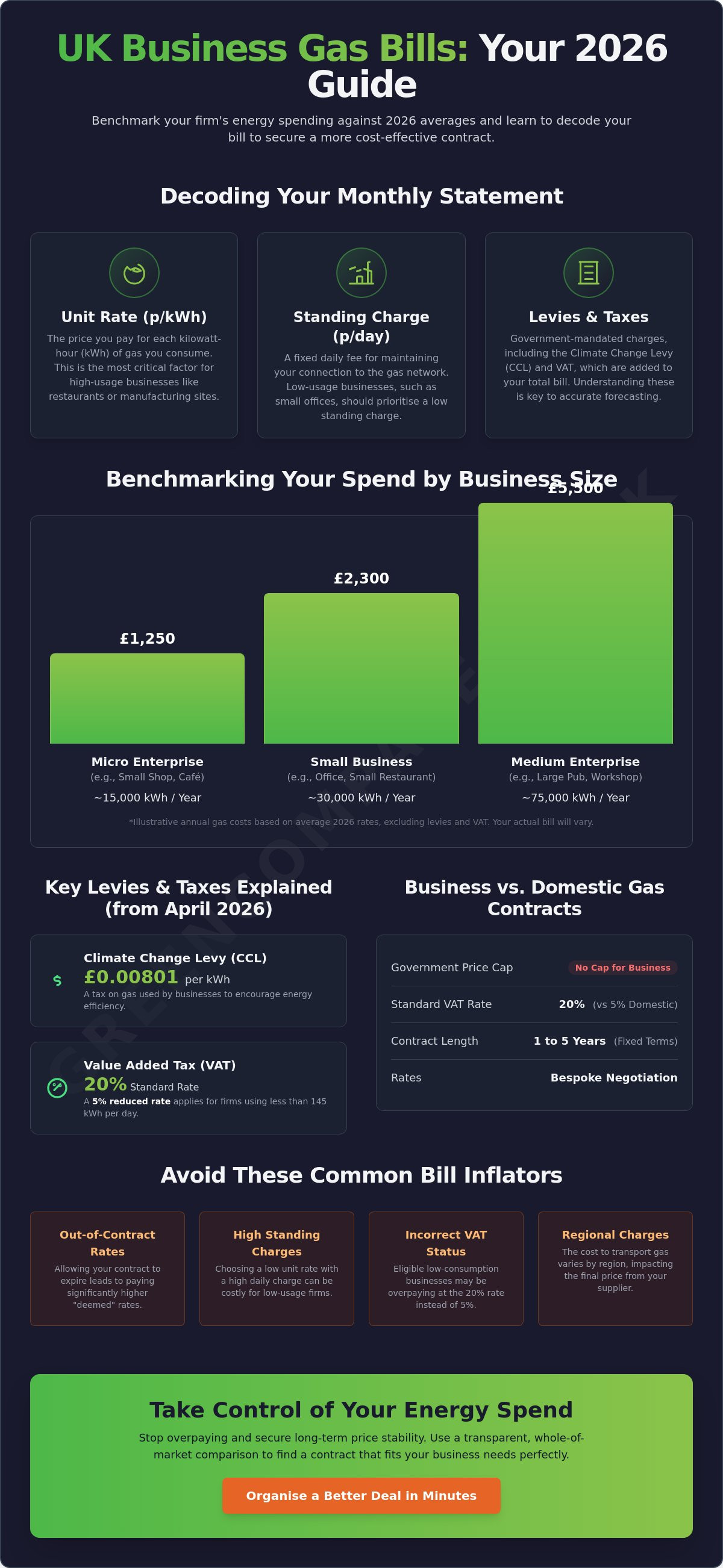
Unlike the residential sector, there is no universal government price cap for the commercial market in 2026. This means your rates are entirely dependent on your ability to negotiate a bespoke contract. Taxation also plays a significant role in your final statement. Most firms pay the standard VAT rate of 20%, but smaller consumers using less than 145 kWh per day may qualify for a reduced 5% rate. Your choice of contract length, typically ranging from one to five years, will also heavily influence the average monthly figure you see. Longer contracts often offer greater stability in a market that remains sensitive to geopolitical shifts.
The 2026 Energy Market: Volatility and Trends
Volatility has become the new normal for UK SMEs. International events have made the NBP more reactive, leading many firms to favour fixed-rate deals in 2026 to lock in certainty. We have also seen a significant rise in the availability of "Green Gas" or biomethane. Whilst these environmentally conscious tariffs sometimes carry a slight premium, they are becoming a standard amongst businesses aiming for net-zero targets. This shift is gradually influencing standard tariff averages across the country. Secure your firm's future by choosing a tariff that balances cost-effectiveness with modern corporate responsibility.
Decoding Your Bill: Unit Rates, Standing Charges, and Levies
Understanding the mechanics of your monthly statement is the most effective way to protect your firm's bottom line. Most owners feel frustrated by unpredictable totals, yet the structure of the average business gas bill uk is remarkably consistent across suppliers. Your bill is essentially a puzzle of consumption costs, fixed service fees, and government mandates. Recent ONS analysis of energy costs highlights how these non-commodity elements have become a significant portion of total commercial spend. By identifying each component, you can spot inaccuracies and ensure you only pay for the energy you actually use.
The Unit Rate vs. The Standing Charge
The unit rate is the price you pay for every kilowatt-hour (kWh) of gas your firm consumes. Whilst it is tempting to chase the lowest possible unit rate, you must consider the standing charge, which is the fixed daily cost of maintaining your physical gas connection. A low unit rate paired with a high standing charge is often a trap for low-usage firms, such as small offices or boutique shops. If your business operates only during standard daylight hours, you should prioritise a lower standing charge. Conversely, high-volume users like laundries or restaurants should focus on securing the most competitive unit rate to achieve maximum savings. You can compare these rates side-by-side to find the balance that suits your specific operational hours.
Taxes and Levies: The CCL and VAT
Government levies are often the "hidden" extras that inflate your total spend. From 1 April 2026, the Climate Change Levy (CCL) for natural gas is set at £0.00801 per kWh. This tax aims to encourage energy efficiency, but certain organisations, including charities and those with very low consumption, are exempt. You should also pay close attention to your VAT status. Whilst the standard rate is 20%, the "De Minimis" threshold allows businesses using less than 145 kWh of gas per day (approximately 4,397 kWh per month) to qualify for a reduced 5% rate. Check your most recent statement to ensure your supplier hasn't wrongly applied the standard rate. If you've been overcharged, you are often entitled to a rebate covering up to four years of payments.
Inaccurate billing frequently stems from estimated readings rather than actual data. If your supplier hasn't received a recent meter reading, they will guess your usage based on historical patterns, which often leads to significant overpayment. Submit a manual reading every month or consider installing a smart meter to ensure your average business gas bill uk reflects real-time consumption. This simple habit eliminates the stress of "catch-up" bills and keeps your cash flow predictable. Taking these linear steps transforms your utility management from a source of stress into a transparent, manageable part of your business growth.
Benchmarking Your Spend: Average Gas Bills by Business Size
Your latest energy statement is the most important document in your office right now. It's the only way to determine if your firm is overpaying for essential utilities. Whilst unit rates provide a snapshot of price, the total annual figure is what truly impacts your cash flow. Data from June 2026 reveals that the average business gas bill uk varies dramatically depending on your consumption bracket. An Office for National Statistics report highlights that energy remains a primary concern for non-domestic users, making these benchmarks essential for any proactive procurement strategy.
The following table outlines the 2026 benchmarks for commercial gas spend across the UK. Use these figures to gauge where your firm sits on the spectrum.
| Business Size | Typical Annual Usage (kWh) | Estimated Annual Bill (2026) |
|---|---|---|
| Microbusiness | 10,000 | £920 |
| Small Business | 22,500 | £18,131 |
| Medium Business | 47,500 | £38,328 |
| Large Business | 65,000+ | £52,200 |
These averages are a vital starting point, but remember that your sector heavily influences your specific costs. A high-street boutique and a small restaurant might both fall into the "Small Business" category, yet the restaurant's reliance on gas for cooking will lead to a much higher bill. Find your most recent annual statement and compare your total spend to these figures. If you're paying significantly above the benchmark, it's time to re-evaluate your contract.
Micro and Small Business Benchmarks
Microbusinesses typically consume under 10,000 kWh annually. For a standard UK shop, the 2026 average of £920 represents a manageable overhead, provided you aren't stuck on a default tariff. Small businesses using up to 22,500 kWh face a steeper climb, with average bills reaching £18,131. The introduction of "Faster Switching" in the UK market has significantly boosted agility for these smaller firms. You can now move between suppliers in a matter of days, allowing you to capitalise on price drops as soon as they happen. Don't let your loyalty to a legacy supplier drain your resources.
Medium and Large Enterprise Costs
For medium and large enterprises, gas consumption often exceeds 50,000 kWh annually. Whilst these firms often secure lower unit rates—averaging around 5.4p per kWh for large users—their total standing charges are significantly higher. In 2026, medium businesses see daily standing charges of approximately 79.2p. Many larger firms now utilise half-hourly metering to manage this large-scale consumption. This technology provides granular data, allowing managers to identify usage spikes and adjust operations to maintain efficiency. This level of transparency is essential for justifying energy spend to board-level stakeholders and driving long-term sustainability goals.
Factors That Inflate Your Business Gas Bill
Achieving a competitive average business gas bill uk requires more than just picking a supplier; it demands vigilance against hidden costs that quietly drain your budget. Even the most efficient firms can see their overheads skyrocket if they fall into common procurement traps. Whilst market rates fluctuate, several internal and external factors exert a massive influence on your final statement. Understanding these variables allows you to take proactive steps toward securing long-term price stability for your organisation.
One often overlooked factor is your firm's credit score. In 2026, energy suppliers use sophisticated financial profiling to determine the risk of a commercial contract. If your business has a lower credit rating, you may be offered higher unit rates or required to provide a security deposit. Similarly, your physical location plays a role. Regional distribution charges vary across the UK, meaning the standing charge for a centre in London might differ significantly from one in South Wales. These regional variances are a standard part of the grid's infrastructure costs, but they must be factored into your benchmarking.
The Danger of Rollover Tariffs
Doing nothing is the most expensive choice a business owner can make. When your fixed-term deal expires without a new agreement in place, your supplier will move you onto "deemed" or out-of-contract rates. These rates are often 100% higher than competitive market deals. Under 2026 regulations, suppliers must provide clear notice periods before a contract ends, but the responsibility to act remains with you. We help firms avoid these rollover traps by providing automated reminders and instant market access. You can organise a better deal today and ensure you never pay a penny more than necessary.
Operational Inefficiency and Waste
Physical infrastructure is a major driver of gas waste. Old boilers and poor insulation can waste up to 30% of the gas you pay for, effectively throwing a third of your energy budget out of the window. Heating an uninsulated warehouse or office centre is a losing battle against the British winter. Smart meters are no longer an optional luxury; they are a vital tool for modern utility management. By analysing your usage data, you can identify "vampire" gas loads, which is unnecessary consumption that occurs during closing hours when your premises should be dormant.
Audit your premises for draughts and consider upgrading to high-efficiency boiler technology. These improvements might require an initial investment, but the reduction in your annual gas consumption will pay dividends for years. Combined with strategic procurement, these operational changes move your firm away from the stress of high overheads and toward a future of sustainable, collaborative growth. Take control of these factors now to ensure your firm remains agile and competitive in an ever-changing market.
Strategic Utility Management: Organise a Better Deal with Green Compare
Securing a competitive average business gas bill uk is no longer a matter of luck; it's the result of strategic procurement and rapid execution. In 2026, the speed of the market demands a partner that values your time as much as your bottom line. We've designed our service to be the antithesis of the cold, clinical brokerage model. Instead, we act as a proactive ally, providing whole-of-market access and total transparency. Our 2026 comparison tool is built for the modern entrepreneur, delivering a comprehensive quote in minutes rather than days. This efficiency allows you to move quickly from identifying a problem to implementing a high-impact solution.
Our commitment to your firm extends far beyond a simple transaction. We adopt a partnership-oriented outlook, staying with your account for the entire duration of your contract. This ensures that you're never left to navigate supplier disputes or mid-contract queries alone. We believe in shared progress, where our proficiency in utility management fuels your firm's long-term development. By streamlining the complex world of commercial energy, we alleviate the stress of rising overheads and replace it with a sense of optimistic control.
Switching in 5 Working Days
The 2026 Ofgem Faster Switching Programme has transformed the energy landscape, allowing firms to move between suppliers with unprecedented agility. You don't have to wait weeks for a transition to complete whilst your cash flow suffers under an expensive tariff. We handle the entire administrative burden of the switch, ensuring the process is seamless and stress-free. This rapid transition is a core part of our efficiency benchmark, designed to get your firm onto a better rate as quickly as possible. Don't let administrative inertia hold back your professional advancement. Compare business gas prices now and start your journey toward a more cost-effective future.
Financing Your Energy Future
Reducing your consumption is the only way to permanently lower an "average" bill and insulate your firm from market volatility. However, we recognise that the capital required for energy-efficient infrastructure can be a barrier to growth. This is where our integrated approach provides a unique advantage. We offer business loans specifically designed to fund high-efficiency gas boilers, heat pumps, and modern insulation. By upgrading your physical centre, you reduce your reliance on the grid and align your firm with contemporary environmental values. This dual focus on competitive procurement and financial support positions us as a central hub for your business growth. We're not just helping you pay less; we're helping you build a more sustainable, resilient organisation that is ready for the challenges of tomorrow.
Secure Your Firm's Financial Future
Understanding the average business gas bill uk is the foundation of a resilient commercial strategy. You've identified the 2026 benchmarks for your sector and decoded the hidden levies that often inflate your monthly statement. Now, the path to long-term stability requires shifting from observation to action. By addressing operational inefficiencies and auditing your VAT status, you transform a standard overhead into a streamlined engine for growth. This proactive approach ensures your firm remains agile whilst your competitors struggle with unpredictable outgoings.
Our partnership approach simplifies this transition by offering a whole-of-market comparison alongside expert guidance on CCL and VAT exemptions. We even provide access to business loans for essential energy upgrades, ensuring your infrastructure matches your modern ambitions. Don't let market volatility dictate your firm's progress or drain your resources. Secure a more competitive business gas rate in minutes and join a community of forward-thinking UK businesses. It's time to reclaim your schedule and focus on what you do best, whilst we handle the complexities of your utility management. Let's move forward together toward a more sustainable future.
Frequently Asked Questions
What is the average business gas bill for a small UK company in 2026?
The average business gas bill uk for a small firm consuming 22,500 kWh annually is approximately £18,131 as of June 2026. This figure acts as a vital benchmark to ensure your firm isn't overpaying on a legacy tariff. If your latest statement is significantly higher than this baseline, it's time to audit your consumption and compare current market rates for a more cost-effective deal.
How much VAT should my business be paying on gas bills?
Most businesses pay a standard VAT rate of 20% on their gas bills. However, if your firm uses less than 145 kWh of gas per day, you qualify for a reduced rate of 5%. Check your bill carefully to ensure this "De Minimis" threshold is applied correctly. You might even be entitled to a rebate for previous overpayments if you've been wrongly charged the standard rate.
Can I switch my business gas supplier if I am in a fixed-term contract?
Switching is generally only possible once you enter your contract's "renewal window," which typically starts six months before the expiry date. Commercial agreements are legally binding and rarely offer the same mid-term flexibility as residential deals. Start your comparison early so you're ready to transition the moment your current term ends. This prevents you from falling onto expensive out-of-contract rates.
What is the Climate Change Levy and does every business have to pay it?
The Climate Change Levy (CCL) is a government tax on commercial energy use, set at £0.00801 per kWh for natural gas from 1 April 2026. It aims to encourage efficiency and reduce carbon emissions across the UK. Charities and very small consumers are often exempt from this charge. Verify your status with your supplier to ensure you aren't paying for levies your organisation doesn't owe.
How long does it take to switch business gas suppliers in 2026?
Under the Ofgem Faster Switching Programme, moving to a new supplier can now take as little as five working days. This rapid process ensures your firm benefits from lower rates almost immediately. We handle the administrative heavy lifting to ensure your transition is seamless. This speed is essential for maintaining price stability in a volatile market.
Why is my business gas standing charge so high compared to my home?
Commercial standing charges are higher because they reflect the increased cost of maintaining the industrial-grade infrastructure required for business connections. Unlike residential bills, business rates aren't protected by the domestic price cap. This makes strategic procurement essential to offset these fixed daily costs. Higher standing charges are a standard part of the non-domestic landscape, but they can still be negotiated.
Does Green Compare charge a fee for comparing business gas prices?
Green Compare doesn't charge users a direct fee for comparing business gas prices or organising a new contract. Our service is designed to be a transparent, cost-effective solution for firms looking to grow. We receive a commission from the supplier, allowing us to act as your expert guide without impacting your operational budget. This ensures our interests are aligned with your long-term success.
Is it better to choose a 1-year or 3-year fixed gas contract right now?
Choosing a contract length depends on your firm's need for stability versus flexibility. A 3-year fixed deal offers total protection against market volatility and simplifies your long-term budgeting. Conversely, a 1-year contract allows you to capitalise on potential price drops sooner. Evaluate your cash flow requirements to decide which path supports your collective progress and helps you manage the average business gas bill uk effectively.