How to Read a Commercial Gas Bill: A Business Owner’s Guide for 2026

Wholesale energy prices in 2026 remain 35% higher than pre-crisis levels, yet many business owners still treat their monthly statement like an unavoidable tax rather than a manageable cost. It's frustrating to stare at technical jargon whilst worrying that estimated readings or expensive out-of-contract rates are quietly draining your cash flow. You deserve total transparency over your overheads. We understand that your time is your most valuable asset, so let's simplify the complexity together.
This guide shows you exactly how to read a commercial gas bill so you can master complex calculations and spot hidden charges before they impact your budget. We'll decode the confusing shift from M3 to kWh, explain the latest 2026 Climate Change Levy rates, and provide a linear strategy to secure better rates through smarter procurement. Stop overpaying for your energy and start using your billing data as a tool for growth. By the end of this article, you'll have a clear, step-by-step plan to transform your gas bill from a source of stress into a strategic advantage for your business.
Key Takeaways
- Master the conversion from cubic metres to kWh to ensure your business only pays for the energy it actually consumes.
- Learn how to read a commercial gas bill to identify "Estimated" versus "Actual" readings that could be quietly draining your cash flow.
- Decode the Climate Change Levy and standing charges to spot potential overspending on non-commodity costs and taxes.
- Use your Annual Quantity (AQ) data as a strategic tool to negotiate better rates and more favourable contract terms.
- Implement a rapid 5-minute audit process that turns complex financial statements into actionable savings for your organisation.
The Anatomy of a Commercial Gas Bill: Why It Differs from Domestic Statements
Your commercial gas bill is a complex legal document that reflects the specific energy procurement strategy of your organisation. Unlike domestic energy, which benefits from the Ofgem price cap, business gas is entirely deregulated. This means your rates are determined by a bespoke contract, making it essential to understand how to read a commercial gas bill to ensure you aren't being overcharged. Every line item on your statement is a reflection of your agreement, and even small errors can lead to significant overspending over a long-term contract.
Begin your review by examining the "Header Information" typically found on the first page. This section usually includes:
- Account Number: Your unique reference for billing enquiries.
- Invoice Period: The specific dates covered by the current charges.
- Site ID: A vital marker for businesses with multiple locations to track facility-specific costs.
Accuracy in these details is the starting point for any thorough utility bill audit. Ensuring this data is correct allows your financial reporting to remain robust and guarantees that energy costs are allocated precisely within your business accounts.
Locating Your Essential Contract Data
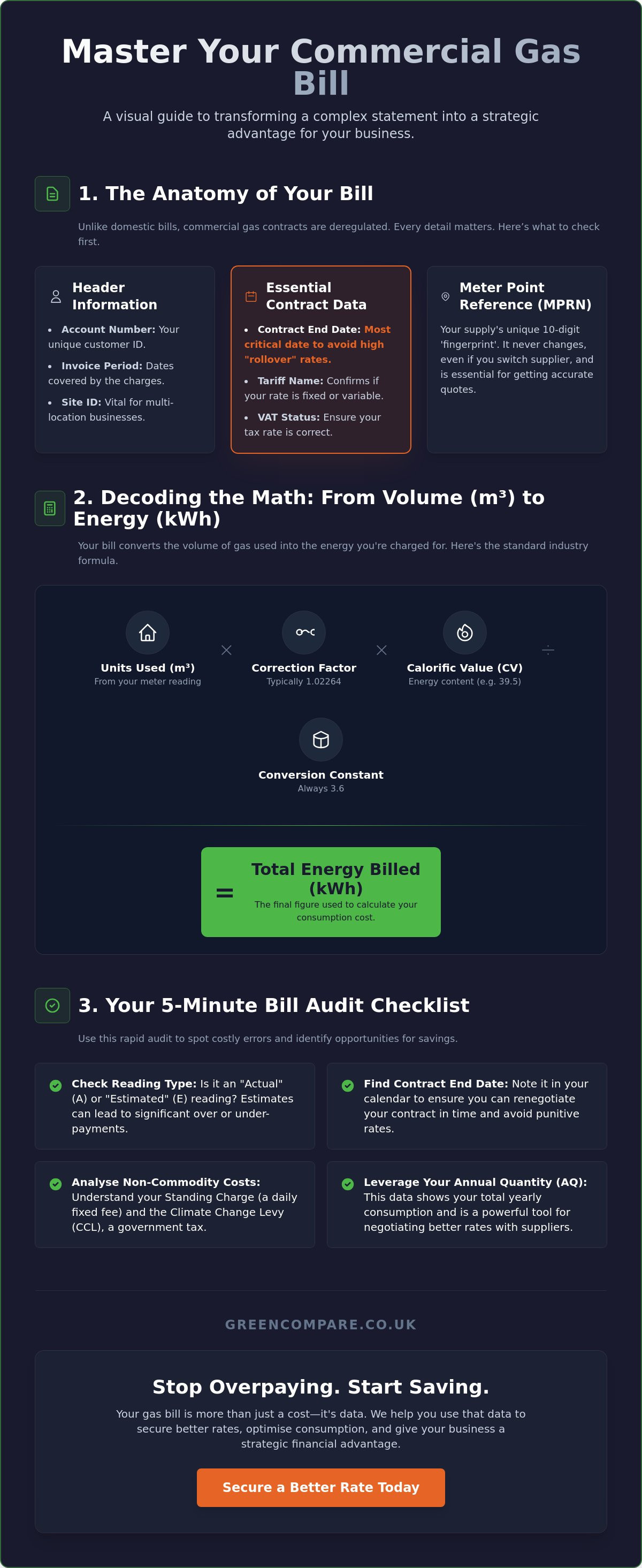
Find your contract end date immediately. It's often positioned in a small font near the top or bottom of the bill, but it's the most important date for your cash flow. Missing this deadline usually triggers a move to "rollover" or "deemed" rates, which are significantly higher than negotiated tariffs. Identify your current tariff name and confirm whether it's a fixed or variable arrangement. Fixed rates offer protection against 2026's market volatility, whilst variable rates can fluctuate based on global events. Also, check your VAT status and billing address. Small errors in these details can lead to tax compliance issues or missed payments if correspondence goes to the wrong centre.
The Role of the MPRN
The Meter Point Reference Number (MPRN) is your supply's unique 10-digit identifier. Think of it as a fingerprint for your gas connection that never changes, regardless of which supplier you choose. You'll find this listed as your "M-number" or "MPR" on your statement. It's vital to keep this number on hand when you're looking to organise a new energy contract. Suppliers use the MPRN to access your site's historical usage data and provide accurate, competitive quotes. Because this number is tied to the physical location and not the account, it remains the most reliable piece of data for identifying your specific energy needs during a switch.
Decoding the Technical Math: How Volume Becomes kWh
Most meters display usage in cubic metres (m3) or cubic feet (ft3), yet your invoice asks for payment in kilowatt-hours (kWh). Bridging this gap is the most technical part of learning how to read a commercial gas bill. It isn't a direct 1:1 swap. Suppliers must account for physical variables like temperature and pressure through a "Correction Factor". This number, usually set at 1.02264, ensures you aren't penalised for the natural expansion or contraction of gas caused by local conditions. Understanding your gas bill requires looking past the raw meter read to see how these multipliers impact your bottom line. By mastering this conversion, you move from being a passive observer to an active manager of your energy overheads.
Understanding Calorific Value (CV)
Calorific Value (CV) represents the specific heating power of the gas flowing into your premises. It essentially measures the "punch" per cubic metre. In the UK, this value isn't static; it varies daily depending on the gas source currently in the grid, whether it's from the North Sea or international pipelines. Your supplier doesn't set this value; it's provided by the network operators who monitor the gas quality. You can find the average CV for your specific billing period listed in the technical breakdown of your statement. Monitoring this ensures you're paying for the actual energy potential delivered, not just the volume of gas moved.
The Volume Conversion Formula Step-by-Step
The conversion factor for cubic feet is 2.83, whilst metric meters use the raw volume recorded on the dial. To demystify the numbers, let's walk through a mock calculation. Imagine your metric meter shows 500 units of usage. You would multiply those 500 units by the correction factor (1.02264), then by the calorific value (for example, 39.5), and finally divide the total by 3.6 to reach your billed kWh. The 3.6 is a universal constant used to convert megajoules into kilowatt-hours. This multi-step math is the most common place for billing discrepancies to occur, often due to incorrect CV averages or transposed digits. If the totals on your statement don't align with your manual check, it's a clear signal to compare your business gas options and find a provider that offers better transparency. We believe every penny saved through technical accuracy is a penny that can be reinvested into your company's future growth.
Beyond Consumption: Understanding Standing Charges and Taxes
Your gas usage is only part of the financial story. To truly master how to read a commercial gas bill, you must look at the fixed costs and statutory levies that appear on every statement. First, identify your "Standing Charge". This is a daily fee that covers the maintenance of the national gas network and the cost of your meter. In 2026, these charges typically range from 25p to 35p per day for small enterprises. You'll pay this regardless of whether your heating is on or off. It's a non-negotiable part of your connection, but comparing these rates across suppliers is a vital step in your broader cost-reduction strategy. Look out for "Other Charges" too. These might include small administrative fees or site-specific levies that vary depending on your location and meter type.
Are You Eligible for 5% VAT?
Most businesses expect a flat 20% VAT rate, but many organisations are overpaying because they don't know the "De Minimis" threshold. As of June 2026, if your premises uses less than 145 kWh of gas per day (roughly 4,397 kWh per month), you qualify for the reduced 5% VAT rate. This isn't just for micro-businesses; charities and non-profit organisations also sit in this bracket. To claim this saving, you'll need to submit a VAT Declaration Certificate to your supplier. It's a simple process that can lead to significant annual savings. Use this checklist to ensure you're ready:
- Verify your average daily usage over the last six months.
- Confirm your charity or non-profit status with official documentation.
- Download the specific VAT declaration form from your supplier's portal.
- Submit the signed form to trigger the rate change on your next invoice.
The Climate Change Levy (CCL) Explained
The Climate Change Levy (CCL) is a government tax designed to encourage energy efficiency across the UK. As of 1 April 2026, the CCL rate for natural gas is 0.801p per kWh. Whilst this might seem small, it adds up quickly for larger operations. Some businesses are exempt, particularly those with very low energy requirements that fall under the De Minimis threshold. If your organisation is a heavy energy user, you can still reduce this burden. Participating in a Climate Change Agreement (CCA) can secure you a massive discount of up to 89% on your gas CCL. We see this as a powerful opportunity for professional advancement, turning a mandatory tax into a strategic incentive for sustainable growth. Understanding these nuances ensures your business gas strategy remains both ethically conscious and financially lean.
The 5-Minute Bill Audit: How to Spot Costly Errors
Reclaiming lost revenue starts with a simple, monthly habit. Learning how to read a commercial gas bill isn't just about understanding technical math; it's about auditing every line for administrative accuracy. Spend five minutes reviewing your statement as soon as it arrives to protect your cash flow. Start by identifying the "E" and "A" markers next to your meter readings. An "A" represents an actual reading, whilst an "E" indicates an estimate. Suppliers use algorithms to guess your usage when they lack data, and these guesses are rarely in your favour. Next, pull out your original contract. Does the unit rate on the bill match the one you signed for? Suppliers occasionally apply annual price increases or pass-through costs that may not align with your bespoke agreement.
Check the billing periods for overlaps too. Ensure the start date of your current invoice isn't identical to the end date of your previous one. Double billing is a common clerical slip that can cost your business hundreds of pounds if left unchecked. Finally, verify that any agreed discounts or loyalty credits are clearly visible and deducted from the subtotal. If these figures don't align with your records, you've found a clear opportunity to recover funds. We believe that professional advancement involves mastering these small administrative details to fuel larger corporate growth.
Estimated vs. Actual Readings
Estimated bills are often significantly higher than your real usage. This happens because suppliers prefer to over-collect and credit you later rather than risk under-billing. Take control of your data by providing a manual meter reading five days before your billing cycle ends. It's a small task that ensures your capital stays in your business rather than the supplier's bank account. If you spot a massive discrepancy on an estimated statement, act fast. Request an "Adjustment Note" from your supplier immediately to rectify the balance and ensure your next payment reflects your true consumption.
The Contract Expiry Red Flag
"Out-of-Contract" or "Deemed" rates are a primary drain on business resources. These tariffs can be 100% higher than standard fixed-term rates. Spot them by looking for terms like "Standard Variable" or "Rollover" in your tariff description. If your unit rate has suddenly jumped without a change in your usage, you've likely fallen out of your contract period. Don't let this persist for another billing cycle. You can compare business gas rates today to secure a new fixed agreement and stop the financial leak. We're ready to help you move quickly from overspending to strategic, cost-effective energy management.
Turning Bill Data into Savings: The Green Compare Advantage
Understanding the numbers is just the first step. The real power lies in using that data to drive your business forward. One of the most critical figures you've uncovered whilst learning how to read a commercial gas bill is your "Annual Quantity" (AQ). This is the network's estimate of your yearly gas consumption based on historical data. Suppliers use this figure to calculate your risk profile and determine the rates they offer. When you master your AQ, you stop being a passive consumer and become a proactive energy buyer. Green Compare acts as your strategic partner in this process; we organise your complex billing data into a clear, competitive advantage.
We believe your time is better spent growing your enterprise than wrestling with spreadsheets. Our platform is designed for rapid results, moving you from bill analysis to a new, cost-effective contract in mere minutes. This isn't just about individual savings; it's about collective progress. By switching to more efficient or greener suppliers, your business contributes to a larger narrative of sustainability and ethical corporate behaviour. We're here to ensure that transition is seamless, transparent, and financially rewarding.
Gathering Your Data for a Switch
Procuring a better energy deal is stress-free when you have the right information ready. You don't need to decipher every single digit on your statement to make a change. Focus on these three essential data points found on your bill:
- MPRN: Your unique 10-digit Meter Point Reference Number.
- Annual Usage: Your total kWh consumption over the last 12 months.
- Contract End Date: The day your current fixed-rate protection expires.
Having these details at your fingertips allows Green Compare to scan the market with precision. We identify the most competitive 2026 rates tailored to your specific site requirements. This level of preparation eliminates the guesswork and ensures you're always negotiating from a position of strength.
Your Next Steps to Efficiency
Don't wait for a renewal letter to arrive. By the time your current supplier contacts you, they've often already placed you on an expensive default path. Take a proactive stance instead. One of the most effective strategies for professional advancement is "Future Dating". This allows you to secure a new contract up to 12 months before your current one ends. You lock in today's prices to protect your future budget against market volatility. It's a simple, linear step that provides long-term financial reassurance. We're ready to help you turn your technical knowledge into tangible growth. Compare your business gas rates with Green Compare today.
Master Your Overheads for Sustainable Growth
You now possess the technical expertise to transform a complex financial statement into a strategic roadmap for savings. By mastering how to read a commercial gas bill, you've moved past the confusion of calorific values and estimated readings. You're now equipped to audit your statements in minutes, ensuring every kilowatt-hour fuels your company's progress rather than draining its cash flow. This level of transparency is the foundation of a leaner, more resilient organisation.
Don't let your newly decoded data sit idle. Use it to negotiate from a position of strength. We provide commission-free transparency and direct access to the UK’s top 20+ commercial energy suppliers. Whether you require specialist support for SME procurement or complex corporate energy management, our platform streamlines the entire journey. Take the next step toward professional advancement and secure a more competitive business gas rate in under 60 seconds. Your business deserves an energy partner that values your time and your bottom line as much as you do. Let's start building your more efficient future today.
Frequently Asked Questions
What is the difference between a kWh and an m3 on my gas bill?
An m3 measures the physical volume of gas that passes through your meter, whilst a kWh represents the actual energy value of that gas. Suppliers convert volume to energy using a specific formula because the heating power of gas fluctuates daily. You pay for the energy (kWh) consumed, as this is the standard unit for gas pricing across the UK energy market. Understanding this conversion is a vital part of learning how to read a commercial gas bill accurately.
Why is my commercial gas bill so much higher than my residential one?
Commercial gas isn't protected by the Ofgem price cap, meaning rates are directly influenced by wholesale market volatility. Additionally, most businesses pay 20% VAT compared to the 5% residential rate. You also face the Climate Change Levy (CCL), which is a mandatory environmental tax for non-domestic users. These factors combined make it essential to monitor your statements closely to manage higher overheads. Professional advancement in business management often starts with mastering these complex utility costs.
Can I get a refund if my gas bill was based on an estimate?
Yes, you're entitled to a refund or a credit on your account if an estimated bill exceeds your actual usage. Submit an accurate meter reading to your supplier immediately to trigger a revised invoice. They'll issue an adjustment note to correct the balance. Providing regular monthly readings is the most efficient way to avoid these discrepancies and keep your cash flow predictable. It ensures your capital stays in your business rather than with the energy provider.
How do I find my contract end date if it is not clearly marked on the bill?
Contact your supplier directly or log into your online account portal if the date isn't visible on your statement. Suppliers are legally required to provide this information upon request. You can also find it on your original contract document or the most recent renewal offer. Knowing this date is vital to avoid being moved onto expensive out-of-contract rates once your fixed term expires. Identifying this deadline early allows you to organise a better deal well in advance.
What is the Climate Change Levy (CCL) and do I have to pay it?
The CCL is a government tax on energy delivered to non-domestic users to encourage better efficiency. Most businesses pay it, but you're exempt if your usage falls below the "De Minimis" threshold of 33kWh per day. Charities and non-profit organisations can also apply for reduced rates or exemptions. For larger energy users, participating in a Climate Change Agreement can reduce the amount you owe significantly. This tax is a key component when learning how to read a commercial gas bill for 2026.
Is it possible for a business to switch gas suppliers with an outstanding balance?
You can usually switch if your debt is less than 28 days old, but suppliers can block a transfer if the balance is older. If you're in a "Deemed" or out-of-contract period, you have more flexibility to move. Clear any undisputed arrears before starting a switch to ensure the process remains stress-free and fast. Managing your debt proactively is a strategic step toward better procurement and long-term financial health.
What should I do if I think my gas meter is faulty?
Notify your supplier immediately to request a formal meter accuracy test if you suspect a fault. They'll arrange for an engineer to inspect the equipment and verify its performance. Be aware that you may have to pay for the test if the meter is found to be working correctly. Compare your current reads against historical usage data first to rule out seasonal spikes or operational changes before booking a visit. Transparency in your data is your best defence against billing errors.
How often should I receive a commercial gas bill?
Most commercial gas suppliers issue bills on a monthly basis, though some smaller enterprises may still be on quarterly cycles. Monthly billing is generally preferred for better cash flow management and more accurate tracking of consumption patterns. If your billing frequency doesn't suit your business needs, you can often request a change through your account manager. Aligning your billing cycle with your internal financial reporting creates a more streamlined and efficient administrative process.