Deemed Rates for Business Energy Explained: A Guide for UK Enterprises in 2026

Is your business paying a "lazy tax" simply because you moved into a new premises? If you are using gas or electricity without a signed contract, your supplier is likely charging you at the highest possible price point. This guide provides deemed rates for business energy explained to help you identify these profit-draining charges before they impact your 2026 growth plans. With average default electricity rates often exceeding 38p per kWh this year, staying on these default terms is a choice your bottom line cannot afford.
We understand the frustration of sticker shock when a utility bill arrives. It feels like you're trapped in an expensive cycle with no clear exit. The good news is that you have more power than you think, and we're here to help you reclaim it. Discover exactly how these rates work and why they are costing you a fortune. We will walk you through the latest Ofgem transparency rules and show you how to switch to a competitive fixed-rate contract in minutes. Let's move your business away from expensive defaults and toward a more sustainable, cost-effective future.
Key Takeaways
- Identify the specific triggers that land your enterprise on expensive default tariffs when moving premises or ending a contract.
- Get deemed rates for business energy explained to understand why these non-negotiated prices are significantly higher than standard fixed-term deals.
- Distinguish between deemed and out-of-contract rates to ensure you aren't paying unnecessary penalties to your current supplier.
- Learn why energy providers charge a premium for these arrangements and how to protect your profits from wholesale market volatility.
- Master a fast, stress-free method to switch to a cheaper contract and lower your monthly utility outgoings in just a few minutes.
What are Deemed Rates for Business Energy?
A deemed rate is a default safety net that catches your business when you fall out of a formal contract. It is an automatic, non-negotiated tariff applied when your enterprise uses gas or electricity without a signed agreement. While this ensures your operations never grind to a halt, it is rarely a cost-effective way to manage your overheads. Getting deemed rates for business energy explained is the first step toward reclaiming your profit margins. These rates are a standard feature within the wider UK energy policy, ensuring no commercial premises is left without power during transitional phases.
Suppliers have a legal obligation to keep your energy flowing, but they are not required to offer you their most competitive prices. Deemed rates are essentially emergency rolling contracts. They are designed for temporary supply, not long-term partnership. Because the supplier has no guarantee of how long you will stay, they charge a significant premium to cover their risk. Ofgem regulations specify that these rates must not be "unduly onerous", but in the volatile market of 2026, even a "fair" deemed rate can be double the cost of a negotiated fixed deal.
Common Scenarios Where Deemed Rates Apply
- Moving Premises: When you move into a new commercial property, the previous tenant's supplier will continue the supply on a deemed basis until you agree to a new contract.
- Contract Termination: If you terminate your current deal but fail to arrange a new one by the end date, you will automatically roll onto these default rates.
- Landlord Management: Landlords often find themselves on deemed rates for unlet units whilst they search for new tenants to take over the responsibility.
How Deemed Rates Differ from Domestic Tariffs
The business energy market operates under very different rules compared to the residential sector. Unlike domestic "standard variable" rates, business energy has no regulatory price cap. This means the gap between a fixed deal and a deemed rate is far wider for a company than for a household. Whilst domestic customers might see modest fluctuations, a business could see their bills skyrocket overnight. Most deemed contracts allow you to exit with just 28 days’ notice, providing a fast route to better value if you act quickly.
Why Deemed Rates are Significantly More Expensive
Suppliers don't view deemed contracts as long-term partnerships. Instead, they see them as high-risk, temporary arrangements. Because you haven't signed a formal agreement, the provider has no idea if you'll stay for a day or a year. To protect themselves against this uncertainty, they apply a significant price premium. Having deemed rates for business energy explained reveals that much of this cost is a buffer against wholesale market volatility. In 2026, energy prices remain sensitive to global events. Suppliers use these higher rates to hedge against sudden spikes that could otherwise erode their margins.
Beyond risk, there is the simple reality of administrative overhead. Deemed accounts often require more frequent monitoring and manual billing adjustments compared to streamlined fixed deals. However, for many enterprises, a large portion of the bill is effectively a "lazy tax." It's the cost of inaction. If you haven't compared the market lately, you are likely subsidising the cheaper deals offered to proactive competitors. You can quickly check current market rates to see how much your current supplier is overcharging for this lack of commitment.
The Financial Impact: Deemed vs. Fixed Rates in 2026
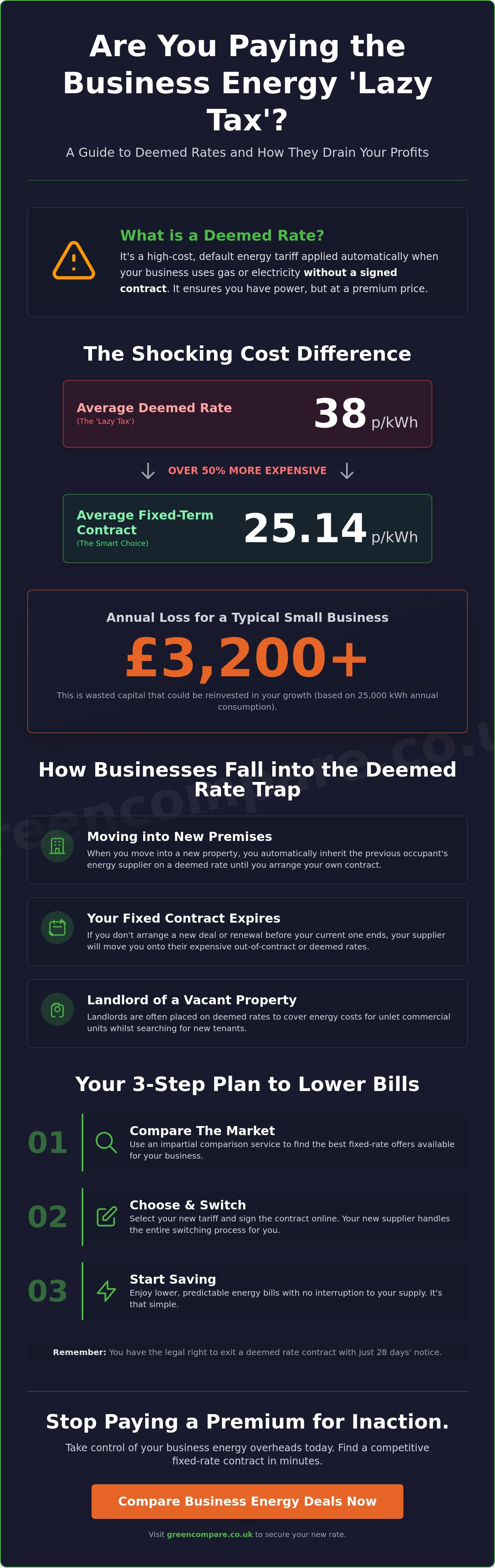
The numbers for 2026 tell a stark story. As of June, average out-of-contract electricity rates for SMEs sit at approximately 38p per kWh. Compare this to a small business fixed rate of roughly 25.14 p/kWh. The daily standing charges add even more weight to your overheads, often reaching £2.58 per day for electricity and £3.41 for gas on a deemed basis. For a typical small enterprise consuming 25,000 kWh annually, staying on a deemed tariff could lead to over £3,200 in wasted expenditure every year. This is capital that could be better spent on staff, equipment, or expansion.
Ofgem Regulations and Pricing Restrictions
Whilst prices are high, they aren't unregulated. Ofgem requires suppliers to take all reasonable steps to inform you when you're on a deemed contract. They must also ensure their pricing isn't "unduly onerous." This doesn't mean the rates will be cheap; only that they must be justifiable based on the higher costs the supplier incurs. You have a legal right to clear information. Suppliers must provide full terms and conditions upon request, and they cannot charge you a termination fee if you decide to switch. Use this flexibility to your advantage and move to a better deal today.
Deemed vs. Out-of-Contract Rates: Spotting the Difference
Understanding the nuances between different variable tariffs is essential for protecting your cash flow. Whilst both options are expensive, they stem from different contractual situations. Having deemed rates for business energy explained helps you realise that these apply when you have never signed an agreement with the current supplier at your premises. This usually happens during a move-in. In contrast, out-of-contract (OOC) rates occur when your existing fixed-term deal expires and you haven't arranged a replacement. You remain with the same provider, but the "honeymoon period" of negotiated pricing is over.
The pricing structure is where the pain really intensifies. Suppliers often use OOC rates as a financial penalty to encourage renewals. These are frequently the most expensive tariffs in the UK market, sometimes exceeding even the high costs of deemed rates. Whilst a deemed rate is an "inherited" tariff from a previous occupant's supplier, an OOC rate is a default position with your chosen partner. Regardless of the label, both statuses leave you vulnerable to market fluctuations. The solution is identical for both scenarios: stop the drain on your profits by comparing the market and securing a fixed deal immediately.
How to Identify Which Rate You Are Paying
Identifying your current status is the first step toward a cheaper bill. Grab your most recent statement and look for specific red-flag terminology. If you see phrases like "Variable Price Plan," "Standard Variable," or "Deemed Tariff," you are paying too much. You should also check your original contract end date. If that date has passed and you haven't signed a new document, you have rolled onto OOC rates. If you are still unsure, call your supplier directly. Ask them for your current "contractual status" and your current unit rates. This transparency allows you to calculate exactly how much you can save by switching.
The Risk of Staying on Variable Rates
Living on a variable tariff is a gamble that rarely pays off for UK enterprises. These rates offer zero protection against price hikes, which can be implemented with as little as 30 days’ notice. This volatility makes it impossible to accurately budget for your monthly business overheads, creating unnecessary stress for your finance team. Additionally, most renewable energy incentives and "green" tariffs are only available on fixed-term contracts. By staying on a default rate, you miss out on the chance to align your brand with sustainable values whilst locking in a lower price. Transitioning to a fixed deal provides the stability your business needs to grow with confidence.
How to Exit a Deemed Rate Contract in 2026
Escaping the high costs of a default tariff is a straightforward process that rewards proactive leaders. Since you aren't bound by a long-term agreement, you can initiate a move at any time. This roadmap ensures you have deemed rates for business energy explained through the lens of a quick exit strategy. Follow these four steps to secure your company's financial future and stop the unnecessary drain on your monthly profits.
- Step 1: Identify and Gather. Find your current supplier and locate your most recent bill. If you don't have a bill, take a fresh meter reading. This data is the foundation of an accurate quote.
- Step 2: Compare the Market. Use a specialist business energy comparison service to view prices from across the industry. This allows you to see how your current deemed rate stacks up against the best available deals in seconds.
- Step 3: Select Your Deal. Choose a fixed-rate contract that aligns with your growth targets for the next 12 to 36 months. Consider both the unit price and the daily standing charge.
- Step 4: Confirm and Switch. Once you sign your new agreement, your new provider handles the logistics. They will coordinate with your old supplier to ensure a seamless transition without any loss of power.
The entire process is designed for maximum efficiency. You can compare business energy prices today to find a deal that protects your bottom line from future market spikes. Don't let administrative inertia cost your business thousands in 2026.
Finding Your Current Supplier Fast
If you have just moved into a new premises, you might not know who currently supplies your energy. Use the "Find My Supplier" tool or check the national database to identify the incumbent provider quickly. If you cannot find any paperwork, look directly at your meter to find your MPAN (Electricity) or MPRN (Gas) numbers. Your MPAN is the passport number for your energy supply. Having these numbers ready allows comparison services to pull your historical usage data and provide precise, real-time pricing.
What to Look for in a New Fixed Contract
Choosing the right deal requires balancing immediate savings with long-term stability. Consider your contract length carefully; whilst a one-year deal offers flexibility, a three-year deal protects you against the rising non-commodity costs expected throughout 2026. Review the balance between the standing charge and the unit rate. High-usage businesses should prioritise lower unit rates, whereas low-usage enterprises might benefit from a smaller daily standing charge. Finally, look for green credentials. Many modern fixed deals now include 100% renewable electricity as standard, helping you meet your corporate sustainability goals whilst lowering outgoings.
Optimise Your Business Overheads with Green Compare
Securing the future of your enterprise requires more than just identifying high costs. It demands a proactive partner who can turn those insights into immediate action. We specialise in commercial utility procurement for UK organisations, moving beyond the cold approach of traditional brokerages. Having had deemed rates for business energy explained, you now recognise the urgency of escaping default tariffs. Our role is to act as your expert guide, simplifying complex financial procedures into linear, stress-free steps. We view every saved pound as a building block for your long-term development and shared progress.
Efficiency is the heartbeat of our service. We understand that your time is your most valuable asset, especially when navigating the volatile energy market of 2026. Our platform is designed to eliminate the friction of manual comparisons and endless supplier calls. We possess the industry authority to navigate the commercial sector on your behalf, ensuring you never pay a penny more than necessary for your Business Gas or Business Electricity. This partnership approach means we are genuinely invested in your success, offering a visionary stance that aligns your utility management with your broader corporate values.
The 60-Second Energy Comparison
Speed is our signature of efficiency. Our streamlined comparison engine moves your business from a profit-draining deemed rate to a tailored competitive quote in under a minute. This rapid result is achieved without sacrificing depth or reliability. We handle the supplier negotiations, removing the burden from your shoulders so you can focus on core operations. Take control of your overheads today by using our transparent, accessible platform. You don't have to stay stuck with an expensive supplier; the power to switch is entirely in your hands, and it starts with a single, simple action.
Supporting Your Business Growth
Reducing your monthly energy outgoings is a strategic move that frees up vital capital for reinvestment. Whether you want to upgrade your equipment or expand your team, those savings provide the fuel for professional advancement. To further support your journey, we also provide access to Business Loans designed to meet the unique needs of modern UK enterprises. We believe in a holistic approach to commercial finance, where sustainability and profitability grow together. Join the thousands of businesses making rapid progress toward their goals by choosing a smarter way to manage utilities. Compare business energy prices now and stop paying deemed rates to secure your fixed-rate deal and protect your bottom line.
Secure Your Competitive Edge Today
Staying on a default tariff is a drain on your resources that no modern enterprise should tolerate. Now that you've had deemed rates for business energy explained, you know that these high prices are merely a temporary hurdle. By taking control of your utility procurement, you stop the leak in your profit margins and redirect those funds toward your long-term growth and development.
Transitioning to a fixed-rate deal is a simple, linear step that protects your bottom line from the market volatility of 2026. We provide the expertise you need to navigate these complexities with total confidence. You'll gain direct access to wholesale market rates and benefit from our expert UK-based support. We're proud to be trusted by thousands of UK enterprises that value speed and efficiency above all else.
Don't let another expensive billing cycle pass by. Take sixty seconds to reclaim your time and your capital.
Switch and Save: Compare Business Energy Rates in 60 Seconds
Your journey toward a more efficient and profitable future starts with this one proactive choice. We are ready to help you thrive.
Frequently Asked Questions
Can I switch suppliers if I am on deemed rates?
You can switch to a new provider at any time without facing financial penalties. Under Ofgem regulations, businesses on deemed contracts have the right to move to a more competitive deal without paying termination fees. This freedom allows you to act immediately when you find a better rate. Don't let your current supplier convince you that you are "stuck" on their default tariff.
How long does it take to move from a deemed rate to a fixed contract?
The transition usually takes between five working days and a few weeks, depending on the suppliers involved. Whilst the backend transfer takes some time, you can secure a new fixed-rate quote in under a minute using our comparison service. We focus on speed to ensure your enterprise stops overpaying as quickly as possible. Your power supply remains constant throughout the entire process.
Is there a notice period for deemed energy contracts?
Most deemed contracts require no notice period at all, though some providers may ask for up to 28 days. Because these are rolling agreements rather than fixed-term deals, you have the flexibility to leave whenever you choose. Always check your supplier's published terms and conditions on their website to confirm their specific requirements. This lack of commitment is your best tool for lowering overheads.
Are deemed rates the same as the energy price cap?
No, the energy price cap only protects domestic households and does not apply to commercial properties. This is a vital distinction because it means your business costs can rise without a regulatory ceiling. Having deemed rates for business energy explained helps you understand that your bill is based on the supplier's own costs and risk margins. Without a cap, staying on a default tariff is a significant financial risk.
Can a supplier block me from switching if I am on a deemed tariff?
A supplier can only block your switch if you have an outstanding debt on your account. If your payments are up to date, they have no legal grounds to prevent you from moving to a better deal. Ensure you pay your final bill promptly to avoid any administrative delays. If an objection is raised unfairly, we can help you navigate the resolution process to keep your switch on track.
What happens if I move into a property and don’t know who the supplier is?
You can find your supplier quickly by using a national database or contacting the local Distribution Network Operator. You will need your meter's MPAN for electricity or MPRN for gas to identify the incumbent provider. Once you know who is supplying the energy, you can immediately request their deemed rates or start a comparison to find a cheaper alternative. Knowledge is the first step toward cost reduction.
Do I have to pay a backdated bill if I only just moved in?
You are only liable for the energy consumed from the exact date your lease began or you took ownership. It's essential to take a meter reading on your first day at the premises to establish a clear starting point. You are not responsible for any debt or usage left behind by the previous tenant. Provide your opening readings to the supplier immediately to ensure your first bill is accurate.
Are deemed rates available for green energy?
Deemed rates are almost never "green" by default and usually rely on a standard fuel mix. Most suppliers reserve their renewable energy certificates for customers who sign up for specific fixed-term green contracts. If your business is committed to sustainability, you should move off default rates and choose a dedicated renewable tariff. This allows you to support environmental progress whilst locking in a much lower unit price.