Commercial Energy Comparison 2026: The Strategic Guide to Reducing Business Overheads

What if those rising standing charges and complex non-commodity costs weren't just an unavoidable burden, but a hidden opportunity to reclaim your business's growth capital? You likely feel that a commercial energy comparison is often a drain on your time and mental energy. It's frustrating to watch overheads climb whilst deciphering jargon that seems designed to confuse rather than clarify. We understand that the fear of being rolled over onto expensive out-of-contract rates is a genuine stressor for any forward-thinking leader.
This guide changes that narrative. You're about to master the complexities of the 2026 market and discover how to secure a competitive contract that fuels your business growth in under 60 seconds. We'll show you exactly how to navigate the latest wholesale price shifts and the 3.4% increase in the Climate Change Levy. By the end of this article, you'll have a clear, linear path to immediate cost reduction and a partnership that handles the paperwork, letting you focus on what you do best: leading your company to success.
Key Takeaways
- Learn how to transform your energy bills from a static overhead into a strategic growth lever by securing long-term fixed-rate security in a stable 2026 market.
- Master the essential terminology of the UK market and perform a rapid commercial energy comparison to identify the most competitive unit rates and standing charges.
- Identify and avoid "hidden cost" traps, such as out-of-contract rates, which can often lead to a 40% premium on standard business bills.
- Follow a linear, two-step process to organise a seamless switch using our 60-second market-scanning tool and your latest bill details.
- Explore how to leverage your utility savings alongside business loans to fund sustainable upgrades that drive long-term commercial value.
Why Commercial Energy Comparison is a Strategic Growth Lever in 2026
For too long, businesses viewed utility bills as a fixed, unchangeable cost of doing business. In 2026, that passive mindset is a liability. Savvy SME directors now treat energy procurement as a strategic lever. By performing a regular commercial energy comparison, you transform a standard administrative task into a powerful cash-flow exercise. This isn't just about saving pennies; it's about reclaiming capital to reinvest in your core operations. Every pound saved on a unit rate is a pound that can fuel your next project.
The 2026 market has reached a point of relative stability compared to the volatility of recent years. This window of calm offers a unique chance to secure longer-term fixed-rate security. Whilst others wait for prices to drop further, proactive leaders are locking in certainty. Sticking with a legacy supplier often carries a heavy "opportunity cost." Those funds lost to uncompetitive rates could have funded a new hire or a marketing campaign. A comprehensive commercial energy comparison reveals the gap between what you pay and what the market actually offers.
The Impact of Energy Costs on UK Business Valuations
Leaner overheads do more than just help your monthly bank balance; they directly improve your EBITDA. When you're looking for funding, such as Business Loans, a lower cost base makes your business far more attractive to lenders and investors. Modern UK energy policy also places a higher premium on efficiency. Demonstrating a proactive approach to energy management is now a key metric for many "Green" business certifications. There is also a significant psychological benefit. Predictable fixed costs in a volatile market provide the reassurance needed to plan for the long term with optimism.
Moving Beyond the "Admin" Mindset
Stop treating your energy bills like a minor chore. Treat them like any other high-value supply chain component. You wouldn't accept a 20% markup on your raw materials; don't accept it on your Business Electricity or Business Gas. Green Compare acts as your expert procurement partner, removing the stress of the process. Speed is the ultimate currency for the modern SME director. Our platform moves you from a problem to a solution in 60 seconds. This allows you to focus on growth whilst we handle the complexities of the national market. Efficiency isn't just a goal; it's our standard.
Decoding the UK Commercial Energy Market: Tariffs and Terminology
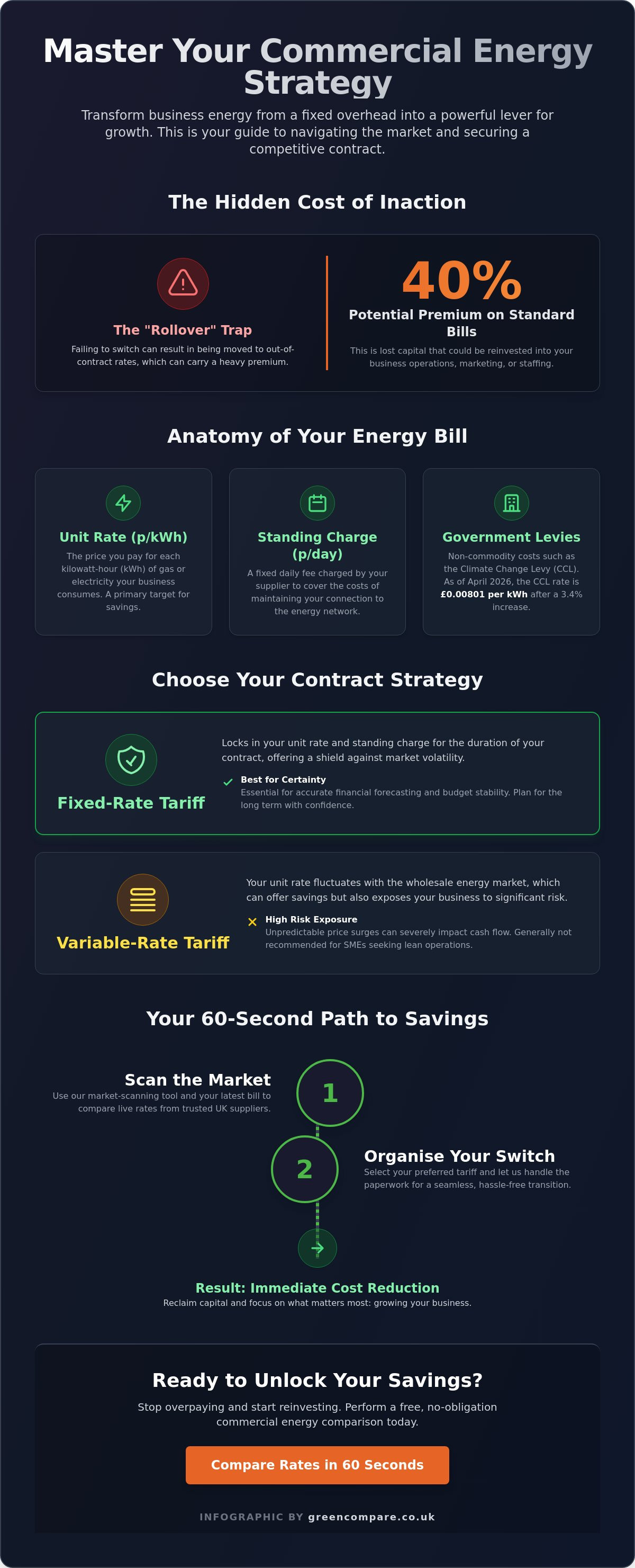
Mastering the mechanics of your bill is the first step toward procurement excellence. A commercial energy comparison involves a meticulous audit of supplier rates to find the optimal balance between unit prices and daily fees. To navigate this effectively, you must understand the three pillars of your energy statement: the unit rate, the standing charge, and government-mandated levies. The unit rate is the price you pay for every kilowatt-hour (kWh) consumed, whilst the standing charge is a fixed daily fee that covers the cost of maintaining the connection to the grid. Together, these form the core of your monthly commitment.
In 2026, the Climate Change Levy (CCL) remains a significant factor in your total spend. As of April 1, 2026, the CCL rate for both electricity and gas increased by 3.4% to £0.00801 per kWh. Understanding these figures allows you to forecast your overheads with precision. Whilst most businesses pay the standard 20% VAT, some charities or low-usage micro-businesses may qualify for the reduced 5% rate. Identifying these nuances early ensures you aren't overpaying on non-commodity costs that many providers fail to explain clearly.
Choosing between fixed and variable tariffs depends entirely on your risk appetite and growth plans. Fixed-rate contracts offer a shield against wholesale price spikes, providing the financial certainty required for bold long-term planning. Variable rates might seem attractive during brief market dips, but they leave your business exposed to sudden surges. For most SMEs, the security of a fixed contract outweighs the gamble of a flexible one, especially when trying to maintain a lean operation. Ready to see how your current rates stack up? You can view live market rates in seconds.
Unit Rates vs. Standing Charges: The Balanced Audit
Don't be seduced by a low unit rate alone. Suppliers often hide punitive daily standing charges behind attractive kWh prices. Your "True Cost" depends entirely on your annual consumption patterns. If you're a low-usage office, a high standing charge could outweigh any savings on the unit rate. Conversely, high-intensity industrial users should prioritise the lowest possible unit rate to manage their bulk consumption. Some "No Standing Charge" tariffs exist, but these usually carry much higher unit prices, often only benefiting seasonal businesses or unoccupied properties.
The 2026 Regulatory Landscape: Ofgem and P272
The regulatory environment is shifting to provide better protection and transparency for businesses of all sizes. Following Ofgem's business energy advice is essential for understanding the latest safeguards, particularly for micro-businesses facing contract renewals. A major trend in 2026 is the ongoing migration to Market-wide Half-Hourly Settlement (MHHS). This initiative ensures all meters record usage every thirty minutes, providing the granular data needed for peak efficiency. For larger industrial users, managing Transmission Network Use of System (TNUoS) charges is critical, as these costs are set to rise significantly throughout the year.
The "Hidden Cost" Audit: What Competitors Won’t Tell You
Transparency is the foundation of any successful partnership. Whilst a basic commercial energy comparison might show you the cheapest headline rates, it often fails to highlight the contractual traps that can inflate your bills by 40% or more. The most common of these is the "Deemed" or "Out-of-Contract" rate. This happens when your current deal ends without a new one in place, leaving you exposed to the supplier's highest possible pricing. It is a punitive premium that drains your capital without adding any value to your operations.
Identifying "greenwashing" is equally vital for the modern, ethically conscious director. Many suppliers claim to offer 100% renewable energy, but they often rely on REGO certificates rather than direct investment in green infrastructure. To ensure your procurement aligns with your corporate values, look for providers who invest directly in UK-based solar, wind, or tidal projects. Consulting Ofgem's guide to business energy can help you verify these claims and understand the regulatory standards for green tariffs. We help you look beyond the marketing gloss to find genuine environmental responsibility.
Issuing a proper Letter of Authority (LOA) is your first step toward contract freedom. This simple document allows us to audit your usage and negotiate on your behalf, removing the need for you to spend hours on the phone with various providers. It's a tool for professional advancement that standardises your procurement process. By authorising an expert partner, you ensure that every commercial energy comparison you conduct is based on accurate, real-time data from your specific meters.
Navigating the "Rollover" Trap
Suppliers frequently use automatic renewals to lock you into peak rates for another year. To avoid this, set up a "Termination Window" calendar immediately. The Termination Window is the critical 30-to-90-day period before a contract expires. During this time, you must officially notify your supplier of your intent to switch or renegotiate. Managing this window ensures you maintain freedom of movement and never pay more than necessary for your Business Gas or Business Electricity.
The Truth About Broker Fees
Many "free" comparison sites hide their margins within the unit rates they present to you. Green Compare prioritises a transparent partnership, ensuring you understand exactly how our service is funded. We standardise our fees so you can focus on the savings. A multi-supplier panel offers far more resilience than a single-broker relationship. This approach gives you access to a broader spectrum of the national market, ensuring your business always has the most competitive edge possible.
How to Organise a Perfect Commercial Energy Switch
Organising a switch shouldn't feel like a second job. It's a streamlined process designed to protect your margins and empower your business. First, gather your latest bill and locate your Meter Point Administration Number (MPAN) or Meter Point Reference Number (MPRN). These unique identifiers ensure your commercial energy comparison is linked to your specific site rather than a generic estimate. Accuracy at this stage prevents billing disputes later down the line.
Next, use the Green Compare 60-second tool to scan the national market. Our platform filters through dozens of suppliers to find the most competitive rates for Business Gas and Business Electricity. Don't just look at the monthly direct debit. Evaluate the "Total Contract Value" (TCV). This figure includes all unit rates, standing charges, and levies over the entire term. It provides a true picture of your financial commitment and prevents nasty surprises. Once you've selected your deal, start your switch today and let us handle the transition.
Execute the switch whilst your expert partner handles the supplier liaison. We manage the dialogue with the new and old providers to ensure a smooth handover. Finally, verify your first bill. A quick check ensures the "Change of Tenancy" or "Switch" was seamless. This final step confirms you're being billed at the new, lower rate and that your procurement strategy is officially delivering results.
Data Accuracy: The Key to a Valid Quote
Estimated annual consumption (EAC) is a common cause of billing errors. If a supplier bases your quote on a guess, you'll likely face a "reconciliation" bill later that wipes out your savings. Find your MPAN on your bill; it's usually in a box starting with 'S'. Smart meters are the ultimate tool for precision. They automate your next commercial energy comparison by providing real-time usage data, ensuring every quote you receive is 100% accurate and tailored to your actual behaviour.
Timing Your Switch for Maximum Impact
Strategic timing is a hallmark of professional advancement. Consider a "Forward Purchasing" strategy. In 2026, you can often secure 2027 rates to protect against future inflation. Monday mornings are typically the best time to lock in wholesale-linked rates. Markets are fresh and less reactive. Avoid the "Friday Afternoon" rush. This is when market volatility peaks as traders close positions, often leading to temporary price spikes that you don't want to be locked into for the next two years.
Beyond the Bill: How Green Compare Fuels Your Long-Term Growth
Energy procurement is only one piece of your financial puzzle. In 2026, the most successful UK businesses are those that view their overheads through a holistic lens. A commercial energy comparison shouldn't exist in a vacuum. Instead, it should act as the catalyst for a broader strategy of capital optimisation. By reducing what you pay for Business Gas and Business Electricity, you immediately unlock liquid cash that can be diverted into high-impact growth areas. This is the year to consolidate your position, optimise your utilities, and refine your debt structure simultaneously.
We believe in a partnership that extends beyond a simple switch. Our approach integrates utility savings with bespoke Business Finance Solutions. Whether you are looking to bridge a cash-flow gap or fund a major expansion, the savings generated from a leaner energy contract provide the perfect foundation. We don't just find you a better rate; we help you build a more resilient business. This visionary stance ensures your company is prepared for the long-term development of the UK's shifting economic environment.
Unlocking Capital Through Overhead Optimisation
The mathematics of growth are simple but powerful. Consider the impact of a £5,000 annual saving on your energy bills. That reclaimed capital could comfortably support the interest payments on a significant growth loan, effectively making your expansion self-funding. There is also a natural synergy between "Green" energy and "Green" finance incentives. Many lenders now offer preferential rates for businesses that can prove their commitment to sustainability through renewable energy tariffs. Many UK SMEs are already using these utility savings to fund staff training programmes or digital transformation projects, turning a mundane bill into a competitive advantage.
Your Partner in Commercial Progress
Our commitment to you is built on rapid results and ethical procurement. We value your time above all else. That is why our platform is designed to move you from analysis to action in under a minute. Beyond utilities, you can access our suite of Business Loans to bridge temporary cash-flow gaps or invest in new equipment. We are not just a utility platform; we are a proactive partner invested in your professional advancement. Take the first step toward a leaner, more agile business today. Start your 60-second comparison and take control of your overheads today. Your journey toward sustainable growth begins with a single, efficient commercial energy comparison.
Take Command of Your Commercial Overheads Today
Your journey from passive utility payment to strategic procurement is now complete. You've discovered how to bypass the 40% out-of-contract premium and how a simple commercial energy comparison can unlock vital capital for reinvestment. By mastering your termination window and leveraging real-time data, you've turned a mundane admin task into a tool for professional advancement.
Green Compare has provided expert procurement guidance since 2019. We offer access to a comprehensive panel of UK commercial lenders and energy suppliers; this ensures you find the perfect fit for your specific risk profile. Our commitment to transparency means you'll receive a clear commission disclosure on every contract, building the trust necessary for a genuine partnership.
Don't let market volatility dictate your margins. Secure your 2026 business energy rates in under 60 seconds and reclaim your focus for what truly matters: growing your company. We're ready to act as your knowledgeable ally in this collective progress toward a more efficient, sustainable future.
Frequently Asked Questions
How much can a UK business save by comparing energy prices?
UK businesses can often reduce their annual spend by up to 40% simply by avoiding punitive out-of-contract rates. For a medium-sized enterprise with an average 2026 bill of £10,200, this represents a significant recovery of growth capital. The exact saving depends on your current tariff and consumption patterns, but a proactive procurement strategy always yields better results than staying with a legacy provider.
What is the difference between domestic and commercial energy contracts?
Commercial energy contracts differ from domestic ones because they lack a price cap and are typically fixed for one to five years. Businesses must also navigate the Climate Change Levy (CCL), which increased by 3.4% on April 1, 2026, and different VAT rules. Whilst domestic users can often switch with short notice, business directors must wait for their specific termination window to avoid expensive exit fees.
Do I need a smart meter to switch business energy suppliers?
You don't strictly need a smart meter to switch, but having one ensures your quotes are based on actual usage rather than estimates. As the Market-wide Half-Hourly Settlement (MHHS) rollout continues throughout 2026, smart meters are becoming the industry standard. They automate the data collection needed for your next commercial energy comparison, making the entire process faster and more accurate.
What happens if I don’t switch and my business contract expires?
If you allow your contract to expire without a new agreement, your supplier will move you onto "Deemed" or "Out-of-Contract" rates. These are almost always the most expensive tariffs available, often carrying a heavy premium over standard fixed rates. This is a common trap that drains business capital; always set a reminder for your termination window to maintain control over your overheads.
Can I switch business energy if I am in a long-term contract?
Most commercial contracts are legally binding for the full term, meaning you cannot switch until your termination window opens. This window usually occurs 30 to 90 days before your current deal ends. However, you can use our 60-second tool to secure a future-dated contract up to 12 months in advance, locking in current rates for your future operations and protecting against market volatility.
How does Green Compare earn commission from energy suppliers?
Green Compare operates with total transparency, receiving a fee from the supplier that is included within your unit rate. We standardise this commission across our entire panel of suppliers to ensure our advice remains impartial and focused on your growth. This model allows us to provide you with expert procurement guidance and handle all the administrative paperwork at no direct cost to your business bank account.
What information do I need to get a commercial energy quote?
To receive an accurate quote, you need your latest energy bill, your annual consumption in kWh, and your unique meter identifiers; these are the MPAN for electricity or MPRN for gas. These details allow us to perform a precise commercial energy comparison tailored to your site's specific needs. Having this data ready allows our platform to scan the national market and provide results in under 60 seconds.
Is green energy more expensive for businesses in 2026?
Green energy is no longer a luxury expense; many renewable tariffs are now price-competitive with traditional fossil-fuel options. In 2026, choosing a green tariff can also provide indirect financial benefits through "Green" business certifications and preferential rates on Business Loans. It's a strategic investment in both your company's ethical standing and its long-term financial resilience in a modern economy.