Compare the Market Business Energy: The 2026 Guide to Commercial Utility Savings

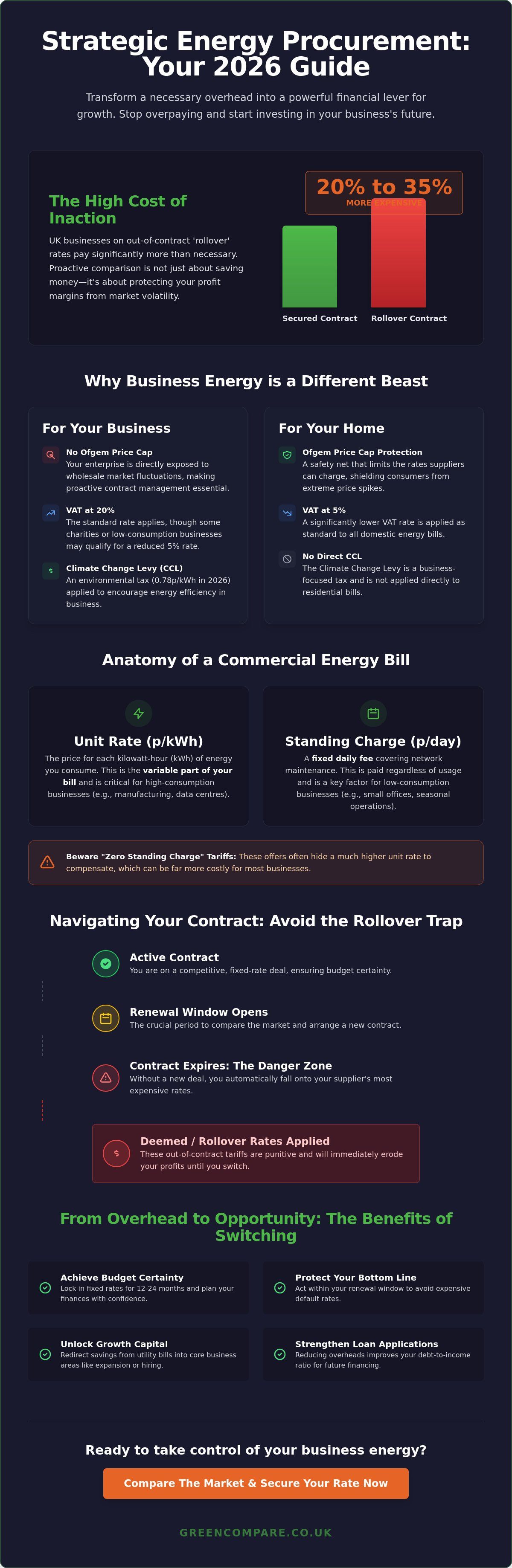
Did you know that UK businesses often pay 20% to 35% more than necessary simply by staying on rollover contracts? Unlike domestic energy, there is no Ofgem price cap to protect your enterprise from sudden market shifts. To protect your margins, you must proactively compare the market business energy options to find the best fit. This is a strategic financial lever that transforms a mundane administrative task into a powerful engine for growth.
We understand that unpredictable price spikes and dense contract jargon can make utility management feel like a burden on your cash flow. You deserve a clear path to budget certainty. This guide empowers you to master the complexities of the 2026 energy landscape and lock in the most competitive rates for your business gas and electricity. We've simplified the process into actionable steps to ensure you never pay a penny more than you should.
Get ready to discover how to decode your commercial bill and stay ahead of the latest regulatory changes. We'll show you how to transition between suppliers seamlessly and use fixed-rate deals to protect your bottom line. Let's start reducing your overheads and fueling your business ambitions today.
Key Takeaways
- View energy procurement as a strategic financial lever to unlock growth capital for your enterprise.
- Utilise our guide to compare the market business energy and secure fixed-rate deals that offer absolute budget certainty.
- Decode your commercial bill by mastering the balance between unit rates and standing charges to eliminate hidden costs.
- Protect your bottom line by acting within your renewal window to avoid expensive rollover and deemed rates.
- Learn how reducing utility overheads improves your debt-to-income ratio and strengthens future applications for business loans.
The Reality of Business Energy Comparison in 2026
Procuring energy for your enterprise is no longer a "set and forget" administrative chore. In 2026, successful UK firms treat energy as a strategic financial lever rather than an inevitable burden. By choosing to compare the market business energy options, you transform a passive cost into a controllable overhead that directly impacts your profitability. This shift towards digital-first brokerage allows you to move with speed and precision, securing rates that protect your margins before market shifts occur. We act as your proactive partner, helping you navigate these choices to ensure your utility spend aligns with your broader growth objectives.
Why Business Energy Differs from Domestic Supply
The most critical distinction lies in the absence of the Ofgem price cap. Whilst residential customers enjoy a safety net, your business is exposed to the raw movements of the wholesale market. This makes proactive management essential for survival. Understanding your electricity bill involves accounting for several factors beyond the simple unit rate:
- VAT: Standard commercial energy attracts a 20% rate, though some charities or low-consumers may qualify for 5%.
- Climate Change Levy (CCL): This is currently set at 0.78p/kWh for 2026 to encourage energy efficiency.
- Half-Hourly Metering: Many modern enterprises utilise this technology to provide granular data, identifying waste and optimising consumption patterns in real-time.
The Impact of Market Volatility on UK SMEs
Wholesale markets have shown some easing in June 2026 as geopolitical tensions in the Middle East subsided. However, the market remains incredibly sensitive to global events. Small and medium enterprises (SMEs) are particularly vulnerable to these fluctuations if they remain on variable rates. Choosing to compare the market business energy allows you to access current pricing data and move away from expensive default tariffs.
If you let your current deal expire without a replacement, your supplier will move you to "deemed" or "out-of-contract" rates. These are the most expensive tariffs on the market. Industry data indicates that switching from these rates can save UK businesses an average of 20% to 35% on their annual bills. Securing a fixed-rate deal provides more than just numerical savings; it offers the psychological benefit of budget certainty. When you know exactly what your utilities will cost for the next 12 to 24 months, you can plan your expansion, hiring, and capital investments with absolute confidence.
Decoding Your Commercial Bill: Unit Rates and Standing Charges
Every quote you encounter when you compare the market business energy is built on two primary pillars. Unlike domestic bills, there's no Ofgem price cap to flatten these costs. This means the gap between a competitive deal and a "deemed" rate is substantial. You must understand how these components interact to find a tariff that actually serves your bottom line. We view this process as a strategic audit of your operational efficiency. By breaking down your bill, you gain the clarity needed to make informed procurement decisions that fuel your company's growth.
Understanding the Unit Rate (kWh)
The unit rate is the price you pay for each kilowatt-hour (kWh) of energy your business consumes. It's the variable portion of your bill. Wholesale market fluctuations in 2026 directly dictate the unit rates offered by suppliers. Larger enterprises with high consumption volumes often secure lower unit rates because suppliers value the scale of the contract. If your business runs heavy machinery or large server rooms, the unit rate is your most critical metric. Securing a reduction of even a fraction of a penny can result in thousands of pounds in annual savings.
The Significance of the Standing Charge
The standing charge is a fixed daily fee. It covers the cost of maintaining the national grid and the physical infrastructure that brings power to your premises. You pay this fee regardless of how much energy you use. For micro-businesses or small offices with low consumption, the standing charge can represent a significant percentage of the total bill. Ofgem's advice for businesses highlights the importance of checking these fixed costs, as they vary wildly between providers.
Be cautious of "zero standing charge" tariffs. Whilst they sound appealing, they usually hide a much higher unit rate to compensate. These are rarely cost-effective for businesses with consistent daily operations. To find the right balance for your specific usage profile, you can view tailored quotes that match your consumption patterns.
Hidden Costs and Usage Profiles
Your bill also includes "hidden" pass-through costs that suppliers rarely lead with in marketing. These include distribution and transmission charges, which pay for the movement of energy across the UK's network. Your business profile determines which charge you should prioritise:
- High-Usage Profiles: Prioritise the lowest possible unit rate. The standing charge is negligible compared to your total consumption.
- Low-Usage Profiles: Focus on the standing charge. A low daily fee often provides better value than a rock-bottom unit rate you aren't using.
When you compare the market business energy, look beyond the headline figure. Analyze the ratio between these two charges. This proactive approach ensures you aren't overpaying for infrastructure you don't need or volume you don't use. We're here to help you navigate these nuances, turning a complex bill into a clear roadmap for utility savings.
Navigating Tariffs: Which Contract Suits Your Business Strategy?
Selecting a tariff is more than a technical choice. It's a commitment to your company's financial stability. When you compare the market business energy, you must align the contract structure with your risk tolerance and operational goals. We view this as a collaborative effort to future-proof your overheads. By choosing the right tariff now, you secure the freedom to focus on your core mission whilst we handle the utility complexities. A well-chosen contract acts as a foundation for sustainable growth.
Fixed-Rate vs. Variable Tariffs
Fixed-rate contracts remain the gold standard for budget certainty in 2026. These deals lock in your unit rate and standing charge for between one and five years. This shields your enterprise from wholesale price spikes, which remain common due to global volatility. You gain a clear, predictable figure for your monthly outgoings. This allows for precise forecasting and protects your cash flow from sudden shocks.
Variable-rate tariffs offer more flexibility, typically allowing you to switch suppliers with just 30 days' notice. However, they leave you exposed. If wholesale prices rise, your bills follow immediately. You should choose a fixed-rate deal if you prioritise long-term planning and stability. A variable rate might only suit a business in a short-term transition or one with a high appetite for market risk.
Avoiding Contract Traps
Stay vigilant against "Deemed" and "Rollover" contracts. A deemed contract occurs when you move into a new premises without signing a deal, or when a contract is terminated but you continue to use energy. Rollover contracts happen when you miss your renewal window and your supplier automatically locks you into a new, often expensive, one-year term. Ofgem's advice for businesses warns that these rates are significantly higher than negotiated deals. Act early to avoid these traps and keep your margins healthy.
The Rise of Green Energy for Commercial Use
Environmental responsibility is no longer a niche concern. In 2026, choosing a green tariff is a powerful signal of your brand's values. These contracts are backed by Renewable Energy Guarantees of Origin (REGO) certificates. These prove that your power comes from wind, solar, or hydro sources. This transparency builds trust with your clients and partners.
Whilst green energy once carried a heavy premium, the price gap has narrowed significantly. Competitive green tariffs are now frequently amongst the most cost-effective options on the market. Switching to a renewable plan does more than lower your carbon footprint. It enhances your Corporate Social Responsibility (CSR) profile, making your business more attractive to modern, ethically conscious consumers. For high-volume users, flexible-purchase contracts offer another path. These allow you to buy energy in tranches, capitalising on market lows. Whatever your size, take the time to compare the market business energy to find the strategic fit your business deserves.
The Switching Process: Avoiding Rollover Rates and Traps
Transitioning your business gas or electricity is a precise operation that requires more than just a surface-level quote. When you compare the market business energy, you're initiating a strategic shift in your procurement. The process is a journey of several distinct stages, each designed to ensure you never experience a gap in supply or a spike in costs. We act as your expert guide, moving you through these steps with speed and transparency. This isn't just about finding a new rate; it's about executing a seamless handover that protects your capital.
- Data Collection: Review your current consumption and contract end dates.
- Letter of Authority (LOA): Sign this document to empower your partner to negotiate with suppliers on your behalf.
- Market Comparison: Evaluate bespoke quotes based on your specific usage profile.
- Termination Notice: Formally notify your current supplier of your intent to leave to prevent a rollover.
- Live Switch: Your new contract begins automatically on the agreed date with no interruption to service.
Mastering the Renewal Window
Timing is everything. Most suppliers allow you to secure a new contract up to six months before your current one expires. Acting within this renewal window is the most effective way to avoid expensive default rates. Whilst Ofgem has restricted auto-rollover clauses for micro-businesses, larger enterprises must still remain vigilant. Organise your documentation early. Missing your window by even a single day can lock you into a standard variable tariff, which industry data shows is often 35% higher than negotiated fixed-rate deals.
Transparency and Broker Commissions
Understanding how the market works is essential for trust. Brokers are typically paid through a "spread" included in your unit rate or a fixed fee. At Green Compare, we prioritise transparency in commercial utility procurement. You should always ask a broker about their market coverage and how they are compensated. A reliable partner will be open about these details, ensuring you get the best possible market coverage without hidden costs.
When reviewing a new contract, watch for hidden clauses. Look for volume tolerance terms, which can penalise you if your energy use changes significantly. Check the notice periods carefully; some suppliers require 90 days' notice even if your contract is ending. To ensure you're getting a fair and transparent deal, start your transparent energy switch with a partner who values your time and your bottom line. We're here to turn a complex administrative task into a narrative of business empowerment.
Beyond Comparison: How Green Compare Powers Growth
Utility procurement shouldn't be an isolated task. When you compare the market business energy with us, you're not just looking for a cheaper unit rate. You're engaging a proactive partner dedicated to your enterprise's long-term advancement. We see every pound saved on business gas or electricity as a pound that can be reinvested into your core mission. This holistic approach distinguishes our service from traditional comparison sites that offer no follow-through on your broader growth strategy. We aim to alleviate the stress of overheads by positioning your utilities as a strategic asset rather than a fixed burden.
Reinvesting Energy Savings into Your Enterprise
Every operational saving improves your debt-to-income ratio. This is a critical metric that lenders use to assess your creditworthiness. For a small business, a £2,000 annual saving on utilities can be the catalyst for securing a business loan. Lenders look for lean, efficient operations when assessing risk. By reducing your fixed overheads, you demonstrate fiscal responsibility and increase your free cash flow. This makes your enterprise a more attractive prospect for funding and often leads to better lending terms.
Green Compare facilitates this collaborative growth by identifying these financial synergies and helping you leverage your utility savings for capital investment. We believe that efficiency in one area should naturally fuel expansion in another. Whether you're looking to hire new staff or upgrade your equipment, the capital you recover from your energy bill provides the foundation for those next steps. It's a cycle of progress that starts with a simple switch and ends with a more resilient, well-funded business.
A Streamlined Solution for Modern SMEs
Your time is your most valuable asset. Managing separate providers for your business electricity, gas, and finance is an unnecessary drain on your focus. We provide a single, efficient platform to handle these essential services simultaneously. This streamlined approach ensures your utilities and your funding work in harmony. Professional guidance is essential in the complex 2026 market, where volatility remains a constant factor. Don't waste hours on administrative friction. Move quickly from problem to solution with a partner that values your progress as much as you do.
Our expert guides are ready to assist you in navigating the nuances of the current market. We offer more than just a utility platform; we offer a helpful, knowledgeable, and forward-thinking alliance. Organise your business utilities and finance with Green Compare today and turn your overheads into an engine for growth. Let's work together to build a more sustainable and prosperous future for your enterprise.
Secure Your Enterprise's Growth Strategy
Mastering your utility spend is a fundamental step toward long-term business empowerment. You now possess the clarity to move beyond passive consumption. By avoiding expensive rollover rates and aligning your procurement with your broader financial goals, you protect your margins for years to come. Every decision you make today regarding your business gas and electricity builds a more resilient foundation for future expansion.
Our expert guidance makes the process of deciding to compare the market business energy simple and stress-free. We prioritise rapid results and offer seamless access to a range of business finance solutions. This ensures your overheads and your funding strategies work in perfect harmony. Don't let administrative complexity or market volatility stall your progress. It's time to lock in budget certainty and focus on the visionary work that drives your enterprise forward.
Secure your competitive business energy quote with Green Compare today. We're ready to act as your transparent and reliable partner in this journey toward shared success. Let's start building a more prosperous future for your business right now.
Frequently Asked Questions
Is there a price cap for business energy in the UK?
No, there is no Ofgem price cap for business energy. Commercial contracts are bespoke and depend entirely on market conditions at the time of signing. This is why you must proactively compare the market business energy to secure fixed-rate deals that offer budget certainty. Without a cap, your enterprise is exposed to wholesale fluctuations unless you lock in a competitive rate.
How much can a business save by switching energy suppliers?
UK businesses can save an average of 20% to 35% on their energy bills by switching from deemed or rollover contracts. These savings directly improve your operational cash flow and can be reinvested into growth initiatives. For a small business, this reduction in overheads can significantly strengthen your debt-to-income ratio when applying for future business loans.
What information do I need to get a business energy quote?
You need your business postcode, current supplier name, and annual consumption in kWh. Having a recent bill helps identify your contract end date and meter point administration number (MPAN) or meter point reference number (MPRN). Providing accurate data ensures your quote is precise and tailored to your specific usage patterns.
Can I switch business energy if I am in a fixed-term contract?
You can typically secure a new deal within the last six months of your current contract. This is known as your renewal window. Whilst you can't usually switch to a new supplier before your current fixed term ends without paying exit fees, you can agree on a future contract today to protect yourself against upcoming price hikes.
How long does it take to switch commercial energy suppliers?
A standard switch takes between 15 and 28 days to complete once you've signed your new contract. Your supply won't be interrupted during this period. We handle the administrative transition with speed and efficiency, allowing you to focus on your core business operations whilst we manage the technical handover.
What happens if my business energy supplier goes bust?
Ofgem will move you to a "Supplier of Last Resort" (SoLR) to ensure your power and gas stay on. Your supply is never cut off. However, you'll likely be moved to a more expensive "deemed" rate. Act quickly in this scenario to compare the market business energy and find a new fixed-term contract that offers better value.
Do I need a smart meter to compare the market for business energy?
No, you don't need a smart meter to compare quotes, but they're highly recommended for accuracy. Smart meters and half-hourly metering provide granular data that helps us identify waste and match you with the most cost-effective tariffs. If you don't have one, we can still provide competitive quotes based on your estimated annual consumption.
What is a Letter of Authority (LOA) and why do I need one?
A Letter of Authority (LOA) is a legal document that empowers us to act on your behalf. It allows your broker to gather consumption data from your current supplier and negotiate directly with the market. This document is essential for a streamlined switching process, saving you hours of administrative work and ensuring we secure the best possible market coverage.