How to Conduct a Business Energy Audit UK: A Step-by-Step Guide to Lowering Overheads

Did you know that the average UK SME could reduce its utility costs by up to 25% just by identifying hidden inefficiencies? With business electricity rates averaging 26p per kWh in 2026, those small leaks in your budget have become significant drains on your profit margins. Mastering a business energy audit uk framework is no longer just a "green" initiative; it is a vital financial strategy to protect your bottom line from unpredictable market shifts.
We understand that facing complex commercial contracts and rising Climate Change Levy rates can feel overwhelming. You want lower monthly bills and total clarity on your energy terms without the stress of cold, clinical brokerage jargon. Our 2026 audit framework simplifies this process, showing you exactly how to spot energy waste and optimise your Business Gas and Business Electricity agreements for maximum efficiency.
This guide breaks down the audit process into actionable, linear steps. You will learn how to identify physical waste, decode hidden contract clauses, and use permanent tax reliefs like Full Expensing to fund your upgrades. Let’s turn your utility management into a streamlined engine for business growth.
Key Takeaways
- Implement a dual-track strategy that audits both your physical consumption and your procurement contracts to maximise total savings.
- Discover how a comprehensive business energy audit uk identifies immediate "no-cost" wins through staff behavioural changes and simple HVAC optimisations.
- Learn to decode complex utility tariffs to ensure your unit rates and standing charges align with your specific consumption profile.
- Prioritise efficiency upgrades using an "Effort vs. Impact" matrix to focus on the improvements that deliver the fastest return on investment.
- Explore how to bridge the funding gap for larger upgrades using government grants, tax reliefs, and tailored commercial finance solutions.
What is a Business Energy Audit and Why it Matters in 2026
A business energy audit uk is your most effective weapon against rising overheads. It is a strategic, two-pronged review of both your consumption patterns and your procurement strategies. To understand the foundations, it helps to define What is an energy audit? at its core. In a commercial setting, this means moving beyond just checking lightbulbs. We advocate for a "Dual-Track" approach. You must audit the physical efficiency of your building whilst simultaneously auditing your Business Gas and Business Electricity contracts for hidden costs.
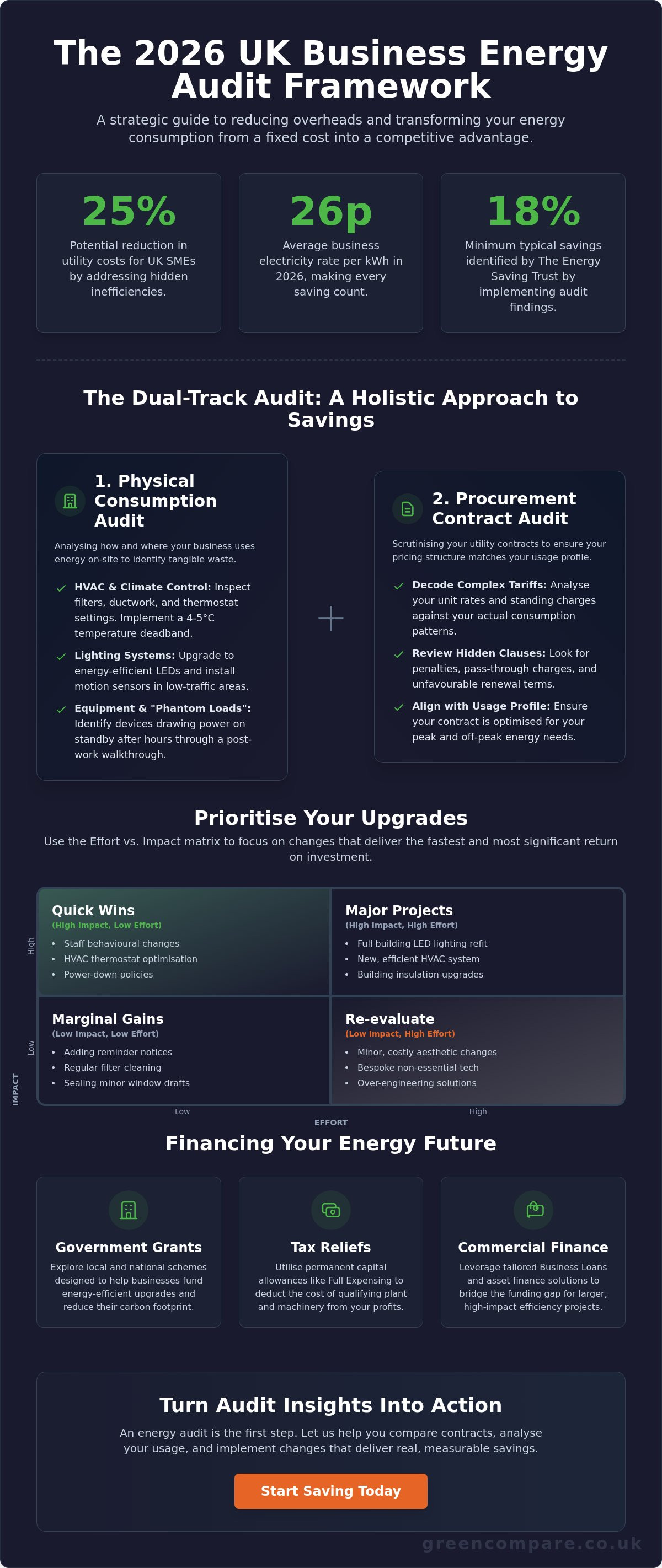
The ROI is immediate and measurable. Data from The Energy Saving Trust suggests SMEs can slash energy costs by 18% to 25% simply by implementing audit findings. With average electricity rates hovering around 26p per kWh in early 2026, these savings directly improve your bottom line. Efficiency is now a vital competitive advantage. It allows you to reinvest saved capital into growth rather than losing it to inefficient machinery or poor contract terms.
The Financial Impact of Energy Waste
Energy waste is a silent drain on your commercial profits. "Phantom loads"—power consumed by equipment left on standby—and outdated HVAC systems often account for a significant portion of utility bills. View this waste as a "hidden tax" on your business. It is capital that could fund new hires or equipment upgrades but is instead vanishing into the grid. Beyond the balance sheet, a lean energy profile builds trust. Modern UK consumers prefer organisations that take environmental responsibility seriously. Efficiency is not just about saving money; it is about future-proofing your brand.
Setting Your Audit Objectives
Define what success looks like before you begin. Are you aiming for a 15% reduction in overheads, or is your goal full carbon neutrality? Start by gathering 12 months of previous utility bills to establish a solid baseline. This data reveals your peak usage times and seasonal fluctuations. Assign a lead for the project. While a manager can conduct the initial walkthrough, you may need a specialist to navigate the complex clauses in your utility contracts or to secure Business Loans for larger efficiency projects. Follow these steps to ensure a faster result:
- Gather all Business Electricity and gas statements from the last year.
- Identify your highest consumption months to spot seasonal trends.
- Set a specific, measurable target for cost reduction.
- Decide on a budget for potential equipment upgrades.
A clear objective turns a mundane administrative task into a powerful narrative of business empowerment. By treating your energy as a manageable asset rather than a fixed cost, you take the first step toward long-term sustainability and financial stability.
How to Conduct a Physical Energy Assessment of Your Premises
Your physical walkthrough is the diagnostic phase of a business energy audit uk. Schedule two separate visits: one during peak operational hours and another after the staff have gone home. Walking through a quiet building often reveals "vampire" devices, glowing monitors, and humming printers that should be powered down. This hands-on approach transforms a simple inspection into a strategic business tool for cost containment. You are looking for the "low-hanging fruit" of efficiency. Start with a room-by-room checklist to ensure no corner of your premises is overlooked.
The HVAC and Climate Control Check
Heating and cooling systems are usually your largest overheads. Start your audit here. Inspect filters and ductwork for blockages that force motors to work harder and consume more Business Electricity. Ensure your heating and cooling are not fighting each other. The deadband is the specific temperature range where neither heating nor cooling is active, preventing unnecessary energy expenditure. Maintaining a deadband of 4 to 5 degrees Celsius can significantly reduce wear on your systems. Check that thermostats are not placed near heat sources or in direct sunlight, as this triggers false readings.
Lighting and Sensory Optimisation
Swap traditional fluorescent tubes for smart LED solutions. This is one of the fastest ways to lower your Business Electricity costs. Identify areas where motion sensors or timers could replace manual switches, particularly in storerooms, corridors, or toilets. Maximise natural light by keeping windows clear and desks positioned near external walls. A full LED refit often pays for itself within 12 to 18 months through reduced consumption and lower maintenance requirements. These small changes create a more productive environment whilst slashing your carbon footprint.
Check your building envelope for heat loss. Draughty windows, poorly insulated roof spaces, and gaps around loading bay doors are common culprits. Use a thermal leak detector to find air currents that are stealing your Business Gas. Finally, audit your office equipment. Printers, coffee machines, and water coolers often run 24/7. Use smart plugs to schedule these devices to switch off automatically outside of office hours. If you find your current infrastructure needs a complete overhaul, you might consider comparing commercial finance options to fund the transition without impacting your daily cash flow.
Analysing Your Commercial Energy Contracts and Tariffs
A truly effective business energy audit uk must audit the contract as rigorously as the hardware. Many owners focus on physical waste whilst ignoring the toxic terms buried in their utility agreements. The "cheapest" unit rate often hides an inflated daily standing charge. For a small office with low consumption, a high standing charge might actually increase your total spend. Conversely, a large industrial unit should prioritise the lowest possible unit rate to manage high-volume usage. Balance these two figures to find the genuine value for your specific consumption profile.
Check your recent bills for VAT and Climate Change Levy (CCL) accuracy. From 1 April 2026, the main CCL rate is 0.801p per kWh for both electricity and gas. If your organisation holds a Climate Change Agreement (CCA), you could receive a 92% discount on the CCL for electricity and an 89% discount for gas. Ensuring these exemptions are applied correctly is a simple, high-impact win for your bottom line. Ignoring these details is effectively leaving capital on the table that could otherwise fund your next stage of growth.
Spotting Hidden Contract Clauses
Don't get caught by "rollover" clauses. If you miss your switching window, your supplier might move you to out-of-contract rates, which are frequently 50% higher than market averages. Watch for "Take-or-Pay" clauses in Business Gas contracts. These penalise you for using less energy than predicted, which can ironically punish you for becoming more efficient. Resources like Business Energy Scotland offer excellent guidance on navigating these procurement complexities. If you use a comparison service, you will need a signed Letter of Authority (LOA) to allow them to benchmark the market on your behalf.
Comparing the Market for 2026 Rates
Benchmarking your current tariff against the 2026 market is a vital step in your financial health check. With average electricity rates for standard variable tariffs at 24.67p per kWh, you need to know exactly where your fixed rate stands. Decide between a fixed-rate contract for long-term price certainty or a flexible procurement strategy that allows you to capitalise on market dips. Compare your business energy rates now to see if you are overpaying for your Business Electricity. Rapid action here can secure your overheads against future price hikes and provide the stability needed for confident expansion.
Procurement is not a "set and forget" task. It is an ongoing part of your efficiency narrative. By aligning your contract terms with your actual usage patterns, you turn a mundane administrative burden into a proactive tool for professional advancement. This level of transparency ensures your utility platform serves your business goals rather than hindering them.
Implementing Low-Cost vs Long-Term Efficiency Upgrades
Your business energy audit uk has likely generated a long list of potential improvements. To avoid overwhelm, categorise these tasks using an Effort vs. Impact matrix. Focus first on "Quick Wins" that require minimal capital but deliver immediate reductions in your Business Electricity or gas bills. This strategic approach ensures you maintain momentum whilst building the financial case for larger, long-term capital projects. By tackling the easiest changes first, you prove the value of efficiency to your stakeholders immediately.
Organise your findings into four quadrants. High Impact, Low Effort tasks like draught-proofing or installing plug-in timers should be your priority. Low Impact, High Effort tasks can often be discarded. This logical sequence moves you quickly from a problem to a solution, mirroring the speed of modern commercial finance. It turns a daunting list of repairs into a structured roadmap for professional advancement.
Staff Engagement and Behavioural Change
Employee habits are often the biggest variable in your daily consumption. Incentivise your team by sharing a portion of the utility savings with a social fund or local charity. Appoint an "Energy Champion" in each department to lead the charge. This person monitors end-of-day shutdowns and identifies new areas for improvement. Phantom load is the energy consumed by equipment like printers and coffee machines whilst they are in standby mode, and it can account for up to 10% of a typical office's energy spend. Eliminating this waste requires zero capital but delivers a permanent reduction in overheads.
The Role of Smart Technology
Data is your most powerful ally in the fight against high utility costs. Ensure your premises are equipped with a SMETS2 smart meter. These devices provide granular, real-time data that eliminates estimated billing and allows you to track the impact of every change you make. Combine this with smart thermostatic radiator valves (TRVs) to create zoned heating. This prevents you from heating empty meeting rooms or storage areas, directly lowering your Business Gas costs. If the upfront cost of smart technology feels daunting, you can explore Business Loans to fund these essential upgrades without straining your monthly cash flow.
For deep, sustainable savings, look toward capital-intensive projects. Solar panels and heat pumps offer the most significant protection against future price hikes. The Boiler Upgrade Scheme currently offers grants of up to £7,500 for replacing fossil fuel systems in non-domestic buildings. Additionally, the "Full Expensing" tax relief policy is permanent. It allows you to deduct 100% of the cost of qualifying energy-efficient machinery from your taxable profits in the first year. This significantly improves the financial viability of major upgrades and accelerates your journey toward a sustainable future.
Lowering Business Overheads: Financing Your Energy Future
A business energy audit uk provides the roadmap, but securing the capital to implement major changes is the final hurdle. Don't let a temporary lack of cash flow stall your progress. Strategic investment in efficiency is one of the most reliable ways to protect your long-term profit margins. By bridging the gap between your audit findings and physical upgrades, you turn potential savings into a tangible financial asset. This proactive stance ensures your organisation stays ahead of the competition whilst reducing its environmental footprint.
Leverage available tax breaks to accelerate your ROI. The permanent "Full Expensing" policy allows you to deduct 100% of the cost of qualifying energy-efficient machinery from your taxable profits in the year of purchase. Additionally, the zero VAT rate on energy-saving materials, including solar panels and heat pumps, remains in effect until 31 March 2027. These incentives work in tandem with your energy savings to make the financial case for upgrades undeniable. When you lower your Business Gas and Business Electricity consumption, you effectively create a new stream of internal funding.
Accessing Business Loans for Green Upgrades
Large-scale projects, such as a full HVAC overhaul or a solar installation, often require external funding. Compare secured and unsecured Business Loans to find the best fit for your balance sheet. Use your audit data to strengthen your application; lenders value clear evidence of how an upgrade will lower overheads and improve cash flow. You might also consider asset finance, where the equipment itself serves as security for the loan. This allows you to preserve your working capital whilst the energy savings cover the cost of the repayments.
The Green Compare Advantage
Managing the intersection of utility procurement and commercial finance doesn't have to be stressful. We act as your expert guide, simplifying the process of finding the right utility contracts and the funding to optimise them. We understand the unique challenges of the UK commercial landscape and provide a streamlined path to lower overheads. Our goal is to move you quickly from a problem to a solution with minimal friction. Explore business finance options to fund your efficiency upgrades and start your journey toward professional advancement today.
Efficiency is a narrative of growth and sustainability. By aligning your procurement of Business Electricity with a smart financing strategy, you build a resilient foundation for the future. Take control of your overheads now and transform your energy management into a powerful engine for collective progress.
Take Control of Your Energy Future
Mastering a business energy audit uk turns a complex administrative burden into a streamlined strategy for growth. By auditing your physical premises alongside your commercial contracts, you uncover immediate savings that protect your bottom line. Whether you're implementing no-cost staff changes or investing in long-term solar projects, every step forward strengthens your competitive edge. You don't have to navigate the complexities of the energy market alone.
Since 2019, we've provided expert UK utility procurement to help businesses like yours thrive. Our streamlined comparison process gives you rapid access to competitive rates for Business Gas, Business Electricity, and Business Loans from leading UK suppliers. We're here to ensure your transition to a leaner, greener operation is both stress-free and highly profitable.
Start lowering your business overheads today with Green Compare. Let's work together to build a more efficient and sustainable future for your organisation.
Frequently Asked Questions
How long does a typical business energy audit take?
A basic walkthrough for a small premises usually takes between two and four hours to complete. For larger industrial sites or complex offices, a professional might spend several days gathering data and inspecting machinery. You can typically expect a full report with actionable savings recommendations within two weeks of the site visit.
Can I perform a business energy audit myself or do I need a professional?
You can certainly conduct an initial "walk-around" audit yourself to catch obvious waste like lights left on or draughty windows. However, large organisations must use a qualified lead assessor to comply with statutory requirements. Even for SMEs, a professional business energy audit uk provides the technical depth needed to uncover hidden contract issues and complex HVAC inefficiencies that a manual check might miss.
What is the difference between an energy audit and an EPC?
An Energy Performance Certificate (EPC) is a legal requirement that provides a standardised rating of a building's energy efficiency. In contrast, an energy audit is a proactive, strategic deep dive into how your business actually uses power day to day. While an EPC tells you how a building should perform, an audit reveals how you can lower your specific Business Electricity and gas costs through behavioural and structural changes.
How much can a UK business save by conducting an energy audit?
Most organisations can significantly reduce their utility spend by following the recommendations in a professional report. These savings often come from low-cost adjustments identified during the process, such as recalibrating thermostats or improving insulation. By identifying these "quick wins," businesses can often recoup the cost of the audit within the first few months of lower utility bills.
Are there any grants available for business energy audits in the UK?
Direct grants for the audit itself are rare, but several schemes fund the resulting upgrades. The Boiler Upgrade Scheme provides up to £7,500 for heat pump installations, whilst the Workplace Charging Scheme covers 75% of EV socket costs. You can also utilise the 0% VAT rate on energy-saving materials, which is in effect until 31 March 2027, to reduce the cost of solar panels or heat pumps.
What are the most common sources of energy waste in UK offices?
Inefficient heating, ventilation, and air conditioning (HVAC) systems are the most common culprits for waste in UK workspaces. Lighting and "phantom loads" from office equipment left on standby also drain significant capital. Identifying these leaks is a primary goal of a business energy audit uk, allowing you to implement smart timers and sensors that eliminate unnecessary consumption during non-operational hours.
How often should my business conduct an energy audit?
Aim to conduct a comprehensive review at least once a year or whenever you consider switching your Business Gas or electricity supplier. Regular checks ensure your equipment remains efficient and your contract terms still align with your usage patterns. Treat the audit as a recurring health check for your overheads that supports your long-term narrative of business empowerment.
What is the ESOS scheme and does it apply to my business?
ESOS is a mandatory energy assessment for large UK organisations meeting specific size criteria, such as having 250 or more employees. To qualify for Phase 4 on 31 December 2026, your business must meet these staff numbers or exceed specific turnover and balance sheet thresholds. For this phase, Display Energy Certificates (DECs) are no longer accepted as a route to compliance, making a formal audit essential for those affected.