What Happens When My Business Energy Contract Ends? A Complete Guide
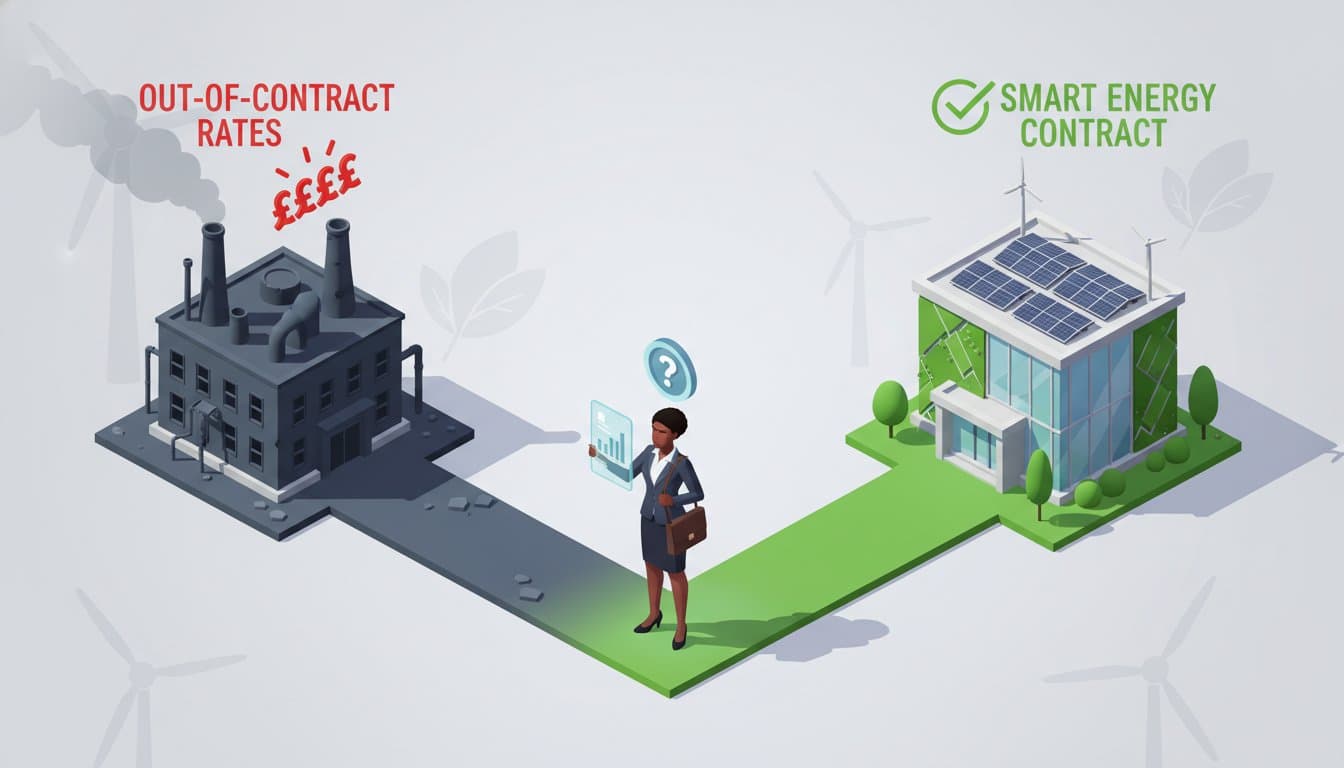
Did you know that staying silent at the end of your energy deal could instantly inflate your unit rates by up to 50%? It's a staggering figure, yet only one in four UK businesses switch their supplier each year. You're likely focused on scaling your operations and don't have hours to spare researching dozens of different providers. However, understanding what happens when my business energy contract ends is the fastest way to reclaim your margins and stop overpaying for essential gas and electricity.
We agree that commercial overheads should be a tool for your progress, not a source of constant stress. This guide shows you exactly how to avoid the "out-of-contract" price trap and navigate the latest 2026 regulatory changes with absolute confidence. We'll walk you through the new small business protections, explain why non-commodity costs now make up over 60% of your bill, and provide a clear, linear roadmap to secure a better deal. Take control of your energy strategy today and turn a routine administrative task into a win for your business growth.
Key Takeaways
- Understand that your energy supply will never be cut off, but you will automatically move to expensive "Deemed Rates" if you fail to act before your current deal expires.
- Identify your specific "Switching Window" to discover exactly what happens when my business energy contract ends and how to lock in lower rates up to six months in advance.
- Avoid the "Inaction Tax" by learning how rollover contracts can legally bind your business to higher prices for a full 12-month term.
- Gather your latest bill to find your Contract End Date and MPAN or MPRN numbers, ensuring you have the essential data ready for a seamless transition.
- Protect your commercial margins by comparing dozens of competitive UK suppliers in the time it takes to make a coffee, turning a complex chore into a quick win.
The Immediate Impact: Deemed Rates and Out-of-Contract Charges
Take a deep breath; the lights won't go out. One of the most common anxieties regarding what happens when my business energy contract ends is the fear of a sudden, dark office or a silent factory. In reality, the UK's energy framework ensures a continuous, uninterrupted supply. You won't face a blackout, but you will face a "price-out." As soon as your fixed-term deal expires, your supplier will transition your account onto their default tariffs. These are known as deemed rates or out-of-contract charges.
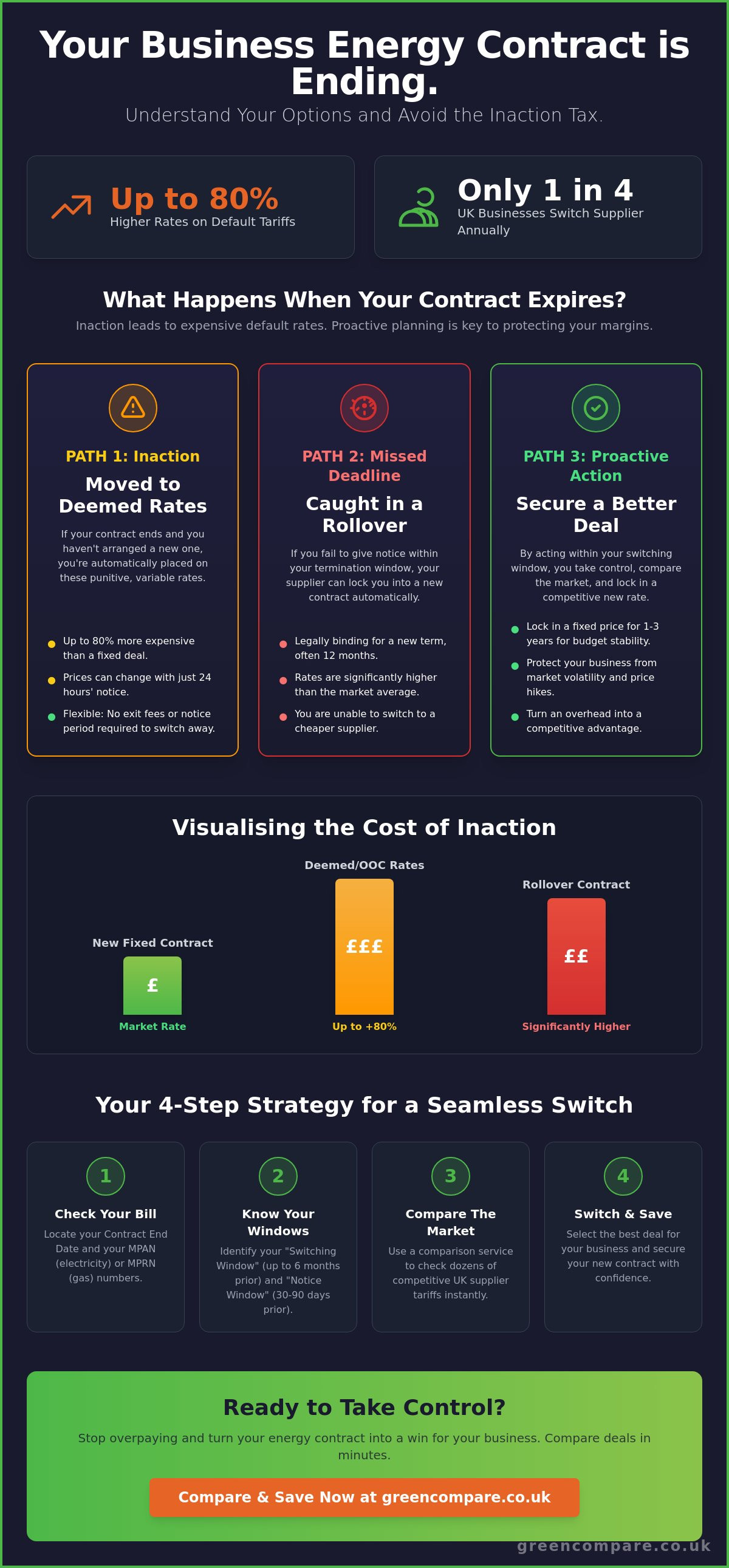
While the UK's largest energy suppliers provide the infrastructure your business relies on, their default pricing models are punitive by design. Deemed rates typically apply when you move into new premises without signing a formal agreement. Out-of-contract rates apply when your existing contract expires and you haven't yet organised a replacement. Both options are significantly more expensive than the negotiated deals you likely enjoyed previously. In many cases, these default rates can be up to 80% higher than a standard fixed-term deal.
The Financial Cliff: Why Deemed Rates Hurt
Think of these rates as a "waiting room" that charges a premium for every second you stay. These tariffs are variable, meaning your supplier can hike the price with as little as 24 hours notice. This volatility makes accurate financial forecasting nearly impossible. These charges are intentionally high to encourage businesses to switch to a more stable, fixed-term agreement as quickly as possible. Deemed rates are the most expensive way to buy commercial energy in 2026.
Your Rights During the Transition
The good news is that this expensive period is entirely within your control. Whilst you're on these default rates, you hold the power of immediate movement. You are free to switch to a new supplier or a better internal deal at any time. Usually, there is no notice period required to leave a deemed contract, giving you the agility to react to better market offers. Most importantly, suppliers cannot charge you a termination fee for exiting a deemed rate. Use this flexibility as a springboard to secure a deal that supports your long-term growth and protects your bottom line.
Understanding Your Options: Rollovers, Fixed Terms, and Extensions
Knowing exactly what happens when my business energy contract ends allows you to move from a passive consumer to a proactive strategist. Your current supplier wants your business to stay, but the terms they offer by default rarely favour your bottom line. Whilst some may offer extensions, most UK suppliers present three distinct paths: automatic rollovers, fixed-term renewals, or variable-rate structures. Each choice impacts your overheads and your ability to pivot in a changing market.
Fixed-term renewals are the most popular choice for SMEs across the UK. These allow you to lock in a set price for your gas or electricity for another one to three years. In a market where non-commodity costs are rising, this stability is a powerful shield for your commercial margins. Conversely, variable or flexible options are often tailored for larger enterprises with complex usage patterns. These track wholesale market movements. They offer potential savings when prices drop but require a higher risk tolerance if market volatility returns.
The Rollover Trap: What to Watch For
A rollover contract is an automatic extension, usually for 12 months, triggered when you miss your termination deadline. Unlike the deemed rates mentioned earlier, which allow you to leave at any time, a rollover contract legally binds you to a new term. These rates are significantly higher than the competitive market prices available to proactive switchers. You must act within your "Notice Window" to prevent this automatic lock-in.
This window is the specific timeframe where you must formally notify your supplier of your intent to leave. For many, this is between 30 and 90 days before the contract expires. If you miss this date, your supplier can roll you over onto a new, more expensive deal. Always check for "Maximum Price" clauses. These terms allow suppliers to increase rates significantly during the rollover period, further draining your budget without warning.
Fixed vs. Variable: Which Suits Your 2026 Strategy?
Deciding between a fixed or variable deal depends on your specific business goals for the coming years. Understanding what happens when my business energy contract ends is the first step in choosing the right path for your needs. Fixed-term contracts provide absolute budget certainty. You know exactly what you will pay for every unit of energy, making your financial forecasting simple and reliable. This is the cornerstone of a steady growth plan. You can compare business electricity and gas deals side-by-side to see which structure aligns with your specific goals.
Variable rates might suit businesses that expect wholesale prices to fall and have the cash reserves to handle occasional spikes. However, for most UK firms, the security of a fixed deal is the preferred route to long-term progress. Your growth plans should dictate your contract length. If you expect to move to larger premises or upgrade your equipment within 18 months, a shorter contract provides the agility you need to adapt without facing hefty exit fees.
The True Cost of Inaction: Why 'Doing Nothing' Drains Your Budget
Choosing to do nothing is a decision that carries a heavy price tag. In the commercial world, this is often called the "Inaction Tax." It's the silent drain on your capital that occurs when you allow a competitive fixed-term deal to expire without a replacement. A typical SME spending £10,000 annually on electricity could easily lose over £2,500 in a single quarter by sliding onto out-of-contract rates. These charges aren't just slightly higher; they are designed to be punitive. Don't let the confusion of what happens when my business energy contract ends paralyse your decision-making. Every day you spend on a default tariff is a day your competitors are using their saved capital to outpace you.
Many directors hesitate because they believe procurement is a time-sink. However, when you quantify the hourly "wage" of switching, the perspective shifts. If it takes you 10 minutes to secure a new deal that saves your company £1,200 annually, you've essentially earned a pro-rata rate of £7,200 per hour. This is one of the most efficient uses of a business leader's time in 2026. Reclaim your schedule and your margins by making switching a non-negotiable part of your quarterly review.
Supplier Renewal Offers vs. Market Rates
Your renewal letter is rarely a reward for your loyalty. In fact, your current supplier's primary goal is retention at the highest possible margin. These standard renewal offers often sit significantly above the current market-leading rates. This "Loyalty Penalty" is prevalent across the commercial sector. To get the best results, you must treat your energy procurement as a competitive tender process. Force suppliers to bid for your business rather than accepting the first number that lands on your desk. This shift in behaviour ensures you aren't subsidising the better deals offered to new customers elsewhere.
Impact on Business Cash Flow
Energy costs are a fundamental pillar of your cash flow. They sit alongside other critical overheads like staff costs or repayments for business loans. A saving of £500 a month on your electricity bill is equivalent to a significant increase in monthly turnover without the associated cost of sales. In 2026, with rising non-commodity costs like the 62% increase in TNUoS charges, every penny saved on the unit rate is vital. Positioning energy switching as a strategic financial move, rather than a mundane chore, allows you to boost your bottom line with minimal effort. This capital can then be reinvested into shared progress, such as green technology or expanding your team.
The 90-Day Strategy: How to Organise Your Exit and Switch
Timing is the most critical asset in your procurement strategy. Most UK suppliers open a "Switching Window" between 90 and 120 days before your current deal expires. This is your period of maximum leverage. Instead of reacting to what happens when my business energy contract ends, you can dictate the terms of your next agreement. Start the process early to ensure you have ample time to navigate the 4-6 week switching timeline without rushing into a sub-optimal deal.
Follow these linear steps to secure your business's financial future:
- Locate your data: Find your most recent bill. You need your Contract End Date and your unique meter identifiers (MPAN for electricity or MPRN for gas).
- Issue notice: Send a formal termination notice to your current provider. This prevents them from legally locking you into a rollover contract.
- Survey the market: Use a high-efficiency platform like Green Compare to view rates from dozens of suppliers simultaneously.
- Synchronise your live date: Secure your new rate and set the start date to begin the moment your old contract finishes.
This proactive approach transforms a mundane administrative task into a strategic win. You can compare business energy quotes in minutes to see how much your business could save by acting today.
Finding Your Contract End Date
Your ability to switch hinges on knowing your exit date. For microbusinesses, UK regulations require suppliers to print this date clearly on every bill. If your firm is larger, you should request a "Statement of Renewal" from your provider. This document outlines your current terms and your final date of service. Don't wait for the renewal letter to arrive in the post. Set a calendar alert for six months before your expiry date. This gives you a clear runway to monitor market trends before your switching window even opens.
Writing Your Termination Notice
A termination notice is your formal declaration of independence. Your letter must include your account number, the full site address, and a clear statement of your intent to leave. Be precise in your language. You are "terminating to switch" to a new provider, which is different from "terminating to cease supply" (usually reserved for businesses closing down). Always send this notice via a trackable method or request an email acknowledgement. Keep this record safe. It is your primary evidence if a supplier attempts to claim you missed the window and tries to apply a rollover rate.
Securing Your Next Contract with Green Compare
Navigating the transition between suppliers shouldn't feel like a second job. Green Compare acts as your proactive partner, turning the uncertainty of what happens when my business energy contract ends into a clear opportunity for professional advancement. We provide a unified utility strategy, managing both your business gas and business electricity under one streamlined approach. By scanning the market for dozens of competitive rates in the time it takes to brew a coffee, we allow you to focus on your core operations whilst we handle the heavy lifting of procurement. Start your journey toward better margins today.
Our platform is designed for high-speed results. We believe that commercial finance should be simple, transparent, and geared toward collective progress. You don't need to be an energy expert to secure a great deal; you just need the right tools to compare the market with absolute clarity. Move quickly from the problem of expiring rates to the solution of a fixed-term contract that protects your bottom line for years to come.
Why Efficiency Matters in Energy Procurement
Your time is your most valuable asset. Our streamlined process is built to eliminate hours of administrative labour, replacing complex spreadsheets with a simple, linear comparison. We maintain a strict commitment to transparency and ethical brokerage. This ensures you see the full picture without hidden fees or clinical jargon. We are more than a utility platform; we are a knowledgeable ally in your business growth. If the transition period reveals a temporary cash flow gap, our experts are also on hand to facilitate business loans to keep your momentum high. We view your utility management as part of a broader narrative of business empowerment and long-term sustainability.
Take Control of Your 2026 Energy Budget
The most successful UK firms don't wait for a renewal letter to land on their desk. They act early to secure the best possible margins. Take a visionary stance on your overheads today and protect your business from the volatility of the default market. The window for your next great deal is open right now. By choosing a proactive path, you align your company with modern corporate values of efficiency and responsibility. Don't let your budget be dictated by the "Inaction Tax" of the past. Secure your future today.
Compare business energy prices now and secure your future margins
Take Command of Your Commercial Energy Strategy
You now have the strategic roadmap to navigate your next utility transition with absolute confidence and speed. By understanding exactly what happens when my business energy contract ends, you've moved from administrative risk to operational resilience. Remember that inaction is a decision that drains your capital through punitive deemed rates and restrictive rollover clauses. Instead, use your 90-day switching window to treat energy as a competitive tender. This simple shift in behaviour protects your margins and provides the financial agility needed to fuel your long-term growth.
Our platform is built to be your proactive partner in this journey. We provide dedicated support for UK SMEs and microbusinesses, offering expert guidance on the latest Ofgem regulations to ensure you stay protected. You can compare 50+ UK suppliers in minutes, ensuring your utility strategy is as efficient as the rest of your business operations. Take the final step toward professional advancement today and reclaim your time for what matters most.
Switch and save on your business energy today
Let's turn your overheads into a stable foundation for shared progress and sustainable success.
Frequently Asked Questions
Can I switch my business energy supplier before my contract ends?
You can secure a new deal and lock in a price up to six months before your current agreement finishes. Whilst the new contract is signed early, the actual switch only goes live the day after your existing deal expires. This proactive approach allows you to bypass market spikes and ensures a seamless transition between providers without any overlap in costs.
How much notice do I need to give to cancel my business energy contract?
Notice periods vary between suppliers but usually fall between 30 and 90 days before your end date. You must check your specific terms to identify your "notice window". Failing to provide formal notice within this timeframe is the most common reason firms find themselves trapped in expensive rollovers. Set a reminder for six months out to give yourself ample time to act.
What is a rollover contract and how do I avoid one?
A rollover is an automatic extension, often for 12 months, that your supplier triggers if they don't receive a termination notice. Avoid this by submitting a formal letter of intent to leave during your switching window. This is a vital part of managing what happens when my business energy contract ends; it keeps you agile and prevents a year-long commitment to uncompetitive rates.
Will my business energy supply be interrupted during a switch?
Your energy supply will remain completely unaffected throughout the entire switching process. The transfer is entirely administrative, handled behind the scenes between your old and new suppliers. You use the same wires, pipes, and meters as before. There is no need for any physical work at your premises, meaning your business operations continue to run smoothly without a second of downtime.
What happens if I move premises before my contract ends?
Moving out of your current site usually allows you to end your contract through a "change of tenancy" process. You must notify your supplier at least 30 days before the move and provide evidence, such as a new lease or a solicitor's letter. This break in the contract is a perfect opportunity to compare the market and secure a better deal for your new location.
How do I find out when my current business energy contract expires?
Your contract end date must be printed on every bill if you are classified as a microbusiness. Larger organisations should check their original signed agreement or request a "Statement of Renewal" directly from their supplier. Locating this date is the foundation of your strategy, as it dictates exactly what happens when my business energy contract ends and when you can legally move.
Are out-of-contract rates always more expensive than fixed deals?
Default out-of-contract and deemed rates are punitive and almost always significantly higher than negotiated fixed-term agreements. In 2026, these tariffs can be up to 80% more expensive than the market's best offers. Suppliers use these high prices to encourage you to sign a new deal quickly. Staying on these rates for even a single month can cause a major dent in your quarterly cash flow.
Do I need a smart meter to switch to a new business energy contract?
You don't need a smart meter to change suppliers, but having one often gives you access to a wider range of competitive tariffs. Many modern suppliers prefer smart meters because they provide accurate, automated readings and eliminate estimated billing. If you don't have one, your new provider will likely offer a free installation as part of your new agreement to help you monitor your consumption more effectively.