The Business Energy Contract Renewal Trap: How to Avoid Costly Rollover Rates in 2026

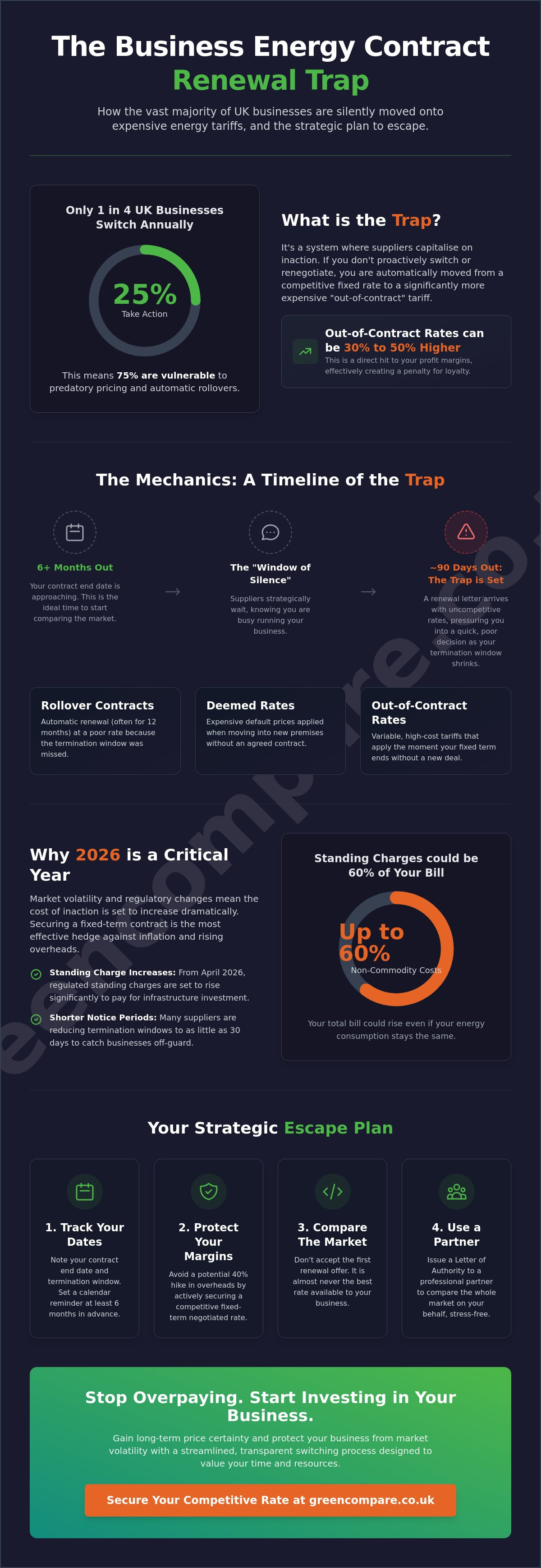
Only 1 in 4 UK businesses switch their energy supplier each year, leaving the vast majority vulnerable to predatory pricing. If you aren't part of that proactive minority, your company is likely falling into the business energy contract renewal trap. It's exhausting to navigate aggressive sales calls and opaque contract terms whilst managing your daily operations. You want lower overheads and price certainty, but the market often feels designed to keep you in the dark.
This guide reveals the hidden mechanisms of commercial renewals so you can secure the most competitive rates for your business gas and business electricity. We'll show you how to avoid out-of-contract rates that are currently 30% to 50% higher than negotiated fixed contracts. We also explore the impact of the April 2026 standing charge increases and the shift toward Market-Wide Half-Hourly Settlement. Discover a streamlined, stress-free switching process that protects your margins and empowers your long-term growth. It's time to stop overpaying and start investing back into your business's future.
Key Takeaways
- Identify the three hidden mechanisms of the business energy contract renewal trap to prevent being automatically moved onto expensive deemed or rollover rates.
- Navigate the "Window of Silence" by tracking your contract end dates at least six months in advance to avoid missing critical notice periods.
- Protect your profit margins from a potential 40% hike in overheads by securing fixed-term negotiated rates for your business gas and business electricity.
- Simplify your utility management by issuing a Letter of Authority to a professional partner who can compare the whole market on your behalf.
- Gain long-term price certainty and move your business forward with a streamlined switching process designed to value your time and resources.
What is the Business Energy Contract Renewal Trap?
The business energy contract renewal trap is a structural mechanism designed to capitalise on administrative inertia. It consists of specific contractual clauses that automatically transition your company from a competitive fixed rate to a significantly more expensive "default" tariff. Unlike the domestic sector, the UK business energy market has no price cap. This means suppliers possess total freedom to set out-of-contract rates as high as they wish; often resulting in costs 30% to 50% higher than your previous agreement.
Suppliers rely on the fact that SME owners are often too busy to monitor the fine print of their utility agreements. By staying silent, you are effectively giving your supplier permission to increase their profit margins at your expense. This dynamic is a fundamental part of the retail electricity market, where the burden of finding a better deal rests entirely on the consumer. If you don't take proactive steps to switch, your provider will simply move you to their most profitable, least competitive pricing tier. Recognising this trap is the first step toward reclaiming control over your commercial finance.
Rollover Contracts vs. Deemed Rates
Understanding the terminology is your first line of defence. A rollover contract occurs when a supplier automatically renews your agreement for another year at a non-competitive fixed rate because you missed the termination window. Deemed rates are the expensive default prices applied when you move into new premises without signing a specific contract. Finally, out-of-contract rates are variable, high-cost tariffs that kick in the moment your fixed term ends without a new deal in place. In 2026, deemed electricity rates for small businesses average around 35p per kWh; a stark contrast to the sub-25p rates found in many negotiated fixed contracts.
Why 2026 is a Critical Year for Renewals
Current economic conditions have made "default" rates more unpredictable than ever before. Market volatility means that any business left on a variable tariff is exposed to sudden, sharp price hikes that can devastate cash flow. Securing a fixed-term contract for your business gas and business electricity is the single most effective hedge against 2026 inflation. You must remain vigilant as many suppliers are now shortening notice periods to as little as 30 days to catch busy directors off-guard. Act now to ensure your overheads remain manageable and your business stays on a path of sustainable growth. Efficiency today leads to prosperity tomorrow.
The Mechanics of the Trap: How Suppliers Organise Your Overpayment
The business energy contract renewal trap isn't an accident; it's a deliberate strategy built on a calculated "Window of Silence." Most suppliers wait until approximately 90 days before your contract expires to send a renewal offer. This tactical delay is designed to limit your response time. By the time you receive the letter, you're often already within your 30 to 90-day termination window. This leaves you very little time to conduct a thorough market comparison, pressuring you to accept a sub-optimal deal simply to avoid falling onto expensive variable rates.
Suppliers also utilise complex billing jargon to obscure the true cost of their "Freedom" or "Variable" tariffs. These are often framed as flexible solutions for agile businesses, yet they carry a massive premium. This complexity often hides the rising impact of non-commodity costs. Following Ofgem's December 2025 approval for infrastructure investment, electricity standing charges are set to rise in April 2026. These regulated charges are expected to make up as much as 60% of your total bill. Without a clear breakdown of these costs, you may find your overheads increasing even if your actual consumption remains static. To ensure you aren't caught out by these shifting costs, it's wise to review your business electricity and gas agreements well in advance.
The 90-Day Renewal Letter Myth
The rates presented in your official renewal letter are rarely the most competitive on the market. Suppliers often lead with an "Estimated Annual Cost" (EAC) based on historical consumption data that may no longer be accurate for your business. They count on you being too busy with daily operations to scrutinise the individual unit rates and daily standing charges. By focusing on the total estimated figure rather than the price per kWh, you might miss a cheaper alternative that could save your company thousands over a three-year term.
Notice Periods and Termination Windows
Notice periods are the most common way businesses get caught in a rollover. Whilst micro-businesses have specific Ofgem protections allowing them to switch from deemed contracts at any time, larger enterprises face stricter rules. Many contracts require written notice to be submitted via registered post or specific online portals within a precise timeframe. Missing this deadline by a single day can trigger an automatic rollover, locking you into a high-cost contract for another year. If your contract end date isn't clearly visible on your latest bill, contact your supplier immediately to confirm it and mark your calendar accordingly.
Calculating the Real Cost of Inaction in 2026
The business energy contract renewal trap represents a significant, avoidable tax on your company's growth. Falling onto a default tariff often results in a 30% to 50% uplift in costs, which can instantly erode SME profitability. For a business with multiple sites, these overpayments compound quickly; turning a minor administrative oversight into a major financial liability. Every pound spent on an inflated energy bill is a pound taken away from your marketing budget, staff development, or new equipment.
Standing charges are the silent killer of business energy budgets in 2026. Following the increase in non-commodity costs in April 2026, these daily fees now make up as much as 60% of a total bill for many firms. Because these charges are fixed, you cannot reduce them simply by switching off the lights. The only way to mitigate this impact is to secure a contract that offers a competitive daily rate alongside a low unit price. Inaction doesn't just mean paying more; it means losing the ability to forecast your overheads with any degree of certainty.
Negotiated Rates vs. Default Tariffs
The price gap between proactive procurement and passive renewal has never been wider. In 2026, negotiated fixed-term contracts for business electricity average under 25p per kWh, whilst deemed rates have climbed to an average of 35p per kWh. It's a common misconception that "Variable" tariffs track the market rate; in reality, they reflect "Supplier Discretion." This means your provider can raise prices to protect their own margins regardless of wholesale market trends. For an average UK retail unit, a 12-month rollover at these default rates could cost thousands of pounds in unnecessary expenditure.
The Opportunity Cost of Wasted Capital
Think of your energy savings as a dedicated investment fund. Reclaiming the capital lost to the business energy contract renewal trap allows you to reinvest in the areas that actually drive your business forward. Lowering your fixed overheads also improves your balance sheet, making it easier to secure competitive business loans or other forms of corporate financing. Green Compare identifies these hidden savings in minutes, providing you with a clear roadmap to reduced overheads and professional advancement. Transitioning to a better deal isn't just about saving money; it's about empowering your business to reach its next milestone with confidence.
Your Strategic Escape Plan: How to Avoid the Renewal Trap
Neutralising the business energy contract renewal trap requires a proactive strategy that begins long before your current agreement expires. Waiting for your supplier to send a renewal letter is a reactive move that leaves you with limited options and higher costs. To protect your margins and ensure long-term price certainty, follow this five-step escape plan. It's designed to move your business from a position of vulnerability to one of market-leading efficiency.
- Step 1: Identify your contract end date at least six months in advance. Use your latest bill or contact your supplier directly to confirm this date.
- Step 2: Issue a Letter of Authority (LOA) to a trusted comparison partner. This allows an expert to gather your usage data and negotiate on your behalf without you having to spend hours on the phone.
- Step 3: Compare the whole market. Don't limit yourself to the "Big Six" legacy suppliers; smaller, more agile providers often offer better rates for business gas and business electricity.
- Step 4: Serve formal termination notice to your current supplier. This is the most critical step to prevent an automatic rollover into a high-cost contract.
- Step 5: Secure a future-dated contract. Lock in today's rates for a start date in several months' time to shield your budget from future market volatility.
Executing this plan ensures you remain in control of your overheads. If you want to streamline this process and see what your business could be saving, you can compare business energy rates now and secure a deal that supports your growth.
The Power of Early Comparison
The typical renewal window for business energy contracts is between one and six months before the end date, but the most successful businesses start their search even earlier. Looking for quotes six to 12 months in advance allows you to take advantage of forward-buying. This process involves purchasing your energy at current market prices for a future start date. It acts as a powerful shield against the price shocks expected in late 2026. Working with a specialist also gives you access to "unlisted" rates. These are bespoke tariffs not available to the general public, providing a level of cost-effectiveness that direct supplier offers simply cannot match.
Serving Termination Notice Correctly
A termination notice must be legally binding to be effective. It should clearly state your account number, business name, and the specific date you wish the contract to end. Most suppliers require this notice between 30 and 90 days before the contract expires. Always request a written acknowledgement of your notice to prevent any disputes later. Be prepared for "retention" calls from your current provider. They may offer "special" rates to keep your custom, but these are often still significantly higher than what you could find on the open market. Stay focused on the data and trust your market-wide comparison to deliver the best results for your company's future.
Why Green Compare is Your Ally Against the Renewal Trap
Green Compare stands as your dedicated partner in the fight against the business energy contract renewal trap. We replace the stress of opaque terms and aggressive sales calls with a streamlined procurement process built on transparency and speed. Our team accesses a vast national network of suppliers to ensure your business gas and business electricity rates reflect true market value rather than supplier convenience. We don't just find a deal; we manage the entire transition to ensure you never pay a penny in "default" or deemed rates. This proactive approach turns a potential financial drain into a strategic advantage for your company.
Our commitment to your success goes beyond a single transaction. We believe in long-term partnerships that foster sustainable growth. By monitoring the market on your behalf, we identify the ideal moment to secure your next agreement, shielding you from the volatility seen in recent years. We provide the clarity you need to make informed decisions quickly. This efficiency is the hallmark of our service, designed to move you from a problem to a solution in the shortest possible timeframe. We value your time as much as you do.
The Efficiency of Expert Guidance
Managing a switch shouldn't be a second job. We handle the administrative heavy lifting, saving you valuable hours that are better spent leading your team. Our deep understanding of 2026 market trends, including the impact of rising standing charges and the transition to Market-Wide Half-Hourly Settlement, gives your business a significant competitive edge. We transform complex financial procedures into simple, linear steps. Our aspirational goal is to see your business flourish by eliminating the unnecessary overheads that stifle innovation. Trust our expertise to navigate the fine print whilst you focus on your core objectives.
Beyond Energy: A Holistic View of Business Finance
We view utility management as a cornerstone of your broader commercial success. Reducing your monthly outgoings does more than just save cash; it strengthens your balance sheet. A leaner operation often improves your credit profile, which is vital when you need to secure competitive business loans for future expansion. This synergy between cost reduction and capital access is how we foster collective business progress. We aren't just a utility platform; we're a knowledgeable ally invested in your professional advancement. Take control of your costs and secure your competitive business energy quote with Green Compare today.
Secure Your Business Future Today
Securing your company's financial health requires more than just careful budgeting; it demands a strategic approach to your fixed overheads. You now have the tools to identify the business energy contract renewal trap and the practical steps to neutralise it before it impacts your bottom line. By tracking your contract end dates and serving termination notices correctly, you protect your business from the significant price hikes common in out-of-contract tariffs.
Green Compare has provided expert guidance since 2019, offering national coverage across all UK commercial sectors. As specialists in both energy procurement and business finance, we simplify the complex so you can focus on expansion. Don't let administrative inertia dictate your profit margins. Take the lead and ensure your utility costs remain a foundation for progress rather than a barrier to success.
Avoid the renewal trap and compare business energy rates now
Your path to a more efficient, cost-effective future starts with a single proactive decision. We're ready to help you lock in certainty and propel your business toward its next milestone with confidence.
Frequently Asked Questions
Can I switch business energy suppliers if I am still in a contract?
You cannot usually switch to a new supplier until your current fixed-term contract ends. However, you can secure a new agreement for your business electricity and gas up to 12 months before your current deal expires. This proactive approach helps you avoid the business energy contract renewal trap by locking in competitive rates for the future whilst your current contract runs its course.
How much notice do I need to give to cancel my business energy contract?
Most commercial contracts require a notice period of between 30 and 90 days before the contract end date. You should check your specific terms immediately to ensure you don't miss this critical window. Missing the deadline by even a single day can result in an automatic rollover into a high-cost contract with your current provider, often at much higher rates than the market average.
What happens if I miss my business energy renewal deadline?
If you miss the deadline, your supplier will typically place you on out-of-contract or deemed rates. These variable tariffs are often 30% to 50% more expensive than negotiated fixed rates. In some cases, you might be rolled over into a new one-year fixed contract at a non-competitive price. This significantly increases your overheads and removes your ability to switch until the new term ends.
Is there a price cap for business energy in 2026?
No, there is no energy price cap for businesses in the UK. Unlike the domestic market, suppliers are free to set their own prices for out-of-contract and deemed rates. This lack of regulation makes it vital to actively compare the whole market. Securing a fixed-term agreement is the only way to protect your company from sudden price volatility and the business energy contract renewal trap.
What is a Letter of Authority (LOA) and why do I need one?
A Letter of Authority is a legal document that permits a trusted partner to act on your behalf with energy suppliers. It allows us to gather your usage data and negotiate competitive rates without you having to manage the administrative burden. It's a standard tool that streamlines the procurement process. This ensures you get the best market insights and professional guidance with minimal effort on your part.
Can a business energy supplier block me from switching?
A supplier can only block a switch if you have outstanding debt on your account or if you are still within a fixed-term contract period. If your account is clear and you've provided the correct termination notice, they are legally required to allow the transfer. Always ensure your final bills are paid and your notice is acknowledged in writing to prevent any tactical delays in the switching process.
How long does the business energy switching process take?
The actual transfer of supply usually takes between 15 and 30 days once your current contract has reached its end date. However, the negotiation and securing of a new contract should happen months in advance. Our efficient process aims to make this transition as fast and stress-free as possible. We move you straight onto your new, lower rates the moment your old contract expires.
Will my energy supply be interrupted when I switch contracts?
No, your energy supply will not be interrupted at any point during the switch. The transition is purely administrative; the same pipes and wires deliver your business gas and electricity. The only change you'll notice is a lower bill from your new provider. You'll also enjoy the peace of mind that comes with fixed-price certainty for the duration of your new contract.