Letter of Authority for Business Utilities: A 2026 Guide

What if you could hand over the administrative headache of energy procurement without actually losing the steering wheel? Many business owners hesitate to delegate their utility management because they fear losing control over their contracts or getting tangled in technical jargon like MPAN and MPRN. You are likely asking, what is a letter of authority for business utilities, because you want to unlock better rates without the risk of being sidelined by fine print.
It's a common concern; nobody wants to sign away their decision-making power. This 2026 guide promises to help you master the essentials of a Letter of Authority to streamline your utility management and secure better commercial rates with ease. You'll learn exactly how to use this document as a tool for empowerment rather than a surrender of control.
We'll explore the new 2026 Ofgem regulations for energy brokers and explain how mandatory commission disclosures protect your bottom line. From understanding the legal boundaries of an LoA to navigating the RIIO-3 price control framework, this article provides a clear roadmap to delegating admin whilst staying firmly in charge of your business gas and electricity.
Key Takeaways
- Understand what is a letter of authority for business utilities and how it acts as a legal bridge between your enterprise and energy suppliers.
- Discover how delegating administrative tasks to an expert intermediary can save you hours of red tape whilst unlocking exclusive wholesale rates.
- Learn the critical difference between Level 1 and Level 2 authority so you can choose exactly how much control you want to retain over contract signatures.
- Master the secure drafting process by using official company letterheads and specific identifiers to ensure rapid supplier acceptance.
- Gain the confidence to revoke your LoA at any time, ensuring you always remain the final decision-maker in your utility procurement strategy.
Understanding the Letter of Authority (LoA) in Business Utilities
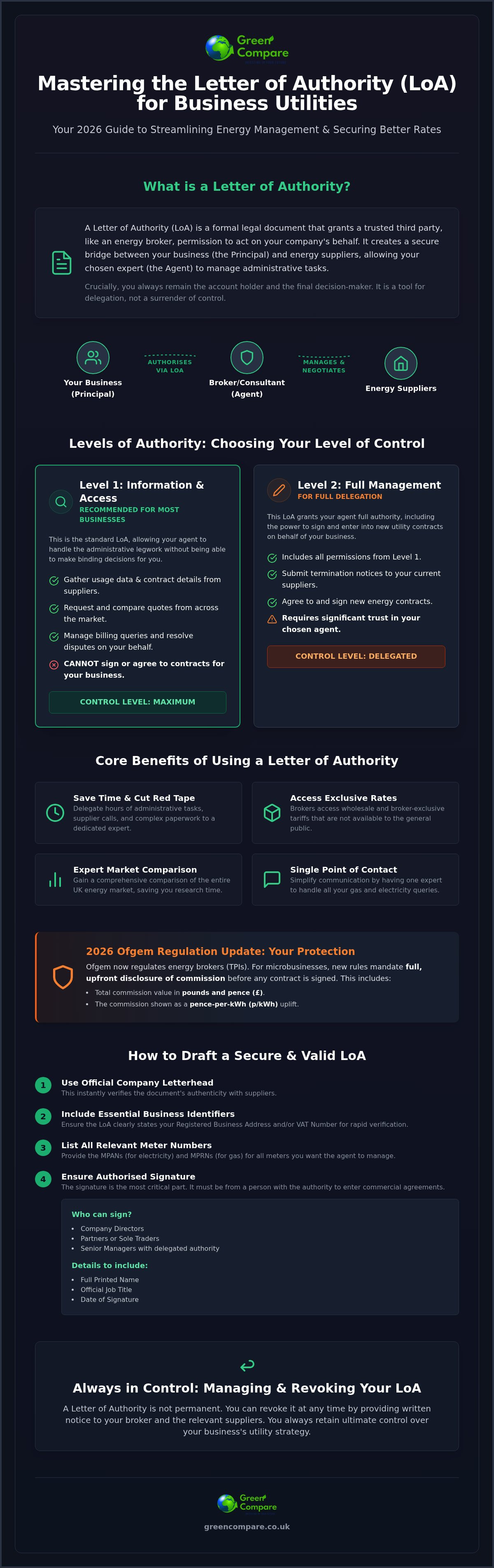
A Letter of Authority is a formal legal document that permits a third party to act on your behalf. If you have ever wondered what is a letter of authority for business utilities, think of it as the essential bridge between your business and energy suppliers. This document creates a structured partnership where your business acts as the "Principal" and your broker or consultant serves as the "Agent." It provides the legal weight required for an intermediary to handle the heavy lifting of procurement whilst you focus on core operations.
Crucially, whilst an LoA grants permission to manage specific tasks, it does not transfer ownership of your accounts. You remain the account holder at all times. The document simply authorises your agent to gather data and present options. It is a tool for professional advancement that allows you to delegate administrative burdens without surrendering your final decision-making power.
The Legal Framework: Principal and Agent
The relationship between a principal and an agent is built on a foundation of trust and professional responsibility. Your agent has a clear duty to act in the best interest of your business. Energy suppliers operate under strict data protection laws; they cannot share sensitive usage data or contract end dates without seeing a valid LoA. This protects your enterprise from unauthorised access to your financial information.
As of 2026, the regulatory landscape has become even more transparent. Ofgem now regulates energy brokers and Third-Party Intermediaries (TPIs) directly. New rules require brokers to disclose their commission in writing to microbusinesses before any contract is signed. This disclosure must include the total commission in pounds and pence, alongside the pence-per-kWh uplift. These protections ensure that your agent uses the LoA to find genuine value rather than hidden costs.
Who Can Sign an LoA for Your Business?
Precision is vital when executing legal documents. Only authorised signatories should sign an LoA to ensure it is valid in the eyes of the supplier. Typically, this includes company directors, partners, or senior managers with the delegated authority to enter into commercial agreements. Avoid allowing junior staff to sign these documents; suppliers will often reject them, which causes unnecessary delays in your procurement timeline.
To ensure your LoA is processed rapidly, the signatory must provide specific details. Ensure the following information is clear and legible:
- Full printed name of the signatory.
- Official job title (e.g., Managing Director or Operations Manager).
- The date the document was signed.
- Your Registered Office address or VAT number for verification.
Using these identifiers ensures your utility management remains secure and professional from the very first step.
Why UK Businesses Use LoAs to Manage Energy and Finance
UK enterprises are increasingly turning to professional intermediaries to manage their overheads. If you are still asking what is a letter of authority for business utilities, it's helpful to see it as a passport to better market access. By delegating the heavy lifting of procurement, you free up vital resources to focus on core business growth. Professional intermediaries use these documents to bypass standard retail desks and access "wholesale-only" or "broker-exclusive" rates that aren't typically available to the general public. This allows for a faster, more comprehensive comparison of the entire UK energy market in a fraction of the time it would take an internal team.
Cutting Through Administrative Red Tape
Managing energy contracts is notoriously time-consuming. A typical business owner might spend hours on hold with suppliers or wrestling with complex paperwork. An LoA allows a broker to handle these frustrations on your behalf. This is not just about a one-off switch; it's a tool for proactive, long-term utility management. Your agent can resolve complex billing disputes and manage queries across multiple utility meters without your direct involvement.
Having a single point of contact for your gas and electricity saves significant administrative strain. Much like using official UK government authorisation forms to let an accountant deal with HMRC, a utility LoA creates a professional channel for expert representation. It ensures that your business stays compliant and efficient whilst avoiding the "loyalty tax" often imposed on those who don't have the time to shop around.
Accessing Expert Market Analysis
Timing is everything in the energy market. Prices can fluctuate daily based on geopolitical events or network charge updates like the RIIO-3 framework. An LoA enables your partner to gather historical consumption data instantly. This data is essential for securing accurate, competitive quotes that reflect your actual usage patterns rather than broad estimates.
Beyond energy, a Letter of Authority provides the necessary access to streamline applications for business loans through Green Compare. It allows for rapid market scanning and execution, ensuring you never miss a window of opportunity for lower rates or better funding terms. This proactive approach transforms utility management from a reactive chore into a strategic advantage for your enterprise. You remain the final decision-maker, but you gain the speed and proficiency of a dedicated energy department.
Levels of Authority: Level 1 vs Level 2 Explained
Choosing the right level of permission is essential for maintaining a healthy balance between delegation and control. When exploring what is a letter of authority for business utilities, you'll find that the scope isn't fixed. You decide exactly how much power your agent holds. This flexibility ensures that whether you're a startup or a multi-site corporation, your utility strategy aligns with your internal governance. Not all LoAs are created equal; you choose the degree of power you delegate based on your specific operational needs.
Level 1: Gathering Intelligence
A Level 1 LoA is an information-only document. It acts as a safety net for businesses that want professional market scanning without committing to a switch. Your agent uses this to request technical data such as MPAN and MPRN details, consumption history, and current contract end dates. It's the ideal choice for firms in the early comparison phase who want to see what's possible amongst current UK suppliers.
The primary benefit here is transparency. You get a clear view of the market whilst retaining absolute control over the final outcome. Your broker can present options, but they cannot sign a contract or terminate an existing deal. You must still sign the final contract offer yourself. This level provides the intelligence you need to make an informed choice without any risk of unauthorised changes to your accounts.
Level 2: Full Management and Execution
For high-growth firms that value speed, a Level 2 LoA offers full management and execution. This grants your agent the authority to take direct action on your behalf. Specific tasks include terminating existing contracts, agreeing new rates, and managing complex meter installations. It streamlines the entire procurement cycle, moving you from a problem to a solution in record time.
A critical component of Level 2 authority is the "Notice of Termination" clause. This allows your broker to prevent your business from rolling onto expensive out-of-contract rates by serving notice to your current supplier at the optimal time. This level of partnership is particularly effective for businesses seeking rapid progress. It also mirrors the efficiency required when securing business loans, where swift data access can be the difference between a successful application and a missed opportunity. Whilst Level 2 offers the most convenience, it requires a high level of trust in your intermediary's proficiency and reliability.
How to Draft a Secure Letter of Authority
Drafting a secure document is the first step toward efficient utility management. When clients ask what is a letter of authority for business utilities, they often want to know how to protect their data whilst delegating admin. To ensure supplier validity, always print the document on your official company letterhead. This professional touch signals to energy providers that the request is legitimate and authorised by business leadership. A secure LoA must include specific identifiers like your VAT number or Registered Office address to pass the rigorous security checks performed by UK suppliers.
Precision is your best defence against administrative delays. You must include your MPAN (Meter Point Administration Number) for electricity and MPRN (Meter Point Reference Number) for gas to avoid identification errors. Specify the exact duration of the authority; most industry-standard documents are valid for 12 or 24 months. Clearly defining this window prevents your authority from lingering longer than necessary, keeping your procurement strategy tight and professional.
Essential Clauses for Your LoA
A robust LoA leaves no room for ambiguity. Include a "Scope of Work" clause that is highly specific about which utilities or finance products are included, such as business gas, electricity, or business loans. This ensures your agent only accesses the data they need to perform their role. Compliance is equally vital; your document must feature a "Data Protection" clause that explicitly mentions adherence to UK GDPR and the Data Protection Act 2018. Finally, ensure there is a "Termination" clause that outlines how you can end the agreement early if your business requirements change. This keeps you in total control of the partnership.
Common Mistakes to Avoid
Small oversights in drafting can lead to significant procurement hurdles. One of the most frequent errors is leaving the "Expiry Date" blank. This could lead to indefinite authority, which is a significant security risk for any enterprise. If your business operates across multiple locations, you must specify which sites are covered. Failing to list all relevant addresses can result in certain meters being excluded from the market scan. Avoid using generic internet templates that don't meet the specific requirements of major UK suppliers. For a document tailored to your specific needs, you can contact Green Compare to ensure your LoA is secure, compliant, and ready for rapid processing.
Managing and Revoking Your Letter of Authority
Maintaining control is a core principle of commercial agility. You retain the absolute right to revoke an LoA at any time, regardless of any stated expiry date. This ensures you are never locked into a relationship that no longer serves your strategic goals. When you understand what is a letter of authority for business utilities, you realise it is a flexible tool rather than a permanent transfer of power. It is your right to withdraw permission whenever your business needs evolve.
Revocation must be communicated in writing to both the agent and your utility suppliers. This prevents any confusion or overlapping authority if you decide to change consultants. This process, often called cleaning your account, ensures that only your current, chosen partner has access to your sensitive consumption data. Green Compare prioritises transparency in every LoA agreement we facilitate. We believe that a partnership built on openness is the only way to achieve long-term, sustainable growth for your enterprise.
Step-by-Step Revocation Process
Ending a Letter of Authority is a straightforward administrative task. Follow these linear steps to ensure your records are updated correctly across the industry. First, draft a formal Notice of Revocation on your official company letterhead. This document should clearly state the date, the name of the agent, and the specific meters involved. Clarity here prevents any delays in processing.
Next, send the notice via recorded delivery to the agent. This creates a vital paper trail that proves you have formally ended the relationship. Finally, contact your current energy supplier directly. Confirm that they have updated their internal records and that no further data should be shared with the previous agent. Taking these proactive steps protects your business from administrative overlap and ensures your utility strategy remains streamlined.
Partnering with Green Compare for Secure Management
We work as your proactive ally in the complex world of commercial finance. Our team organises your business gas and electricity whilst keeping you firmly in the driving seat. We specialise in commercial-only utility procurement, focusing on rapid and transparent results for UK enterprises. This approach allows you to benefit from our expert market scanning without ever losing the final say on your contracts.
Our commitment to ethically sourced commercial energy and transparent finance solutions sets us apart. We don't just find the lowest rates; we find the right solutions for your long-term development. Empower your business with a partner that values your time and your data security. Organise your business utility comparison with Green Compare today and experience a simpler, more efficient way to manage your commercial overheads.
Empower Your Business with Strategic Utility Management
Understanding what is a letter of authority for business utilities is the first step toward reclaiming your time and securing better commercial rates. You've seen how this simple document acts as a passport to wholesale markets whilst keeping you firmly in control of every contract. Whether you choose the data-gathering intelligence of Level 1 or the streamlined execution of Level 2, you always retain the final decision-making authority for your enterprise.
With the 2026 Ofgem regulations ensuring total commission transparency, there's never been a safer or more efficient time to delegate your administrative burden. Green Compare specialises in expert commercial-only utility procurement through a transparent process designed specifically for UK SMEs. We provide secure access to business loans and green energy options that support your long-term professional advancement and collective progress.
Take the next step toward a more cost-effective and sustainable future. Start your stress-free business utility comparison now and experience the benefits of a proactive partnership. We're ready to help your business thrive with speed, proficiency, and total reliability.
Frequently Asked Questions
Is a Letter of Authority a legally binding contract?
An LoA is a legal document, but it isn't an energy supply contract. When defining what is a letter of authority for business utilities, it's best to view it as a professional permission slip. It authorises an agent to act on your behalf within a defined scope. It doesn't commit you to buying energy or paying a specific rate until you sign the final supplier agreement yourself.
How long does a Letter of Authority usually last for business energy?
The industry standard for validity is 12 months from the date of signing. Some firms opt for a 24-month duration if they're managing longer-term procurement cycles or multiple meters. You should always specify an expiry date on the document to maintain tight control. If you leave it blank, you risk granting indefinite access, which can complicate your future utility management and data security.
Can I have more than one Letter of Authority active at the same time?
Yes, you can have multiple active LoAs, but it's rarely efficient for your enterprise. Suppliers often become confused if they receive conflicting requests from different brokers for the same MPAN or MPRN. This can lead to delays in quoting and procurement. It's better to partner with a single, reliable intermediary who understands your long-term goals and can organise your utilities with total proficiency.
Does an LoA mean the broker can take money from my business bank account?
No, a standard LoA doesn't grant any access to your financial accounts or banking details. Its sole purpose is to allow a third party to manage utility data and negotiate rates. When asking what is a letter of authority for business utilities, remember it's strictly for data and contract management. Direct debits for energy bills are always set up separately between you and the energy supplier.
What is the difference between an LoA and a Power of Attorney?
An LoA is a limited document focused specifically on utility or finance data management. A Power of Attorney is a much broader legal instrument that can grant authority over all your legal and financial affairs. Whilst an LoA allows a broker to act as your agent for energy procurement, it doesn't give them the sweeping powers associated with a full Power of Attorney. It keeps your delegation focused.
Do I need a new LoA every time I want to switch energy suppliers?
You don't necessarily need a new document if your current one is still within its validity period. If your LoA was signed six months ago and had a 12-month term, your broker can use it to negotiate your next switch immediately. However, if you decide to change brokers or if the original document has expired, you'll need to sign a fresh LoA to ensure continued market access.
Will an LoA affect my business credit score when applying for loans?
Signing a Letter of Authority has no direct impact on your business credit score. It's an administrative document, not a credit application. However, using an LoA to secure better energy rates can improve your cash flow, which looks positive to lenders. When applying for business loans, having your utilities organised by a professional partner demonstrates the kind of operational efficiency that builds trust with financial institutions.
What happens if a broker misuses a Letter of Authority?
Misuse of an LoA is a serious breach of trust and regulation. Under 2026 Ofgem rules, brokers must act transparently and in your best interest. If you suspect a broker has exceeded their authority, you should revoke the document in writing immediately. You can also report the behaviour to the Energy Ombudsman. Choosing a transparent partner like Green Compare ensures your authority is used ethically to drive your business forward.