GoCompare Business Energy: A Guide to Specialist Commercial Comparison in 2026

The biggest name on your television screen might be the quickest route to your smallest utility bill. Whilst many leaders assume big-name platforms are only for home insurance, using gocompare business energy tools in 2026 provides a vital gateway to market transparency. You've likely felt the sting of rising operational costs and the frustration of deciphering complex contract jargon. It's exhausting to manually track every market shift whilst trying to scale your company.
We agree that utility management should be a catalyst for growth, not a drain on your resources. This guide promises to show you how to navigate the 2026 energy landscape to secure the most cost-effective rates available. We'll preview the impact of the new £0.00801 per kWh Climate Change Levy rates and the British Industry Supercharger initiative. Learn to move from expensive out-of-contract rates to a transparent, strategic energy plan in minutes. Let's transform your overheads into an engine for shared progress.
Key Takeaways
- Treat commercial energy as a strategic procurement exercise rather than a simple bill payment to avoid expensive out-of-contract rates.
- Use gocompare business energy tools to benchmark your current costs and identify the most competitive suppliers in the 2026 market.
- Analyse the full scope of your quote by looking past headline unit rates to account for rising non-commodity charges and standing fees.
- Organise your documentation, including MPAN and MPRN numbers, to ensure a swift and error-free transition between providers.
- Leverage utility savings to explore bespoke business loans that can fund your next phase of sustainable growth and professional advancement.
Understanding Business Energy Comparison in 2026
Think of commercial energy comparison as a high-stakes procurement exercise rather than a simple administrative chore. It's a strategic move to protect your bottom line. In 2026, the market is defined by volatility and rising non-commodity costs, making passive renewal a recipe for financial leakage. Businesses on out-of-contract rates often pay 30 to 100% more than those with negotiated deals. To avoid these traps, you need a clear view of the landscape.
Securing a fixed-term contract is your best defence against market swings. Whilst the domestic market enjoys certain protections, the commercial sector demands a more proactive stance. This process is streamlined by a Letter of Authority (LOA). This simple document empowers your chosen partner to negotiate directly with suppliers, handle the heavy lifting, and present you with the most efficient options without you spending hours on the phone.
Why Business Energy Differs from Domestic
Your business energy requirements are unique, and the regulations reflect this. Unlike domestic contracts, there's no statutory cooling-off period. Once you agree to a commercial tariff, you're legally bound to it. This makes your initial choice critical. You must also account for VAT differences; whilst the standard rate is 20%, certain sectors or low-usage firms qualify for a 5% reduced rate. Additionally, there is no Ofgem price cap for businesses. You're operating in a truly competitive environment where price is dictated by wholesale trends and your negotiation power.
The Role of Generalist Comparison Sites
Using gocompare business energy tools is a popular starting point for many UK firms. These platforms typically act as a front-end for broker-led negotiations, connecting you with specialist partners who can navigate the complexities of the 2026 market. Whilst the Big Six energy suppliers once dominated the industry, the current landscape includes dozens of smaller, agile providers offering bespoke rates.
Generalist sites provide a quick benchmark, but the real value lies in accessing off-market rates. These are exclusive deals not advertised to the general public. A specialist approach ensures you aren't just seeing the standard list price but are instead viewing a curated selection of contracts designed for commercial growth. This shift from automated results to expert-led strategy is what separates a basic switch from a long-term utility partnership.
Specialist vs Generalist: Selecting the Right Procurement Route
Choosing between a self-service portal and a managed brokerage is a pivotal decision for your growth strategy. While automated tools like gocompare business energy offer rapid benchmarking, they often lack the depth required for complex commercial needs. A self-service model places the burden of accuracy on you. In contrast, a managed service provides a professional audit of your current energy usage to identify patterns that a simple bot might miss. This isn't just about finding a lower price; it's about aligning your utility spend with your operational goals.
One critical factor often overlooked in automated switches is the lack of a cooling-off period. In the commercial sector, the moment you agree to a contract, you're legally bound. There is no 14-day window to change your mind. Following Ofgem energy advice for businesses is essential to understand these legal obligations before you commit. Expert brokers mitigate this risk by managing the termination of your old contracts and ensuring your new agreement starts exactly when the old one ends. This precision prevents you from falling onto "deemed rates," which are the expensive, non-contracted tariffs suppliers apply when a renewal is missed.
The Limitations of Automated Portals
Automated portals are designed for simplicity, but business energy is rarely simple. If you manage multiple sites or have high-volume requirements, a bot cannot negotiate bespoke terms or flexible draw-down contracts. You also risk missing out on niche green energy suppliers that don't pay for placement on large comparison sites. Relying solely on automation can lead to unsuitable standing charges that erode the savings made on unit rates. For a more tailored approach, you can compare business electricity and gas with a partner who understands these nuances.
The Green Compare Advantage
We view our relationship with UK SMEs as a journey of shared progress. We don't just provide a list of prices; we offer a partnership that prioritises ethics alongside cost-effectiveness. Our team handles the complex supplier disputes and administrative hurdles that typically drain your time. By taking a visionary stance on utility management, we ensure your business is powered by transparent, reliable contracts. This collaborative growth model allows you to focus on your core operations whilst we secure the foundations of your professional advancement.
Analysing Your Quote: Beyond the Unit Rate
Look past the headline figure when reviewing your gocompare business energy results. A low unit rate is attractive, but it represents only one part of your total expenditure. A transparent view of the market requires you to dissect every line item on your quote. This includes non-commodity costs, which were projected to add around £25 per megawatt-hour (MWh) to prices from April 2026. Understanding these nuances ensures your utility spend acts as a catalyst for growth rather than a hidden drain on your capital.
The Climate Change Levy (CCL) is a significant factor in your final bill. From 1 April 2026 to 31 March 2027, the rates are set at £0.00801 per kWh for both electricity and natural gas. Whilst some sectors qualify for exemptions, most firms must factor this into their overheads. Consulting Ofgem's guide to business energy helps you identify which levies apply to your specific industry. This level of detail prevents the "bill shock" that often follows a poorly researched switch.
Standing Charges vs Unit Rates
Prioritise your tariff structure based on your consumption behaviour. A standing charge is the fixed daily cost of remaining connected to the grid, regardless of how much energy you use. If you run a seasonal business, such as a holiday centre or a farm, you might benefit from a higher unit rate paired with a lower standing charge during quiet periods. Conversely, high-intensity manufacturing firms should seek the lowest possible unit rate to mitigate the impact of constant demand. Choose a structure that mirrors your operational rhythm to maximise efficiency.
The Hidden Impact of KVA and Capacity Charges
KVA, or kilovolt-ampere, represents the total amount of "apparent power" a distribution network must be capable of delivering to your site at any given moment. For larger premises, your agreed capacity is a contractual limit. Exceeding this limit results in heavy financial penalties from the network operator. Review your maximum demand data to ensure your KVA allowance is set correctly. If it's too high, you're paying for capacity you don't use; if it's too low, you're risking unnecessary fines. Aligning your capacity with your actual needs is a simple step toward professional advancement and cost-effectiveness.
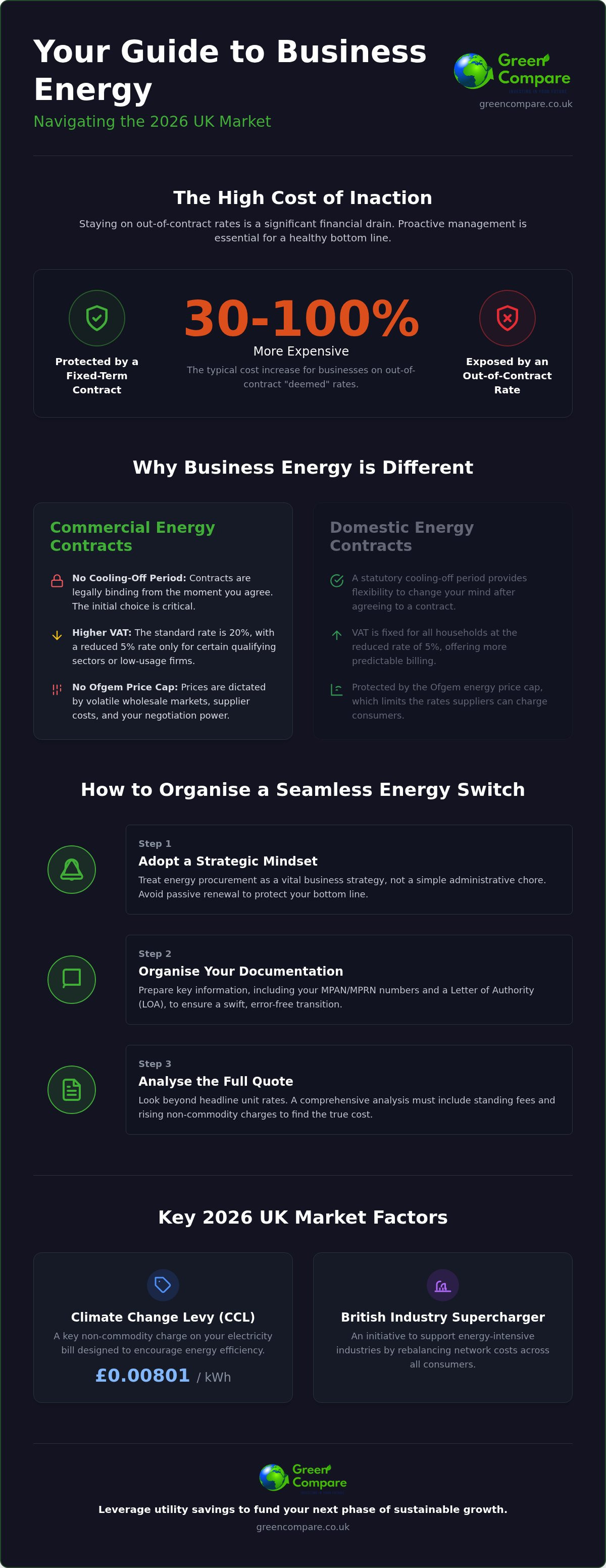
How to Organise a Seamless Energy Switch
Efficiency is the backbone of professional advancement. Whilst gocompare business energy platforms provide a vital benchmark, the actual transition requires a precise sequence of actions to ensure you don't lose money during the handover. We've refined this process into five linear steps designed to move you from a problem to a solution with minimal friction. This streamlined approach respects your time and focuses on rapid results.
- Step 1: Locate your most recent bill. You'll need your Meter Point Administration Number (MPAN) for electricity or your Meter Point Reference Number (MPRN) for gas.
- Step 2: Verify your current contract end date and notice period. This prevents you from triggering exit fees or missing the termination window.
- Step 3: Authorise a specialist broker via a Letter of Authority (LOA). This simple document empowers your partner to handle the technical negotiations on your behalf.
- Step 4: Compare tailored quotes. Review the bespoke options presented by your expert guide and select the tariff that aligns with your 2026 growth targets.
- Step 5: Confirm the switch. Once you've made your choice, let the experts manage the transition and notify your old supplier.
The Power of the Letter of Authority (LOA)
An LOA is a vital tool for rapid, professional comparison. It serves as a bridge, allowing your broker to gather usage data and resolve billing errors directly with suppliers. It's a common misconception that this document gives a broker the power to sign contracts without your consent. It doesn't. Instead, it acts as a recurring signature of efficiency, removing the administrative burden from your desk whilst keeping you in total control of the final decision. You can start your expert-led energy switch in as little as five minutes of your time.
Managing the Termination Window
Missing your termination window is a costly mistake. In the 2026 market, businesses that fail to give notice are often rolled over onto expensive standard variable rates. These out-of-contract tariffs can be 30 to 100% higher than negotiated deals. Under current Ofgem regulations, microbusinesses benefit from increased transparency, meaning suppliers must clearly state your contract end date on every bill. Use this information to your advantage. By acting proactively, you protect your capital and ensure your utility spend contributes to a narrative of shared progress rather than operational waste.
Future-Proofing Your Business with Strategic Utilities
Strategic utilities are about more than just surviving the next quarter. In a volatile 2026 economy, regular market reviews are essential to keep your overheads lean and your operations resilient. Geopolitical tensions and rising transmission network costs have made the market highly responsive to global events. Whilst tools like gocompare business energy provide a necessary starting point for benchmarking, true future-proofing requires a proactive partnership. We view your utility spend as a resource to be optimised. Every pound saved through expert negotiation is a pound that can be reinvested into your professional advancement and long-term stability.
Green Energy: Profit with Purpose
Transitioning to 100% renewable tariffs has shifted from a niche choice to a fundamental brand requirement in 2026. Modern consumers and B2B partners prioritise ethics and environmental responsibility when selecting their commercial allies. By securing a green energy contract, you align your company with contemporary corporate values whilst potentially accessing specific tax breaks or government incentives designed for eco-conscious firms. It's a visionary move. It transforms a mundane administrative task into a powerful marketing asset that signals your commitment to shared progress and a sustainable future for the UK economy.
Beyond Energy: Integrated Business Solutions
The real value of a specialist guide lies in the ability to connect different financial streams for maximum impact. Every penny trimmed from your gas or electricity bills represents liquid capital that can be used to leverage growth. We specialise in identifying these opportunities, helping you bridge the gap between utility management and corporate funding. The savings generated through a more efficient tariff can significantly improve your cash flow. This, in turn, makes your firm more attractive to our bespoke lending partners when you apply for business loans to fund expansion, new equipment, or property development.
We don't just want to find you a cheaper rate; we want to see your business thrive through collaborative growth. Our role is to act as your expert ally, providing the transparency and reliability you need to make confident decisions in an uncertain landscape. This integrated approach ensures your firm remains agile and competitive, regardless of global market shifts. We're invested in your development. Organise your free business energy audit with Green Compare today and take the first step toward a more sustainable, profitable, and empowered future.
Empower Your Business Growth
Securing a sustainable future for your firm starts with a transparent view of your overheads. We've explored how treating energy as a strategic asset allows you to avoid the heavy price hikes associated with out-of-contract rates. Whilst tools like gocompare business energy provide a vital initial benchmark, the real value lies in expert-led procurement that aligns with your specific growth targets. By managing your termination windows and scrutinising non-commodity costs, you transform a mundane bill into a resource for professional advancement.
It's time to move from administrative stress to streamlined success. Our commission-based service ensures there are no hidden fees, providing you with a trusted partner for business gas, electricity, and finance. You'll benefit from expert UK-based support throughout the entire procurement journey. Start your 60-second business energy comparison today and reclaim your time for what matters most. Let's build a narrative of shared progress together. Your next phase of growth is just one efficient switch away.
Frequently Asked Questions
Can I switch my business energy if I am in a fixed-term contract?
You can arrange a switch at any time, but the new rate only begins once your current fixed term ends. Securing a contract up to 12 months in advance is a smart move to lock in prices against market volatility. Always verify your exit fees if you plan to break a contract early. This proactive strategy ensures you aren't caught by expensive rollover rates when your current deal expires.
How long does the commercial energy switching process actually take?
The administrative switch usually takes 15 to 28 days to complete. Whilst the physical transition happens in the background, the actual comparison and agreement phase can be finished in minutes. Your power supply is never interrupted during this period. We prioritise speed and clarity to move your business from a high-cost problem to a low-cost solution without any operational downtime or stress for your team.
Do I need to install a smart meter to get the best business rates?
You aren't legally required to have a smart meter, but it significantly improves your access to the best rates. Meters that support half-hourly settlement allow suppliers to offer more accurate, bespoke pricing based on your real-time consumption. In the 2026 market, data-driven energy management is a cornerstone of professional advancement. A smart meter eliminates estimated billing, ensuring you only pay for the energy your business actually uses to grow.
What happens if my energy supplier goes bust in 2026?
If a supplier fails, Ofgem's Supplier of Last Resort process ensures your energy supply continues without a break. You'll be moved to a new provider automatically. However, you'll likely be placed on an expensive deemed tariff. It's vital to check gocompare business energy options immediately to move onto a competitive fixed deal. We act as a proactive partner to help you navigate these sudden market shifts and protect your bottom line.
Are there any fees for using a business energy comparison service?
Most commercial comparison services use a commission-based model, so you won't face any direct upfront costs. The broker's fee is typically included within the unit rate offered by the supplier. This transparent approach allows you to benefit from expert UK-based support and market analysis for free. It ensures our interests are aligned with yours, focusing on finding the most cost-effective solution for your long-term business development and shared progress.
What is the difference between a microbusiness and a SME for energy?
Microbusinesses are defined by using less than 100,000 kWh of electricity or 293,000 kWh of gas per year. SMEs represent a larger category with higher consumption and staff counts. Microbusinesses benefit from stricter Ofgem rules regarding contract clarity and easier switching processes. Understanding your business size is a pragmatic step that helps us tailor our guidance and ensure you receive the maximum regulatory protection available in the 2026 market.
Can I compare business gas and electricity at the same time?
You can certainly compare both gas and electricity together to save time and effort. Whilst separate contracts are common for different meters, many providers offer incentives for businesses that bundle their utilities. Managing your entire energy portfolio through a single expert guide creates a streamlined workflow. This efficiency allows you to focus on scaling your operations whilst we ensure your total utility spend remains as low as possible.
What information do I need to provide for an accurate energy quote?
To get the most accurate results, you'll need your latest utility bill, your annual consumption in kWh, and your meter reference numbers (MPAN or MPRN). Having your current contract end date is also critical for a smooth transition. Using precise data in your gocompare business energy search prevents the inaccuracy of estimated quotes. This detailed information empowers us to build a strategic procurement plan that supports your company's visionary goals and future expansion.