How to Calculate Business Energy Consumption From Meter Readings: A Professional Guide

Did you know that out-of-contract business energy rates can be up to 80% higher than a negotiated fixed-term deal? It's a staggering figure that highlights why staying on top of your utility data is a vital pillar of commercial growth. We understand that unpredictable estimated bills are more than just a nuisance; they disrupt your cash flow and create unnecessary stress. Learning how to calculate business energy consumption from meter readings is the first step toward reclaiming control over your overheads and ensuring your supplier is billing you with absolute precision.
You likely already suspect that your invoices don't always tell the whole story, especially with the complexity of gas conversion formulas and the industry's shift toward half-hourly billing. We've designed this professional guide to simplify these financial procedures into manageable, linear steps. You'll master the exact formulas needed to convert raw meter data into kilowatt-hours (kWh), allowing you to identify patterns of waste and prepare for a more cost-effective energy comparison. Let's transform your administrative burden into a strategic advantage for your business's future.
Key Takeaways
- Protect your business cash flow by conducting manual audits to eliminate the risk of expensive estimated billing and back-billing shocks.
- Identify your specific electricity meter type to record your usage accurately, ensuring you only pay for the energy your operations actually consume.
- Master the essential conversion steps for how to calculate business energy consumption from meter readings for gas, turning raw volume into precise kilowatt-hours.
- Verify your eligibility for a reduced 5% VAT rate and account for standing charges to gain a complete picture of your total utility overheads.
- Leverage accurate consumption data to secure more competitive rates from suppliers, turning a routine administrative task into a strategic financial advantage.
The Strategic Importance of Calculating Business Energy Consumption
Managing a successful company requires absolute precision in every department. You wouldn't allow a supplier to guess your stock levels or inventory costs, yet many firms permit energy providers to do exactly that with their utility bills. Relying on "Estimated" readings is a silent drain on your commercial finance. When a supplier guesses your usage, they often overcharge to protect their own margins, which traps vital capital that should be fueling your growth. Conversely, if they underestimate your consumption, you face the looming threat of a "back-billing" shock. This occurs when a provider suddenly demands payment for months of unbilled energy, potentially destabilising your cash flow in a single afternoon.
The universal unit of commercial energy is the Kilowatt-hour (kWh). Whether you are looking at a gas bill or an Electricity meter, the kWh is the currency of your consumption. Understanding how to calculate business energy consumption from meter readings isn't just an administrative chore; it is a strategic audit. It transforms you from a passive payer into an informed partner. By mastering these figures, you gain the transparency needed to verify every penny on your invoice and identify exactly where your money is going.
Protecting Your Business from Billing Errors
Commercial energy invoices are notoriously complex, and errors are more common than many directors realise. Inaccurate meter serial numbers, incorrect VAT ratings, or simple human error during manual data entry can lead to significant overpayments. For an SME, this lack of liquidity can hinder your ability to invest in new equipment or talent. Regular manual audits allow you to:
- Identify faulty machinery that is drawing excessive power.
- Spot patterns of energy waste during out-of-office hours.
- Ensure your business is only paying for the energy it actually uses.
Preparing for a Commercial Energy Comparison
When you decide to switch suppliers or renew a contract, accuracy is your greatest leverage. Most providers ask for your Actual Annual Consumption (AAC) to generate a quote. If this figure is based on old estimates, your new contract will be fundamentally flawed. Providing precise data makes the comparison process 100% more accurate, ensuring you don't end up on expensive out-of-contract rates that can be up to 80% higher than a fixed deal. Use your calculated findings to leverage better terms through Green Compare, where we turn your data into a competitive advantage for your bottom line.
Calculating Business Electricity Usage: From Dial to Digital
Precision starts with the hardware. To master how to calculate business energy consumption from meter readings, you must first identify which device is monitoring your supply. Whilst modern smart meters are becoming the standard, many commercial premises still rely on older digital or dial-based systems. Understanding the fundamentals of Measuring electricity is vital for any business owner looking to audit their own supply. It's the difference between blindly accepting a bill and actively managing your overheads.
Reading Different Commercial Electricity Meters
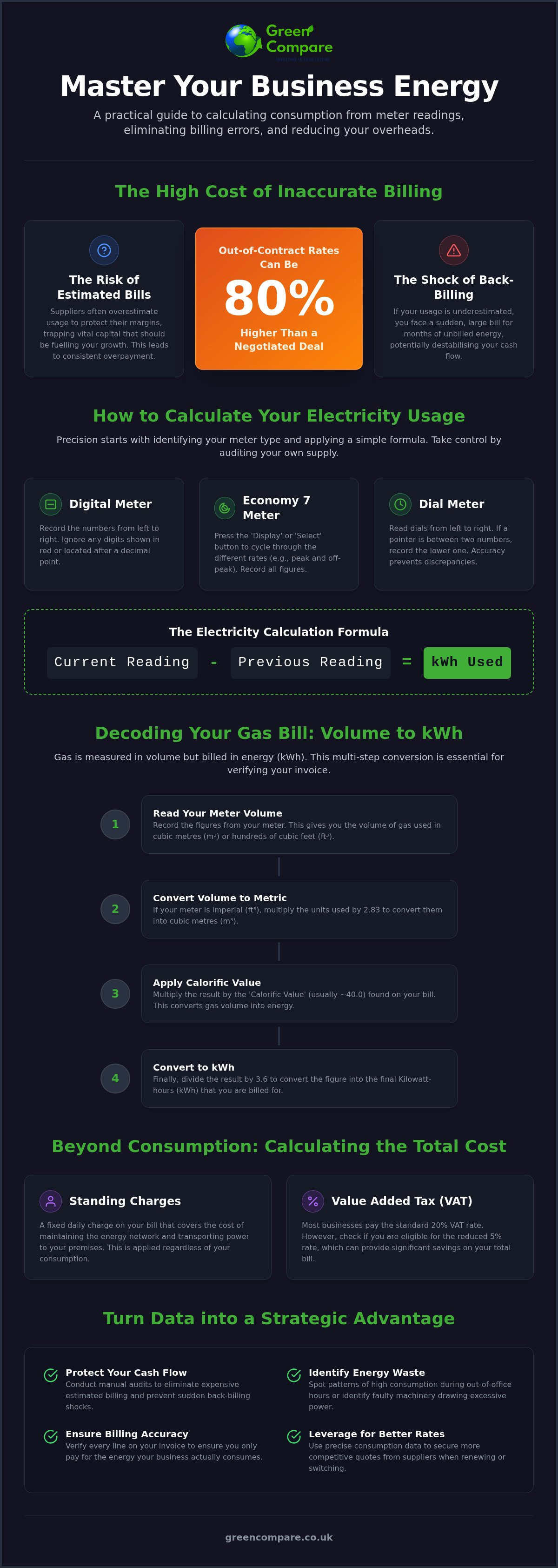
Digital meters are the most straightforward. You simply record the numbers from left to right, ignoring any digits in red or those located after a decimal point. If your business operates 24/7 or has specific off-peak requirements, you likely have an Economy 7 or multi-rate meter. These devices toggle between two or more readings. You'll need to press a button, often labelled "Select" or "Display", to cycle through the peak and off-peak figures. Record both to ensure your supplier isn't applying a daytime rate to your cheaper nocturnal usage.
Dial meters require a more focused eye. They resemble a series of small clock faces. Read the dials from left to right. If a pointer sits between two numbers, always record the lower figure. If it sits exactly on a number, check the dial to its right; if that dial shows nine, round the previous number down. It's a slightly slower process, but accuracy here prevents significant billing discrepancies.
The Electricity Calculation Formula
Once you have your figures, the maths is simple and logical. Subtract your previous reading from your current one to find the total units used. For example, if your last reading was 45,000 and today's is 45,800, you've used 800 kWh. To find the cost, multiply these units by your agreed unit rate. If you've secured a competitive fixed-term contract, this rate might sit between 20p and 23p per kWh. Divide the total by 100 to see the figure in pounds sterling.
Larger firms should also look at Half-Hourly (HH) data exports. With the Market-wide Half-Hourly Settlement (MHHS) rollout gathering pace since October 2025, more businesses are gaining access to granular usage data. This transition, set for completion by July 2027, allows for highly accurate "time-of-use" tariffs. If you're ready to see how these precise figures can lower your overheads, you can compare business electricity rates with our expert team today. This data-driven approach ensures your next contract is built on reality, not estimates.
Deciphering Commercial Gas Meter Readings and Conversion Factors
Gas billing often feels like a riddle wrapped in an invoice. Unlike electricity, where the meter and the bill speak the same language of kilowatt-hours, gas meters measure volume. They track how much space the gas occupies in cubic metres or cubic feet. To understand how to calculate business energy consumption from meter readings for gas, you must bridge the gap between volume and energy. This transition requires a specific mathematical sequence mandated by UK regulations to ensure every business pays a fair price for the actual heating power they receive.
The complexity exists because the energy density of gas fluctuates. Factors like temperature and pressure affect how much energy is packed into a single cubic metre. This is why your bill includes terms like "Correction Factor" and "Calorific Value". Following official guidance on energy consumption analysis is the best way to ensure your internal audits match your supplier's records. It allows you to spot discrepancies before they impact your quarterly profit margins.
The Step-by-Step Gas to kWh Formula
Convert your gas volume into energy with these four precise steps. First, find your volume used by subtracting your previous reading from the current one. Second, multiply this figure by the volume correction factor, which is typically 1.02264. This standardises the measurement for temperature and pressure. Third, multiply that result by the Calorific Value (CV). You'll find the current CV on your bill, usually sitting between 37.5 and 43.0. Finally, divide the total by 3.6. This final calculation provides your total kWh consumption. It's the exact figure your supplier uses to calculate your costs.
Imperial vs Metric: Avoiding the Common 2.8x Error
Identifying your meter type is a critical first step. Older Imperial meters measure in hundreds of cubic feet (ft³), whilst modern Metric meters measure in cubic metres (m³). You can tell the difference at a glance; Metric meters usually have "m³" printed on the face and four or five digits before the decimal. Imperial meters often say "cubic feet" and show four digits. If you have an Imperial meter, you must multiply your "units used" by 2.83 before starting the standard conversion formula. Skipping this step leads to massive errors. For high-volume users like commercial kitchens or manufacturing plants, a 2.8x miscalculation can lead to thousands of pounds in overpayments or unexpected debt.
Beyond the Meter: Calculating the Total Cost of Commercial Energy
Understanding the raw units you consume is vital, but your commercial invoice involves more than just usage. You aren't only paying for the energy you burn; you're paying for the infrastructure that delivers it and the environmental levies mandated by the government. Mastering how to calculate business energy consumption from meter readings provides the foundation, but a true financial audit requires you to account for the fixed and regulatory costs that sit atop your unit rates. These additional figures can represent a significant portion of your monthly overheads, so precision here is essential for accurate cash flow forecasting.
Standing Charges and Unit Rates
The standing charge is a daily fixed fee that covers the cost of maintaining the energy network and reading your meter. As of August 2026, a competitive standing charge on a fixed-term contract typically ranges between 40p and £1.00 per day. However, if your business has lapsed into out-of-contract rates, this daily fee can skyrocket to between £2.00 and £3.00. To calculate your total standing charge, multiply the daily rate by the number of days in your billing period. It's a simple step that often reveals why a low unit rate might be less attractive if paired with an inflated daily connection fee.
Taxes and Levies Unique to Business Energy
Commercial energy attracts specific taxes that domestic users don't face. The most significant is the Climate Change Levy (CCL). As of 1 April 2026, the main CCL rate for both electricity and gas is £0.00801 per kWh. You must multiply your total calculated kWh by this figure to find your levy cost. Additionally, whilst most firms pay the standard 20% VAT rate on their total bill, your business might qualify for the "De Minimis" reduced rate of 5%. This applies if you use less than 33 kWh of electricity or 145 kWh of gas per day on average. Charities and non-profit organisations also frequently qualify for this lower threshold, providing a welcome boost to their operational liquidity.
Once you've tallied your usage, standing charges, and the CCL, apply your VAT rate to the final subtotal. This comprehensive approach ensures you aren't surprised by the final figure on your statement. If these calculations reveal that your current provider is charging excessive daily fees or high out-of-contract rates, you can compare business electricity and gas rates to secure a more transparent, fixed-term deal. Taking ten minutes to audit these extra costs today can protect your bottom line for the next three years.
Streamlining Your Utility Management for Maximum Efficiency
Once you master how to calculate business energy consumption from meter readings, the goal shifts from manual oversight to automated precision. Manual audits provide an essential baseline, but modern technology can remove the administrative burden entirely. Transitioning to advanced metering solutions allows you to redirect your focus toward core business growth whilst maintaining absolute visibility over your utility overheads. It's about moving from reactive bill-checking to proactive financial management.
Modern Metering Solutions for SMEs
Smart meters and Automated Meter Reading (AMR) systems are the primary tools for this evolution. Whilst smart meters are common for smaller premises, larger commercial sites often require industrial AMR. These systems transmit your data directly to your supplier via mobile networks, ensuring your billing is always based on actual usage rather than estimates. This technology is particularly relevant as the UK moves toward Market-wide Half-Hourly Settlement (MHHS). With the rollout having started in October 2025 and a final live date set for July 2027, upgrading your hardware now ensures you're prepared for the future of sophisticated time-of-use tariffs.
Organising this data into a monthly energy dashboard can transform your procurement strategy. By tracking your peak usage periods, you can identify where to implement efficiency measures, such as upgrading LED lighting or optimising HVAC schedules. Larger commercial premises may also benefit from a professional energy audit to uncover deeper operational savings. If you haven't yet upgraded your meter, contact your current supplier; many are actively installing these devices at no upfront cost to meet national sustainability targets and improve grid efficiency.
Your Next Steps: From Calculation to Savings
The most powerful use of your consumption data is at the negotiating table. You should begin looking for a new energy deal at least six months before your current contract expires. This proactive window allows you to avoid the trap of out-of-contract rates, which can be 40% to 80% higher than negotiated fixed-term deals. Armed with your precise annual consumption figures, the comparison process becomes 100% more accurate, preventing any surprises once the new contract begins.
We've designed our platform to turn your data into immediate financial results. By providing your exact usage, we can secure the most competitive rates from multiple UK suppliers, ensuring your next contract is perfectly tailored to your business needs. We see ourselves as your forward-thinking ally, helping you turn mundane administrative tasks into a broader narrative of business empowerment and sustainability. It's time to stop guessing and start saving. Compare business energy prices in seconds with Green Compare and take the final step toward utility management excellence.
Empower Your Business with Data-Driven Utility Management
Mastering how to calculate business energy consumption from meter readings is more than just an administrative task; it's a vital commercial strategy for protecting your cash flow. By understanding the conversion from raw volume to energy units and accounting for business-specific levies, you've moved from passive acceptance to active control. You now possess the precise data needed to eliminate estimated billing errors and identify where your operations can become more efficient. This transparency is the foundation of a more sustainable and profitable future for your company.
At Green Compare, we act as your expert UK-based partner in utility procurement. We've helped thousands of businesses annually to navigate the complexities of the market with absolute clarity. Our service is built on trust, which is why we provide transparent commission disclosure at every stage of the journey. Don't let unpredictable overheads hold your growth back. Use your newly calculated consumption data to find a better deal today. Start your business energy comparison and save today. We're ready to help you turn your administrative insights into long-term commercial success.
Frequently Asked Questions
How often should I take meter readings for my business?
Submit your readings at least once a month to ensure your supplier bills you for actual consumption rather than guesses. Monthly submissions prevent the accumulation of debt from under-estimates and stop you from overpaying on inflated estimates. This simple habit provides a clear, monthly snapshot of your operational efficiency, allowing you to spot and investigate usage spikes before they impact your quarterly margins.
What should I do if my meter reading is lower than the estimate on my bill?
Contact your supplier immediately to provide the actual figure and request a revised invoice. This is a common scenario where knowing how to calculate business energy consumption from meter readings saves you from unnecessary overpayment. Suppliers are obliged to correct your bill based on verified data, which instantly frees up capital that would otherwise be trapped in their accounts.
Is business energy VAT always 20%?
No, whilst the standard rate is 20%, many firms qualify for a reduced 5% rate. This "De Minimis" threshold applies if your business uses less than an average of 33 kWh of electricity or 145 kWh of gas per day. Charities and non-profit organisations also frequently qualify for this lower rate, which can provide a substantial boost to your annual liquidity and cash flow.
What is a Calorific Value and where do I find it?
Calorific Value (CV) is a measurement of the amount of heat energy contained in a cubic metre of gas. Because the quality of gas fluctuates slightly across the UK network, the CV varies depending on your location and the time of year. You can find the specific CV used for your billing period on the second page of your gas invoice, typically listed alongside the conversion formula.
Can I calculate my energy usage if I have a Half-Hourly meter?
Yes, though you'll typically use a digital data export rather than checking a physical dial. Half-hourly (HH) meters provide a granular view of your usage through an online portal or Automated Meter Reading (AMR) dashboard. This level of detail allows you to track consumption in 30-minute increments, making it much easier to identify waste during out-of-office hours compared to a standard manual reading.
Why is my business gas bill so much higher than my electricity bill?
Gas invoices often appear more expensive because they involve a complex conversion from volume to energy. Whilst electricity is measured directly in kWh, gas requires a multi-step calculation involving the Correction Factor and Calorific Value. Additionally, commercial heating requirements or high-volume equipment, such as industrial boilers or kitchen ranges, often consume far more energy than standard office lighting and computing.
What happens if I don't provide a meter reading to my supplier?
Your supplier will rely on estimated readings, which frequently lead to significant billing errors. If they underestimate your usage for several months, you risk a "back-billing" shock where you're suddenly asked to pay for a large volume of unbilled energy. Providing regular data is the only way to maintain a transparent, partnership-oriented relationship with your provider and protect your business from unexpected overheads.
How can I tell if my business gas meter is Imperial or Metric?
Check the unit of measurement printed on the meter's faceplate. Imperial meters are labelled with "cubic feet" or "ft3" and usually feature four digits before the decimal point. Metric meters display "cubic metres" or "m3" and typically show five digits. Correct identification is a vital first step in how to calculate business energy consumption from meter readings, as Imperial meters require an additional conversion step to reach an accurate kWh figure.