Business Energy Automatic Rollover Contracts: How to Avoid the 2026 Cost Trap

Is your energy supplier quietly siphoning 50% more from your bottom line just because you missed a single calendar date? If you've ever felt trapped by business energy automatic rollover contracts, you know the frustration of hidden terms and a lack of transparency. With average out-of-contract electricity rates reaching 35.63p/kWh in 2026, these silent renewals are a significant leak in your commercial budget. You shouldn't be penalised for being too busy to track complex expiry windows.
We believe that managing your overheads should be simple and stress-free. Discover how to identify, terminate, and prevent expensive rollover energy contracts to protect your business bottom line and reclaim control. This article provides a clear breakdown of the 2026 cost landscape, explains your legal termination rights, and offers a straightforward strategy to keep your energy bills lean and predictable. Let's secure your progress and keep your momentum high.
Key Takeaways
- Identify how business energy automatic rollover contracts can lock your company into expensive fixed-term deals if you miss a single notice window.
- Recognise the financial drain of inflated rollover rates and how they prevent your business from capitalising on market dips or sustainable energy tariffs.
- Learn the critical differences between rollover terms and flexible "deemed" rates to better manage your monthly overheads.
- Follow a simple two-step plan to locate your contract end date and calculate your precise termination window with confidence.
- Explore how a proactive partnership allows you to outsource the administrative burden of utility renewals whilst securing the best available rates.
What is a Business Energy Automatic Rollover Contract?
A rollover contract is a legally binding extension of your energy commitment triggered by inaction. When your current fixed-term deal reaches its end, your supplier doesn't simply let it expire. Instead, they move you into a fresh fixed-term agreement. This happens automatically if you fail to provide notice within a specific timeframe. Understanding business energy automatic rollover contracts is vital because, unlike domestic energy, commercial agreements don't always default to flexible tariffs. You could find yourself committed to another year of expensive rates without ever signing a new document.
Most business owners discover this too late. The trigger is usually a missed termination notice window, often hidden in the small print of your original agreement. Whilst you are busy growing your company, your supplier is counting down the days until they can secure your custom for another term. It is a passive process that demands an active response to avoid. If you don't act, you lose your power to negotiate.
The Legal Status of Rollovers in 2026
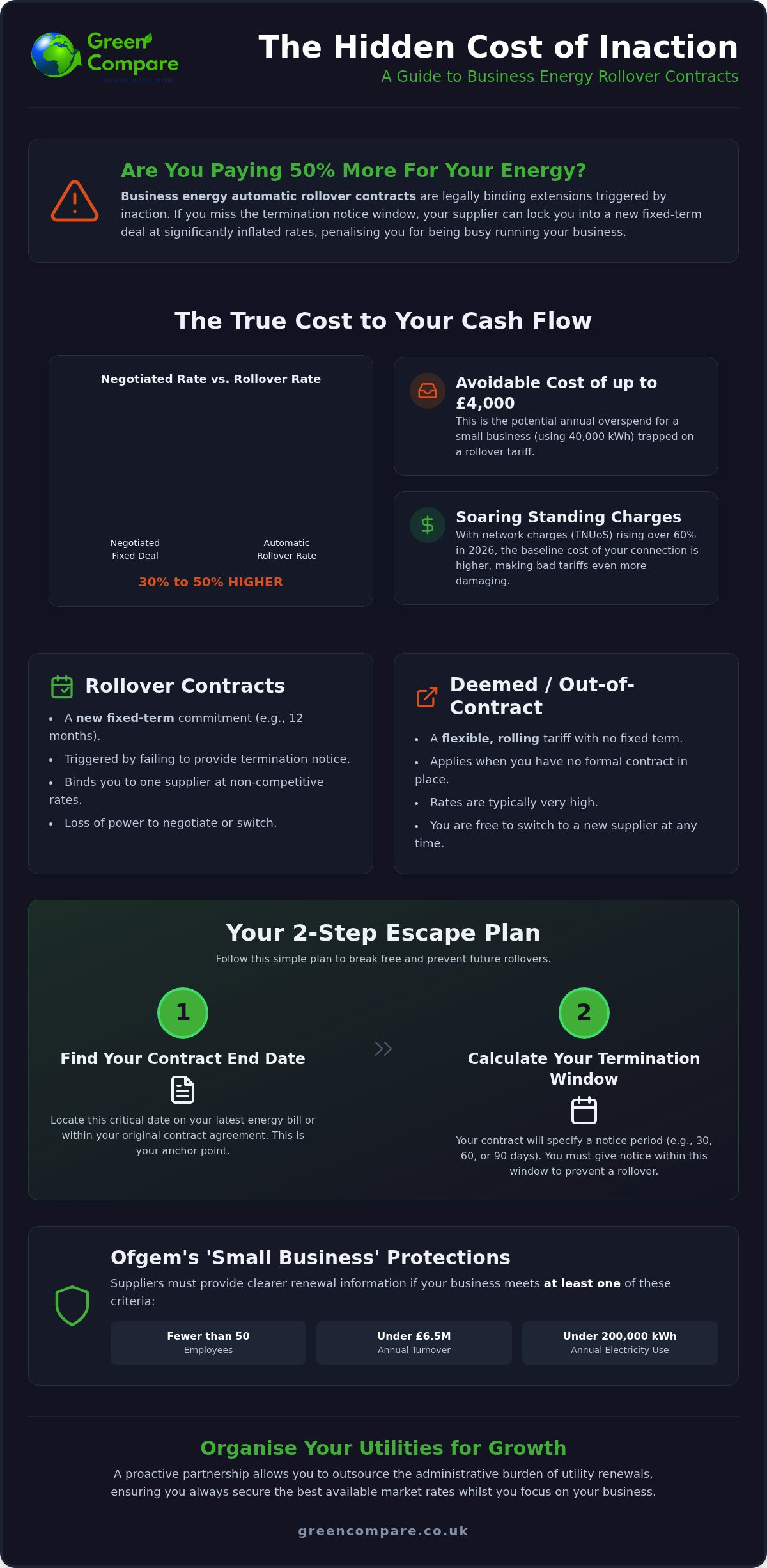
The regulatory environment has shifted significantly. Ofgem, the energy regulator, introduced a new "Small Business" definition in late 2024 to increase transparency. This covers organisations with fewer than 50 employees and a turnover of no more than £6.5 million. If you fall into this category, or use less than 200,000 kWh of electricity per year, you have specific protections regarding how and when you are notified of a contract end. Suppliers must now provide clearer information before a contract renews.
Despite these protections, many suppliers still lean on rollover clauses. They are distinct from "evergreen" contracts, which are rolling agreements you can cancel at any time with standard notice. A rollover is a hard reset of your commitment. It keeps you tied to a single provider, often at rates that don't reflect the current market lows. It is a rigid structure that prioritises the supplier's stability over your flexibility.
Why Suppliers Use Automatic Renewal Clauses
Suppliers use these clauses to manage risk and secure long-term demand. By locking in business energy automatic rollover contracts, they can hedge their energy purchases with certainty on the wholesale market. It guarantees their sales volume for the next 12 months. This protects their margins whilst often penalising your cash flow. It is a defensive strategy for the provider that limits your choice.
Providers frequently frame these clauses as a helpful service. They claim it prevents you from falling onto "deemed" or out-of-contract rates, which are notoriously high. Don't accept this "convenience" as a favour. It is a mechanism designed to bypass the competitive comparison process. Real convenience is having a proactive partner who monitors your windows for you, ensuring you always move toward growth, not stagnation.
The True Cost: Why Rollover Rates Damage Your Cash Flow
Falling into business energy automatic rollover contracts isn't just an administrative slip; it's a direct hit to your profitability. Most suppliers rely on a "loyalty penalty" where the longest-standing customers pay the highest premiums. By staying put, you miss the chance to secure modern, greener tariffs that align with contemporary corporate responsibility goals. This trapped capital affects more than just your monthly balance. Persistent high overheads can weaken your business credit profile, potentially making it harder to secure competitive rates on Business Loans when you need to expand. Efficiency in your utility spend is a clear indicator of a healthy, well-managed enterprise.
Quantifying the Energy Price Hike
The financial jump from a negotiated rate to a rollover rate is often staggering. According to official Ofgem guidance, businesses must be informed of their contract options, yet many still end up on expensive default terms due to missed windows. Research from July 2026 shows that businesses on out-of-contract or rollover rates pay between 30% and 50% more per unit than those on negotiated fixed deals. For a small business using 40,000 kWh of electricity per year, this creates an avoidable cost of up to £4,000 annually.
Standing charges have also become a significant burden. With Transmission Network Use of System (TNUoS) charges rising by more than 60% in April 2026, the baseline cost of staying connected has soared. When these increases are applied to business energy automatic rollover contracts, the cumulative effect can erode a standard SME’s profit margin by several percentage points. Protecting your cash flow requires a proactive approach to procurement rather than passive acceptance of supplier terms.
Opportunity Cost and Business Stagnation
Think about what that wasted capital could achieve elsewhere. That £4,000 lost to a rollover could fund a targeted marketing campaign, upgrade essential equipment, or support a new hire. Every pound spent on an inflated energy bill is a pound taken away from your growth potential. High-performing businesses treat utility management as a strategic priority rather than a background chore.
Choosing to compare business gas and electricity rates ensures your capital stays where it belongs: in your business. Efficient procurement is a hallmark of a modern, forward-thinking enterprise. It signals to partners and investors that you are a proactive leader who values operational proficiency. Don't let administrative inertia hold your business back from its next milestone. Reclaiming your energy budget is the first step toward collective progress and long-term sustainability.
Rollover vs. Out-of-Contract Rates: Spotting the Difference
Understanding your current status is the first step toward reclaiming your energy budget. Whilst both scenarios result in higher bills, the mechanics of how you leave them differ significantly. Business energy automatic rollover contracts are essentially a silent extension of your previous commitment. You are locked into a new fixed term, usually 12 months, which restricts your ability to move even if wholesale prices plummet. In contrast, out-of-contract rates, often referred to as variable or flexible rates, don't have a fixed end date. They offer the freedom to switch at any time, but you pay a heavy premium for that flexibility.
To identify your current situation, examine your latest invoice. Look for terms such as "Standard Variable", "Deemed", or "Out of Contract". If your bill shows a specific "Contract End Date" that is several months away, you've likely already been rolled over. Recognising these markers allows you to stop the financial leak and start planning your exit. Out-of-contract status is a temporary state that requires immediate intervention to prevent long-term capital waste.
The Comparison Framework
When you are evaluating your position, it's helpful to view these two states side-by-side to understand the urgency of your next move. The differences in duration, price, and exit strategy are distinct:
- Duration: A rollover contract is a fixed-term commitment, often lasting one year. Out-of-contract rates are rolling monthly agreements with no long-term tie-in.
- Price: Out-of-contract rates carry the highest unit rate premiums. As of July 2026, average out-of-contract electricity rates are 35.63p/kWh, whilst negotiated fixed-term rates average around 27.8p/kWh.
- Exit Strategy: Rollovers require you to wait for a specific termination window. Out-of-contract rates usually only require a 30-day notice period, making them easier to escape once you find a better deal.
The Dangers of Deemed Contracts
A deemed contract occurs when you move into a new premises and begin using energy without signing a formal agreement. This is a common trap for expanding businesses. Because the supplier has no historical data on your usage and no guaranteed commitment, they place you on their most expensive tariff. These rates are designed to be punitive to encourage you to sign a contract quickly.
Don't let a move to a new office or warehouse stall your progress. Moving from a deemed rate to a competitive fixed-term deal can often be organised within days. It is one of the fastest ways to improve your operational proficiency and ensure your new site is contributing to your growth rather than draining your resources. Acting quickly turns a potential financial hurdle into a streamlined success.
The 2026 Escape Plan: How to Break Free and Prevent Rollovers
Escaping the cycle of business energy automatic rollover contracts requires a tactical approach. You don't have to be a utility expert to protect your margins. Follow these five linear steps to reclaim your freedom and secure a leaner budget. Precision is your best tool for professional advancement.
- Step 1: Locate your current contract. Don't just look at the unit price. Find the "End Date" and the specific "Notice Period" hidden in the terms.
- Step 2: Calculate your "Termination Window". Work backwards from your end date. If you have a 90-day notice period, your notice must reach the supplier at least three months before the contract expires.
- Step 3: Issue a formal notice. Send this in writing via email or registered post. Clearly state your account number and your intent to terminate at the end of the fixed term.
- Step 4: Compare the market early. Start your search at least 6 months before your term ends. Wholesale prices in 2026 have been volatile; locking in a rate early provides essential budget certainty.
- Step 5: Confirm the switch date. Ensure your new contract starts the day after your old one ends. This seamless transition prevents double-billing and avoids expensive out-of-contract rates.
Mastering the Termination Window
Suppliers vary in their requirements. Whilst some only demand 30 days, others insist on 60 or even 90. Missing this window by a single day can trigger a rollover. Always request a "Termination Acknowledgment" from your provider. This document is your shield if a supplier later disputes your notice or claims it arrived too late. If they refuse to acknowledge your request, keep a record of your sent email as proof of your proactive stance.
Proactive Monitoring Strategies
Don't rely on memory to manage your overheads. Set digital alerts for 12, 9, and 7 months before your contract expires. Organise your utility documents in a single digital folder to ensure rapid results during a comparison. Many successful enterprises use a comparison partner to automate this tracking. It removes the administrative burden and ensures you never fall into a rollover trap again. A proactive partner monitors these windows for you, keeping your momentum high and your costs low.
Ready to simplify your procurement and protect your bottom line? Compare business electricity rates today and secure your next fixed-term deal with total confidence.
Organise Your Utilities for Growth with Green Compare
Managing commercial overheads shouldn't be a source of constant stress. Green Compare takes the weight off your shoulders by identifying the most cost-effective gas and electricity rates available in the current market. Our expert guides act as your proactive partner, monitoring your contract end dates so you never fall into the trap of business energy automatic rollover contracts again. By outsourcing this administrative burden, you free up the mental space and capital needed to focus on your core operations. We provide a simple, linear path from expensive, outdated tariffs to lean, efficient procurement.
A Partnership Approach to Commercial Finance
Thousands of UK firms trust us to manage their commercial overheads because we operate on a model of shared progress. When your business saves on utilities, it possesses more capital to reinvest in staff, equipment, and innovation. We don't just offer a utility platform; we provide a knowledgeable ally invested in your long-term development. Our streamlined comparison process is built for speed, delivering rapid results in minutes rather than days. This efficiency ensures your momentum remains high whilst your costs stay low.
We believe that utility management is the foundation of broader financial health. Efficient procurement improves your cash flow and strengthens your business credit profile. This makes it easier to access our suite of Business Loans when you're ready to scale. By addressing the loyalty penalty often found in business energy automatic rollover contracts, you signal to the market that your enterprise is modern, ethically conscious, and professionally managed. Your success is our primary objective.
Next Steps for Your Business
Securing your business's financial future starts with a single, simple step. Experience the efficiency of a service designed for the time-poor owner who values transparency and reliability. Get a bespoke business energy quote today and see how much your bottom line could benefit from expert procurement. Beyond energy, our team is ready to assist you with a range of finance solutions to support your next stage of growth. Don't let administrative inertia hold you back from collective progress.
Secure your competitive business energy quote now and take control of your commercial overheads. Let's build a more sustainable and profitable future for your business together.
Take Control of Your Commercial Future
Proactive procurement is the foundation of a healthy, forward-thinking enterprise. You've learned how to identify your termination window and the critical steps needed to issue a formal notice. By acting at least 6 months in advance, you bypass the "loyalty penalty" and keep your capital where it belongs: in your business. Navigating business energy automatic rollover contracts shouldn't be a source of stress when you have the right strategy in place.
Our expert UK-based utility procurement team is here to provide a rapid, stress-free comparison service. We offer more than just energy savings; we provide access to bespoke business finance solutions to fuel your next stage of growth. Reclaim your time and secure your progress by partnering with specialists who value your bottom line as much as you do.
Compare business energy rates and avoid rollover traps today. Let's work together to build a leaner, more resilient business that is ready for the challenges of 2026 and beyond.
Frequently Asked Questions
Are business energy rollover contracts legal in the UK?
Yes, business energy automatic rollover contracts are legal in the UK, but they are strictly regulated by Ofgem. For microbusinesses and small firms, suppliers must provide clear renewal information well in advance of the contract end date. These clauses allow providers to manage their wholesale energy hedging and secure long term demand. Always review your terms to ensure you understand the specific renewal conditions attached to your agreement.
How much notice must I give to prevent a contract rollover?
You typically need to provide between 30 and 90 days' notice to prevent a rollover. The exact window is specified in your original contract terms. Don't wait until the final week to act. Submit your notice in writing via email or registered post to ensure you have a clear audit trail. This proactive step is essential for maintaining control over your utility overheads and protecting your profit margins.
What is the definition of a microbusiness for energy contract purposes?
As of 2026, a business qualifies for specific energy protections if it meets the updated "Small Business" definition. This includes organisations with fewer than 50 employees and an annual turnover not exceeding £6.5 million. Alternatively, any business using no more than 200,000 kWh of electricity or 500,000 kWh of gas per year also qualifies. These thresholds ensure that smaller enterprises receive clearer communication regarding their contract status and termination rights.
Can I switch suppliers if my contract has already rolled over?
Switching suppliers becomes much more difficult once a contract has officially rolled over. Because a rollover creates a new fixed term agreement, you are legally bound to that supplier for the duration, which is often 12 months. Attempting to leave early usually results in significant exit fees or termination charges. It is far more efficient to organise your switch during the designated termination window before the renewal triggers.
What is the difference between a rollover and an out-of-contract rate?
A rollover contract locks you into a new fixed term, whilst an out-of-contract rate is a flexible, variable tariff. Rollovers provide price certainty but remove your freedom to switch. Out-of-contract rates allow you to leave at any time with 30 days' notice, but they carry the highest premiums. In July 2026, average out-of-contract electricity rates reached 35.63p/kWh, making them an expensive temporary solution for any business.
Does British Gas still use automatic rollover contracts?
Like many major suppliers, British Gas has updated its approach to business energy automatic rollover contracts for smaller customers. Whilst they have moved many microbusinesses toward variable rolling contracts to increase flexibility, larger commercial entities may still encounter fixed term renewal clauses. Always check your latest renewal offer. Transparency is key to ensuring your procurement strategy aligns with your long term growth goals and operational proficiency.
How do I find out when my current business energy contract ends?
Locate your contract end date by checking your most recent energy bill or your original signed agreement. Most suppliers are now required to print the "Contract End Date" and the "Notice Period" clearly on every invoice. If this information is missing, contact your supplier's customer service team immediately. Knowing these dates is the first step toward professional advancement and cost effective utility management.
What happens if I miss my termination window?
If you miss your termination window, your supplier will automatically renew your contract for another fixed term or move you to expensive deemed rates. This administrative oversight can increase your unit costs by 30% to 50% overnight. Don't let inertia damage your bottom line. Use a proactive partner to monitor these windows for you, ensuring your business always moves toward a more profitable and sustainable future.