Business Energy Supplier Switching Problems: A Guide to Troubleshooting Your Switch
Your current energy supplier isn't just letting you walk away; they're often actively building a wall to keep your budget captive. It's incredibly frustrating when you've done the hard work of finding a better rate, only to have the transition stalled by red tape or vague objections. You're likely trying to reduce overheads in a market where electricity network charges rose by up to 3% in April 2026, yet your provider seems determined to keep you stuck. Most business energy supplier switching problems aren't technical errors; they're tactical hurdles designed to keep you on a more expensive tariff.
We believe your time is your most valuable asset. This guide helps you dismantle these barriers quickly, ensuring you bypass common blockers and secure the lower rates your company deserves. We'll identify the specific reasons your move might be stalled, from unexpected contract rollovers to Letter of Authority (LOA) errors. You'll gain a clear roadmap to resolve these disputes and streamline your transition whilst moving from administrative stress to significant savings. Let's get your switch back on track in record time, transforming a mundane task into a moment of professional advancement.
Key Takeaways
- Understand that commercial energy contracts lack the standard 14-day cooling-off period found in domestic deals, making precision vital for a smooth move.
- Identify how to bypass common business energy supplier switching problems like disputed debt or claims of contractual binding that stall your progress.
- Learn to spot and avoid expensive rollover rates and exit fee traps that incumbent suppliers use to penalise your departure.
- Follow a streamlined 5-step plan to audit your current standing and clear administrative hurdles like "ghost debt" with a Statement of Account.
- Discover how a managed switching service can handle the heavy lifting of supplier disputes, saving you time whilst securing better rates.
The Reality of Business Energy Switching in 2026
The energy market in 2026 is faster than ever, yet many directors still find their progress stalled by administrative friction. While technology has streamlined the backend, business energy supplier switching problems remain a significant hurdle for firms looking to optimise their overheads. You might expect a simple transition, but the commercial sector operates under a different set of rules compared to your home supply. Most notably, there is no standard 14-day cooling-off period for business contracts. Once you sign a commercial agreement, you're committed. This makes the accuracy of your initial comparison and the timing of your move critical for your company's long-term growth.
Planning your move starts long before your current deal expires. Understanding what is energy supplier switching in a commercial context requires looking at the 'switching window,' which typically opens 6 to 12 months before your contract end date. Acting early allows you to lock in rates before market volatility or rising non-commodity costs impact your bottom line. Waiting until the final month often leads to rushed decisions and increased exposure to supplier objections. These objections are the primary cause of switching failure, often appearing as administrative errors that are actually tactical moves by your current provider to protect their revenue.
Why Commercial Switches Fail More Often Than Domestic Ones
Commercial contracts lack the safety net of the Energy Switch Guarantee that protects residential users. Large-scale agreements, especially those involving half-hourly (HH) metering or multi-site portfolios, require precise data synchronisation across multiple platforms. If a single Meter Point Administration Number (MPAN) is recorded incorrectly, the whole switch fails. Suppliers also have a vested interest in keeping profitable clients. They may use minor technicalities, such as a tiny outstanding balance or a missing signature, to block your exit and keep you on higher rates for longer.
Current Ofgem Protections for SMEs and Microbusinesses
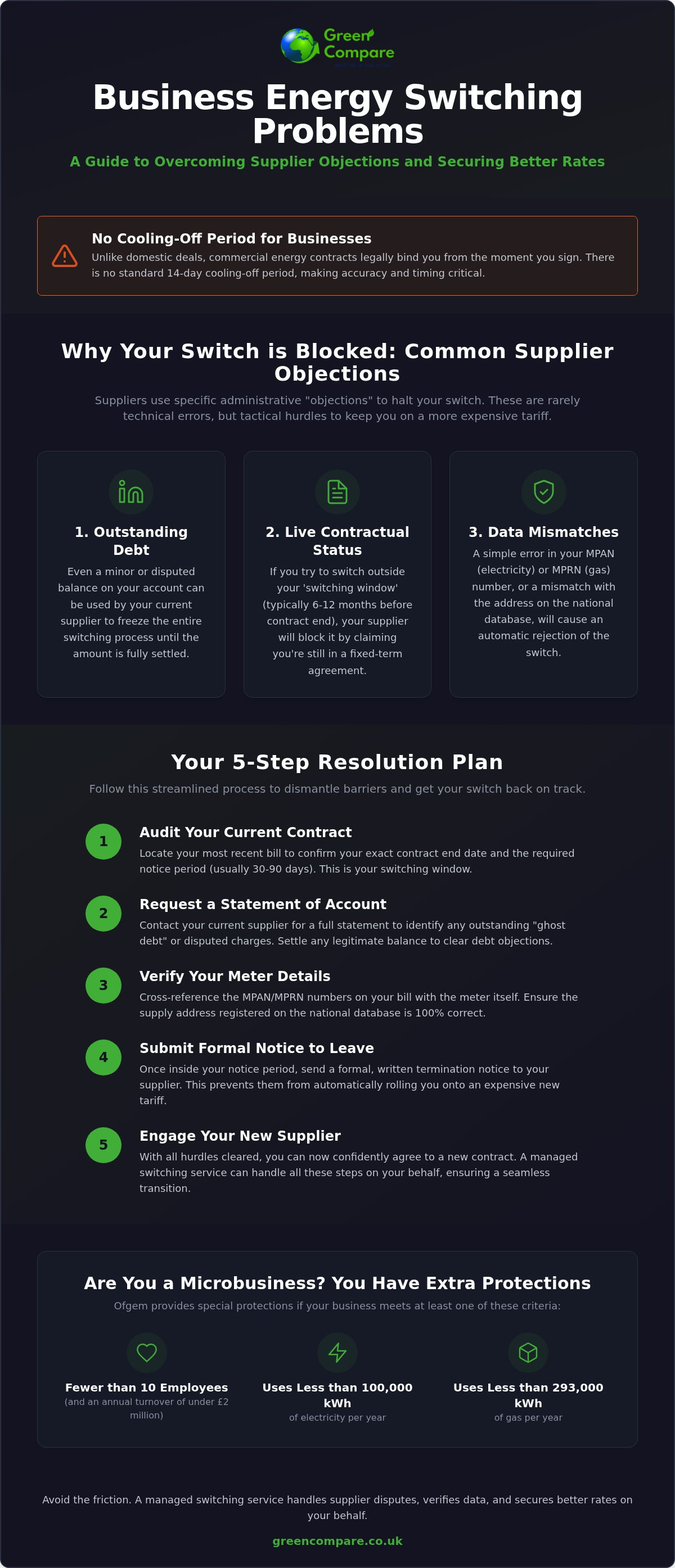
Ofgem has introduced stricter Broker Conduct rules to ensure total transparency for smaller firms. Brokers must now clearly state their commission and provide comprehensive contract terms before you sign, which prevents hidden costs from bloating your bills. In 2026, your business qualifies as a microbusiness if it consumes less than 100,000 kWh of electricity or 293,000 kWh of gas per year, or employs fewer than 10 people with an annual turnover under £2 million. These businesses benefit from shorter notice periods and clearer billing, providing a vital shield against the most aggressive supplier tactics whilst helping you maintain control over your utility spend.
Decoding Supplier Objections: Why Your Switch Might Be Blocked
When you initiate a move, your current supplier receives an automated notification. Instead of a smooth exit, you might face a "rejection code" that halts the entire process. These business energy supplier switching problems aren't usually technical glitches; they're revenue protection measures used by incumbents to keep your business on their books. Most rejections fall into four specific categories: outstanding balances, contract status, notice period failures, or data mismatches. Understanding these blockers is the first step toward overcoming them and securing the lower rates your company deserves.
Outstanding debt is the most common reason for a failed switch. Even a small "disputed" amount can freeze the process. If your supplier claims you owe money but you disagree, the switch remains in limbo until the account is settled or the dispute is formally logged. Similarly, suppliers frequently claim a business is still within a fixed-term agreement. This happens if you missed your specific notice window, which is usually 30 to 90 days before the contract ends. If you don't inform them of your intent to leave within this timeframe, they'll likely roll you onto a more expensive tariff and block your departure.
Data accuracy is another silent switch killer. If your MPAN (electricity) or MPRN (gas) numbers don't match the national database exactly, the new supplier's request is automatically rejected. This often occurs when a business has moved premises or inherited a meter with incorrect address details. To avoid these headaches entirely, you can partner with an expert to manage your utility procurement, ensuring every detail is verified and every dispute is handled professionally on your behalf.
Debt Objections and How to Resolve Them Fast
Distinguish between "actual debt" and "disputed billing" immediately. If you've been overcharged, don't let it stall your switch. You can often access free support to resolve issues through the Energy Ombudsman if your supplier isn't cooperating. For microbusinesses, suppliers generally shouldn't block a switch for debts under £100, though it's always safer to clear the balance and claim it back later to keep your move on schedule. If you hit a wall, ask for a "Letter of Deadlock" to escalate the case and prove you've exhausted the supplier's internal complaints process.
The "Contract Not Terminated" Hurdle
A "Termination Notice" is your most powerful tool against a blocked switch. It's a formal declaration that you intend to leave at the end of your term. Always send these via recorded delivery and keep a clear audit trail of the receipt. In 2026, we're seeing more suppliers adopt "Auto-Termination" clauses where contracts end naturally, but you shouldn't rely on this. Proactively sending your notice ensures there's no room for "contractual binding" arguments when you try to move to a better deal. This simple administrative step protects your right to switch and keeps your business moving forward.
Contractual Pitfalls: Rollovers, Exit Fees, and Credit Checks
Contractual traps are often the most expensive business energy supplier switching problems you'll encounter. While a supplier objection is a temporary delay, falling into a rollover contract or triggering massive exit fees creates a direct financial hit to your bottom line. Suppliers aren't legally required to offer you their best rates when your deal ends; they're counting on your busy schedule to let the deadline pass. If you don't act, you'll likely be moved to a rollover tariff, which can lock you into another year of high prices without your explicit consent. These agreements are notoriously difficult to break without paying significant penalties.
Exit fees are the supplier's final attempt to recoup perceived losses from your departure. These charges are usually calculated based on the amount of energy you would have used during the remainder of your contract. For large energy users, this can amount to thousands of pounds. Understanding your exact contract end date and the associated notice period is the only way to avoid these costs. We focus on helping you navigate these timelines with precision, ensuring your transition happens at the exact moment your current obligations expire.
The Cost of Inaction: Out-of-Contract Tariffs
If your contract expires and you haven't secured a new deal, you move to "deemed" or out-of-contract rates. These tariffs are often two to three times more expensive than a standard fixed rate because they reflect the supplier's highest risk margin. Missing your switching date by just one month can result in a bill that is significantly higher than necessary, effectively wiping out the savings you intended to make. This financial impact is immediate and often irreversible, as deemed rates are rarely backdated once a new contract is eventually signed.
Navigating Credit Check Failures
In the volatile market of 2026, energy suppliers have become increasingly selective about their clients. They view every new business as a potential credit risk, and a lower than average credit score is a common reason for a rejected application. This is particularly challenging for startups or businesses in sectors hit hard by shifting economic conditions. If a supplier perceives a risk, they might demand a substantial security deposit or insist on the installation of a smart meter to monitor usage in real time.
At Green Compare, we understand that a credit score doesn't tell the whole story of your business's potential. We leverage our industry relationships to find suppliers with a higher risk appetite or those willing to negotiate terms based on your payment history rather than just a number. By organising multiple quotes simultaneously, we identify the most sympathetic partners for your specific situation. This ensures that credit hurdles don't stop you from accessing competitive energy, turning a potential rejection into a successful partnership for your future growth.
Troubleshooting the Switch: A 5-Step Resolution Plan
Resolving business energy supplier switching problems requires a methodical approach to clear the path for your new contract. Don't let administrative friction stall your progress or eat into your potential savings. Follow this streamlined five-step plan to regain control of your utility procurement and move your business forward.
- Step 1: Audit your status. Review your current contract and termination status immediately. Confirm your notice window hasn't closed.
- Step 2: Clear ghost debt. Request a formal "Statement of Account" from your incumbent provider. This forces them to justify any balances that might block your exit.
- Step 3: Validate your data. Check your MPAN (Electricity) and MPRN (Gas) numbers against your most recent bill. Ensure they match the national database exactly to prevent automated rejections.
- Step 4: Centralise authority. Prepare a fresh Letter of Authority (LOA) to give your broker the power to fight on your behalf.
- Step 5: Act early. Compare the market at least six months before your contract end date. This ensures a seamless transition on your "live date" without falling into expensive out-of-contract rates.
The Power of a Correct Letter of Authority (LOA)
An LOA is the most underrated tool in your arsenal. In 2026, "Big Six" suppliers have become far stricter with documentation, often rejecting forms that lack precise digital signatures or specific clauses. To be effective, your LOA must distinguish between Level 1 and Level 2 authority. Level 1 only allows a broker to gather data, whilst Level 2 empowers them to negotiate and finalise contracts. Using a managed switching service ensures your LOA meets these high standards immediately. We handle the paperwork and the supplier disputes, removing the administrative burden from your desk and accelerating your switch.
Escalating to the Energy Ombudsman
If your supplier remains uncooperative despite your best efforts, it's time to escalate. You don't need to spend weeks on the phone with customer service teams who aren't authorised to help. Follow the "Eight-Week Rule": if your complaint hasn't been resolved within eight weeks, or if you receive the formal deadlock letter mentioned previously, you are eligible for Ombudsman intervention. Keep a meticulous log of all communications, including dates, names, and reference numbers. This documentation is vital for a successful dispute resolution, ensuring the Ombudsman can see exactly how the supplier has hindered your right to switch.
Avoiding Future Friction: The Green Compare Efficiency Model
Overcoming business energy supplier switching problems shouldn't be a solo mission that drains your internal resources. We position ourselves as your proactive partner, transforming utility management from a source of stress into a streamlined component of your professional advancement. Our 'Managed Switch' service is designed specifically to intercept and resolve the supplier objections we've discussed, such as disputed debt or contractual binding claims, before they can stall your progress. By acting as your expert guide, we ensure that the transition to a more cost-effective tariff is handled with regional pragmatism and modern efficiency.
Our approach is built on a precise time-saving metric that reduces the administrative burden of switching from hours of frustrating phone calls to just a few minutes of your time. We don't just find you a better rate today; we monitor the wholesale market and regulatory landscape to alert you exactly when your next switching window opens. This foresight allows your business to remain agile, locking in savings whilst others are still reacting to price hikes. It's a simple, stress-free solution that prioritises your growth over supplier profit margins.
Beyond Energy: Consolidating Business Finance and Utilities
Managing commercial overheads is most effective when you view your business as a single, cohesive entity. Our platform allows you to consolidate your Business Gas, Business Electricity, and Business Loans into one manageable strategy. This holistic view ensures that your utility procurement supports your broader financial goals, rather than competing with them. By organising your overheads through a single, reliable partner, you create a foundation for collective progress and long-term sustainability. We help you move beyond mundane administrative tasks, framing utility management as a narrative of business empowerment.
Start Your Stress-Free Switch Today
Your journey toward a more efficient, cost-effective future starts with a single step. We are genuinely invested in the long-term development of our clients, offering a partnership that goes far beyond a simple comparison tool. Our team is ready to assist you in navigating the complexities of the 2026 energy market, ensuring your business is always positioned on the most competitive rates available. Don't let supplier friction hold your budget hostage any longer. Take control of your overheads and secure your 2026 business energy rates with Green Compare today.
Secure Your Business Growth with Seamless Utility Management
Navigating the 2026 energy landscape requires more than just finding a lower quote. You must proactively manage supplier objections and avoid the expensive rollover tariffs that stifle commercial development. By auditing your contracts early and validating your meter data, you can bypass the most common business energy supplier switching problems that keep overheads high. Our expert guidance on the latest Ofgem regulations ensures your firm stays protected whilst moving toward a more sustainable financial future.
We're here to transform this administrative burden into a linear, stress-free process. Our commission-based model means you gain access to exclusive commercial gas and electricity rates with no upfront costs. Take the first step toward collective progress and smarter procurement today by leveraging our industry authority and commitment to rapid results. It's time to stop letting supplier friction dictate your budget and start investing in your company's long-term development.
Compare business energy prices and start your managed switch with Green Compare
Let's turn your utility overheads into a strategic opportunity for professional advancement and long-term success.
Frequently Asked Questions
Why has my current energy supplier blocked my switch?
Your current provider can block a move if there is an outstanding balance on your account or if you are still within a fixed-term contract. They might also object if your termination notice wasn't received within the required window. These business energy supplier switching problems are often administrative hurdles. Clear any disputed balances and verify your contract end date to resolve these objections quickly and regain your momentum.
How long does a business energy switch actually take in 2026?
A standard switch now takes approximately five working days under current industry regulations. However, this timeline only begins once your new supplier successfully passes the objection period with your incumbent provider. If administrative blocks occur, the process can stretch to several weeks. To ensure the fastest transition, start your procurement process at least six months before your current deal expires to allow time for troubleshooting any friction.
Can I switch energy supplier if I have a smart meter?
Yes, having a smart meter shouldn't prevent you from switching, though it's important to confirm compatibility with your new provider. Most modern SMETS2 meters remain functional across different suppliers, allowing for seamless data transmission. If you have an older SMETS1 meter, it might temporarily lose its smart functionality and require manual readings until the new supplier updates the software. We'll help you verify meter compatibility to ensure your billing remains precise.
What happens if my business energy contract has already rolled over?
If your contract has rolled over, you've likely been placed on a more expensive default tariff for another twelve months. You must check your contract terms immediately to see if there is a window to terminate or if you're fully locked in. Microbusinesses have additional protections here, such as shorter notice periods. We can audit your current agreement to find any legal exit routes and prepare your next move so you don't miss the window again.
Do I have to pay an exit fee to leave my current business energy contract?
You won't pay an exit fee if you leave at the natural end of your contract term and provide the correct notice. However, exiting a fixed-term agreement early almost always triggers a penalty. These fees are typically calculated based on your projected energy usage for the remaining months. It's usually more cost-effective to wait for your term to end whilst locking in a future rate now to avoid market volatility and rising costs.
What is a Letter of Authority (LOA) and why does my broker need one?
A Letter of Authority is a legal document that empowers your broker to speak with suppliers and manage your account details. Without a valid LOA, suppliers won't release your usage data or discuss contract terms due to security protocols. It's a vital tool that allows us to handle the administrative heavy lifting, resolving business energy supplier switching problems on your behalf whilst you focus on the long-term development of your company.
Can a new supplier reject my business based on a credit check?
Yes, energy suppliers perform credit checks on all commercial applicants to assess the risk of non-payment. In a volatile market, some providers have strict thresholds and may reject businesses with lower scores or those in high-risk sectors. If this happens, don't worry. We can find alternative suppliers who accept security deposits or offer flexible terms, ensuring you still secure a competitive rate despite any initial credit hurdles or industry-specific challenges.
What are "deemed rates" and how do I avoid them?
Deemed rates are the expensive tariffs you pay when you use energy without a formal contract in place. This usually happens when you move into new premises or let a previous deal expire without signing a new one. These rates are significantly higher than fixed-term agreements and can drain your budget. To avoid them, always organise your new contract at least six months in advance. We'll track your expiry dates to ensure you never fall onto these costly plans.