Ending a Business Energy Contract Early: 2026 UK Guide

What if your current energy contract isn't the legal fortress you think it is? With TNUoS charges spiking by over 60% in April 2026, many UK firms feel trapped in agreements that no longer make financial sense. Understanding how to get out of a business energy contract early UK wide has become a critical skill for protecting your bottom line and reclaiming your commercial agility.
You likely feel frustrated by complex jargon and the looming threat of high termination fees. It's exhausting to watch your monthly overheads climb whilst your hands are tied by a restrictive auto-rollover clause. We understand that your priority is growth, not deciphering the fine print of a utility bill that feels increasingly unfair in a volatile market.
We promise to show you that an early exit is a strategic financial calculation, not a legal impossibility. This guide provides the clarity you need to navigate exit costs and leverage modern regulatory protections. We will preview the specific "escape hatches" available in 2026, from Ofgem's latest microbusiness rules to change of tenancy clauses, helping you switch to a more cost-effective or green supplier with total confidence and speed.
Key Takeaways
- Identify if your firm qualifies for microbusiness protections that simplify the exit process under the latest 2026 Ofgem regulations.
- Discover how to get out of a business energy contract early UK by leveraging specific "escape hatches" such as a legitimate change of tenancy.
- Calculate the precise return on investment for an early termination fee to ensure your new rate justifies the initial buyout cost.
- Organise a robust digital audit trail to serve notice correctly and prevent your business from being locked into an expensive auto-rollover.
- Transition quickly to a more sustainable energy supplier to protect your bottom line against rising non-commodity charges and TNUoS spikes.
Understanding the Legal Reality of UK Business Energy Contracts
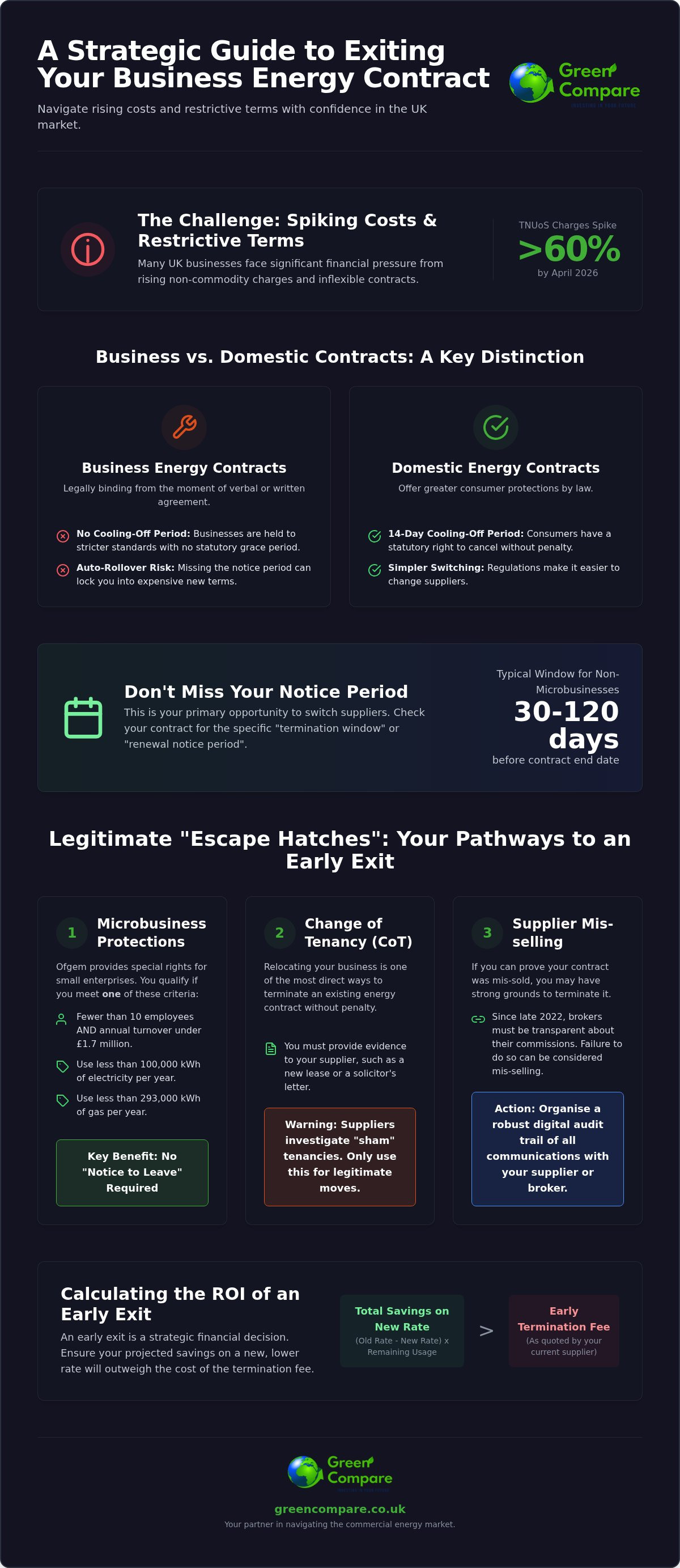
Commercial energy agreements are fundamentally different from the domestic deals you use at home. Whilst a residential consumer enjoys a statutory 14-day cooling-off period, businesses are expected to be more sophisticated and are held to stricter standards. Once you agree to a business energy deal, whether through a signed document or a recorded verbal agreement, you are legally bound to its terms immediately. This lack of a safety net is often why leaders search for how to get out of a business energy contract early UK wide, especially when market volatility makes a previous deal look unfavourable.
Fixed-term contracts provide price stability, but they also lock your capital into a specific rate for a set duration. This structure is influenced by broader market mechanisms like Contracts for Difference, which help manage price volatility in the wholesale market. If your business faces high rates or is forced to close, you cannot simply walk away without facing consequences. You must navigate the specific legal framework of your agreement to avoid fees that can damage your cash flow.
The "No Cooling-Off" Rule Explained
In the UK, business energy law dictates that a contract becomes a binding legal obligation the moment you confirm your acceptance. There is no grace period to change your mind after the fact. This applies equally to fixed-term contracts, where you agree to a set price and end date, and "deemed" rates, which occur when you move into new premises without a prior agreement. Under UK commercial energy law in 2026, every business energy contract is a legally enforceable commitment from the point of verbal or written confirmation.
The Importance of the Notice Period
Your strategy for how to get out of a business energy contract early UK must revolve around your notice period. For non-microbusinesses, this window typically spans between 30 and 120 days before the contract end date. Missing this narrow timeframe can trigger an automatic rollover or move you onto expensive out-of-contract rates. These rates are often significantly higher than negotiated prices, draining your monthly budget. To find your specific requirements, scan your contract for terms like "termination window" or "renewal notice period." Check your latest bill or contact your supplier directly to request your exact end date and notice window in writing. Act now to ensure you remain in control of your transition.
Legitimate "Escape Hatches": How to Exit Without Hefty Penalties
Escaping a rigid agreement requires a tactical approach. You don't have to accept high fees as an inevitability. There are three primary legal pathways to explore when considering how to get out of a business energy contract early UK wide. These include leveraging your status as a microbusiness, executing a legitimate change of tenancy, or identifying instances of supplier mis-selling. Each route offers a specific set of protections designed to keep the commercial energy market fair and competitive.
Microbusiness Protections and Ofgem Rights
In 2026, Ofgem remains a powerful ally for smaller enterprises. You qualify as a microbusiness if you employ fewer than 10 people and have an annual turnover under £1.7 million. Alternatively, using less than 100,000 kWh of electricity or 293,000 kWh of gas per year grants you this status. Under regulations solidified in October 2022, suppliers cannot require a "notice to leave" from microbusinesses. This removes a significant administrative hurdle. Your supplier must also provide clear termination information on every bill. This transparency ensures you always know your exact window for professional advancement to a better deal.
The Change of Tenancy (CoT) Loophole
Moving premises is one of the most straightforward ways to terminate an agreement without penalty. When your business relocates, the existing contract for that site typically ends. You must provide evidence to your supplier, such as a new lease agreement or a solicitor’s letter confirming the move date. Be cautious here. Attempting a "sham" tenancy, where you pretend to move to avoid fees, is a high-risk strategy. Suppliers investigate these claims thoroughly. If caught, you may face legal action and back-dated charges. Stick to legitimate relocations to ensure a smooth transition and rapid progress toward your new goals.
If you suspect your contract was mis-sold, you have further grounds for exit. Since late 2022, brokers must be transparent about their commissions for microbusiness deals. If your provider failed to disclose these costs or used aggressive sales tactics, you can challenge the contract's validity. You deserve a partner who values transparency as much as you do. To see if a better rate justifies your current exit strategy, organise a rapid comparison with an expert who understands the 2026 market landscape. Reclaiming control of your overheads starts with knowing your rights and acting with speed.
Calculating the ROI of an Early Termination Fee
Deciding how to get out of a business energy contract early UK wide is a numbers game. You shouldn't view a termination fee as a dead end, but rather as a hurdle to a more profitable future. To start this process, contact your supplier and request a formal "Early Termination Quote." This document is essential because it moves you from guesswork to concrete data. It outlines the precise cost of your exit, allowing you to weigh that expense against the potential savings of a more competitive 2026 tariff.
Your buyout fee isn't a random figure. It typically comprises the supplier's "lost profit" on the unit rates you committed to and the remaining standing charges for the duration of the term. By understanding these components, you can identify if your provider is being transparent or if there's room to challenge the calculation. Focus on the net result. If a new deal saves you more over twelve months than the cost of the exit fee, staying on your current high-tariff deal is actually the more expensive choice.
Analysing the Termination Fee Structure
Termination fees generally fall into two categories: a flat fee per meter or a percentage of the remaining contract value. In the current market, these percentages often range between 5% and 15% of your estimated energy costs for the rest of the term. Suppliers justify these charges by claiming they have already purchased the energy for your business in advance. To verify the legitimacy of your exit charge, ensure the supplier defines it as "liquidated damages," which represents a genuine pre-estimate of their loss rather than a punitive penalty.
The Comparison Framework: Stay vs. Go
Use a simple three-step logic to determine if you should make the move. This objective approach removes the stress from the decision and highlights the fastest path to growth.
- Step 1: Calculate your total projected spend until the end of your current contract. Multiply your average monthly bill by the months remaining.
- Step 2: Obtain a new quote for 2026 and calculate the cost for that same period, then add the early termination fee.
- Step 3: Identify your break-even point. If the combined cost of the new deal and the exit fee is lower than your current projected spend, you have a clear financial mandate to switch.
Don't ignore the opportunity cost of inaction. Every month you remain on an inflated rate is capital that could be reinvested into your business's advancement. The UK energy market moves fast. Securing a lower rate now protects your margins against future volatility and rising non-commodity costs like TNUoS charges. Reclaiming your financial freedom is a proactive step that positions your business as a leader in efficiency and sustainability.
Step-by-Step Guide to Negotiating and Serving Notice
Executing your exit requires precision. It's not just about saying goodbye; it's about building an unshakeable audit trail. When you're figuring out how to get out of a business energy contract early UK wide, your documentation is your shield. Send every piece of correspondence via Recorded Delivery. This provides a timestamped receipt that prevents suppliers from claiming they never received your notice. Digital audit trails are equally vital, so CC your internal finance team on every email to ensure multiple records exist.
Drafting the Perfect Termination Notice
Your letter must be concise and data-rich. Include your account number, the specific MPAN (Meter Point Administration Number) for electricity, or MPRN (Meter Point Reference Number) for gas. Explicitly state your desired end date and confirm you are not granting permission for an auto-rollover. This clarity removes any ambiguity that a supplier might use to extend your term. Organise these copies in a dedicated folder to ensure you have rapid access if a dispute arises. To ensure you aren't moving from one restrictive deal to another, compare the latest business electricity and gas rates before you sign anything new.
Negotiating the Exit Fee
Don't treat the first exit quote as final. Use live market data to demonstrate that your current tariff is significantly above the 2026 average. If you have a flawless record as a "good payer," use this history as leverage to request a reduction in penalties. Acknowledge that while you're seeking a more cost-effective partner, you value a professional and swift conclusion. If the supplier remains inflexible or the fee feels punitive, inform them you are prepared to involve the Energy Ombudsman. This often encourages a more pragmatic settlement and moves the process forward with speed.
Be prepared for supplier "retention" calls. These departments are trained to keep you on the books with "blend and extend" offers that may look attractive but rarely offer the best market value. Stay focused on your goal of long-term freedom and lower overheads. On your final day, take clear photographs of your meters. Submit these readings immediately to ensure your final bill is accurate and doesn't include estimated charges that could stall your professional advancement. Reclaiming your energy independence is a simple, linear process when you follow these steps.
Secure Your Next Contract with Green Compare
Timing is the most critical factor in your transition. Once you've successfully navigated how to get out of a business energy contract early UK, you must secure a new agreement immediately. If you fail to align your new start date with your exit, your current supplier will move you onto "deemed rates." These out-of-contract tariffs are notoriously expensive, often costing double the market average. We eliminate this risk by synchronising your switch with expert precision.
Our platform organises the 2026 energy market to provide a clear, linear path to savings. We don't just provide data; we provide a strategy for professional advancement. By positioning your business on a more cost-effective tariff, we help you reclaim the capital lost to high overheads. This isn't just about a one-time switch. It's about ongoing utility management that protects your bottom line against future market volatility and rising non-commodity costs.
Rapid Market Comparison for Immediate Savings
Speed is our signature. We understand that your time is your most valuable asset. Our comparison engine accesses exclusive commercial rates that are often hidden from the open market. This allows you to find a deal that justifies your exit fee in minutes, not days. We handle the heavy lifting of procurement, reducing a complex financial procedure into a few simple, actionable steps. Use our expertise to move from a trapped position to a saved one with total confidence.
Compare business energy prices and start saving today
A Partnership for Long-Term Growth
We are a visionary ally invested in your collective progress. Our role extends beyond utility management into the broader landscape of commercial finance. If your exit strategy requires a capital injection to cover termination fees or invest in greener infrastructure, we provide tailored business loans to fuel your journey. We believe in collaborative growth, offering the reassurance and optimism you need to thrive in a challenging economic climate.
Our support doesn't end when your new contract begins. We monitor the market on your behalf, alerting you to the next optimal switching window well in advance. This proactive stance ensures you never fall back into the trap of an auto-rollover. Partner with a guide who values your time, respects your budget, and is dedicated to your long-term success.
Explore our business loan options to fuel your progress
Reclaim Your Commercial Agility Today
Reclaiming your business's financial freedom is about more than just numbers; it's about positioning your firm for sustainable growth in a volatile 2026 market. You now have the blueprint for how to get out of a business energy contract early UK, from identifying microbusiness protections to calculating the precise ROI of a termination fee. Remember that an exit charge is often a strategic investment that pays for itself through significantly lower monthly overheads.
We are here to ensure your transition is rapid and rewarding. Our experts are 100% focused on UK commercial growth, offering the professional guidance needed to navigate complex supplier negotiations with total confidence. You can compare 20+ UK suppliers instantly to find a more cost-effective path for your business electricity and gas. We move at the speed of your ambition, helping you turn administrative hurdles into opportunities for advancement.
Find a cheaper business energy deal in minutes and take the first step toward a leaner, more resilient future. Your business deserves a partner that values your time and shares your vision for progress. Let's start your next chapter today.
Frequently Asked Questions
Can I cancel my business energy contract if the rates have gone down?
You can cancel your agreement, but you will almost certainly face an early termination fee. Business energy contracts are legally binding for the full term to protect the supplier's wholesale purchase. If you find a significantly lower rate elsewhere, you must calculate if the long-term savings outweigh the cost of the buyout. This calculation is a vital part of how to get out of a business energy contract early UK wide when market prices drop.
How much are typical early termination fees for UK businesses?
Typical early termination fees range between 5% and 15% of your estimated energy spend for the remaining contract duration. This figure usually reflects the supplier's lost profit and the costs they incurred when purchasing your energy in advance. Always request a formal quote to see the exact breakdown. Some suppliers may also include a market rate fee if wholesale prices have fallen significantly since you signed your original agreement.
What is a "Letter of Authority" and do I need one to switch?
A Letter of Authority is a legal document that allows a broker or consultant to speak to suppliers on your behalf. You need one if you want a partner to gather your contract data, handle termination notices, or negotiate new rates. It doesn't give them the power to sign contracts without your final approval. It simply streamlines the administrative process and saves you hours of tedious phone calls and emails.
Does a Change of Tenancy always mean I can end my contract?
A Change of Tenancy usually allows you to end a contract, provided you are genuinely vacating the premises. You must provide evidence such as a new lease or a solicitor's letter confirming the move date. Suppliers verify these details rigorously to prevent businesses from using "sham" tenancies to avoid fees. If you are legitimately moving, it remains one of the most effective and straightforward ways to exit a deal early.
What happens if I just stop paying my business energy bill?
Stopping payments is never a viable exit strategy and will lead to severe financial consequences. Your supplier will likely report the default to credit agencies, damaging your business's ability to secure future funding or loans. They may also initiate disconnection procedures or take legal action to recover the debt plus interest. Always seek a negotiated settlement or a "blend and extend" option instead of defaulting on your legal obligations.
Is there a difference in exit rules between business gas and electricity?
Exit rules are broadly similar for both gas and electricity, but the underlying bill components differ. Electricity bills are seeing a 60% increase in TNUoS charges in 2026, which can make the standing charge portion of an exit fee higher. Gas contracts are often simpler but still require the same formal notice periods. Both utilities require a strategic approach to avoid expensive out-of-contract rates that can drain your monthly capital.
Can my supplier refuse to let me leave early?
Yes, a supplier can refuse to let you leave if you are still within a fixed-term period and haven't paid the required termination fee. They can also block a switch if you have outstanding debt on your account. If you follow the correct notice period and settle all final costs, they cannot legally prevent you from moving. Reclaiming your freedom requires following the specific how to get out of a business energy contract early UK guidelines correctly.
How do I know if I am classified as a microbusiness in 2026?
In 2026, you are a microbusiness if you employ fewer than 10 people and have an annual turnover under £1.7 million. You also qualify if you use less than 100,000 kWh of electricity or 293,000 kWh of gas annually. This classification is vital because it grants you specific Ofgem protections. These include the right to see termination dates on every bill and exemption from certain restrictive notice period requirements that apply to larger firms.