Mastering Business Utility Management: A Strategic Guide for UK Enterprises in 2026

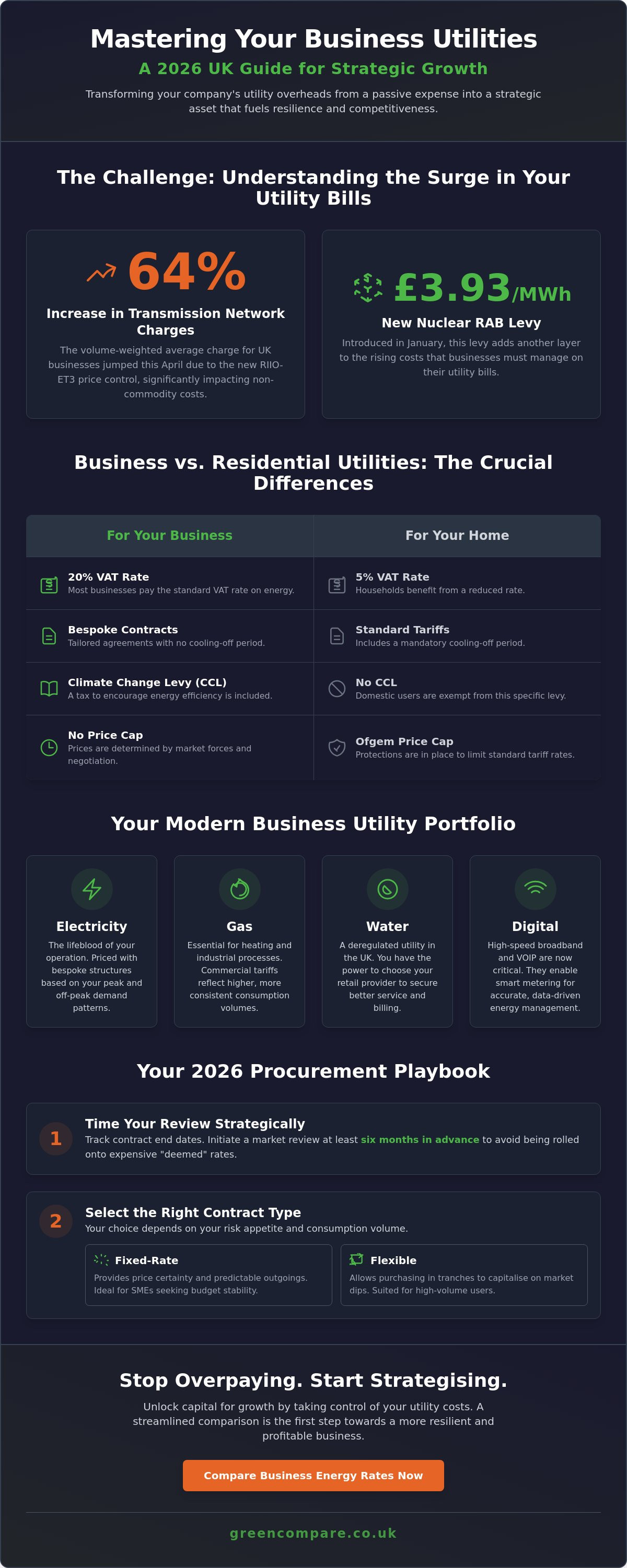
Did you know that the volume-weighted average transmission network charge for UK businesses jumped by 64% this April? With the RIIO-ET3 price control now in effect, your next utility bill likely reflects a sharp increase in non-commodity costs; this includes the Nuclear RAB levy which rose to £3.93/MWh in January. It's a frustrating reality for enterprises trying to protect profit margins whilst navigating complex commercial regulations.
You're likely tired of seeing overheads climb while you're busy trying to scale your operations. We understand that time is your most valuable resource, and comparing dozens of suppliers is a luxury you simply don't have. This guide will show you how to transform your business utilities from a passive expense into a strategic asset that fuels growth. We'll break down the 2026 regulatory shifts, simplify the procurement process, and align your energy strategy with modern sustainability goals to ensure your business remains resilient and competitive.
Key Takeaways
- Conduct a systematic utility audit to identify consumption leaks and ensure your commercial energy contracts are fully optimised for the 2026 market.
- Navigate the complexities of commercial regulations by understanding how VAT, CCL, and business-specific terms differ from residential energy setups.
- Unlock capital for growth by transforming overhead savings into reinvestment opportunities, supported by strategic business loans.
- Accelerate your procurement journey using streamlined comparison methods that prioritise your time and support the UK’s transition to renewable energy.
Defining Business Utility: More Than Just Gas and Electricity
Business utility management is about more than just keeping the lights on. It represents the foundational services your company needs to function, from the energy powering your production lines to the water in your staff room. While a public utility provides the basic infrastructure, a commercial contract is a bespoke financial agreement tailored to your specific consumption profile. Treating these services as a Key Performance Indicator (KPI) called "utility efficiency" allows you to track waste and identify areas for cost recovery.
You cannot simply use a domestic tariff for your business premises. Energy suppliers view commercial users as higher volume and higher risk, requiring different legal terms and credit checks. Unlike residential accounts, business contracts rarely include a cooling-off period. You're also subject to different tax rates; most businesses pay 20% VAT on energy, compared to just 5% for households. Understanding these distinctions is the first step toward taking control of your overheads.
The Core Components: Gas, Electricity, and Water
Business electricity and gas form the bulk of your operational overheads. Because your usage patterns differ significantly from a household, suppliers offer bespoke pricing structures based on peak and off-peak demand. In the UK, water is also a deregulated business utility. This means you can choose your retail provider, giving you the power to negotiate better service levels and consolidated billing across multiple sites. Bespoke pricing ensures you aren't subsidising smaller users with your higher consumption volumes.
Efficient gas usage isn't just about the tariff; it's about the infrastructure. To ensure your systems are performing optimally, you can explore Boiler Repair & Installation with Plumbing & Boilers London to minimise waste and lower your bills.
The Shift Toward Digital Utilities
Modern operations rely on digital connectivity as much as physical energy. High-speed broadband and VOIP systems are now essential utilities for any competitive enterprise. These digital tools don't just facilitate communication; they enable real-time monitoring of your energy consumption. Smart meters require robust digital infrastructure to send accurate data to your supplier. This ensures your bills reflect actual usage rather than estimates, preventing cash flow surprises at the end of the quarter.
Understanding Regulatory Frameworks
Ofgem regulates the market to ensure fair treatment for business consumers, though protections differ from the domestic sector. Most commercial bills include the Climate Change Levy (CCL), a tax designed to encourage energy efficiency and reduce carbon emissions. The Energy Ombudsman serves as the primary dispute resolution body for businesses that cannot resolve complaints directly with their supplier. Staying informed about these regulations helps you maintain compliance whilst protecting your bottom line.
Navigating the UK Commercial Energy Market in 2026
The 2026 energy landscape is defined by a shift from commodity price focus to non-commodity cost management. Network charges, specifically Transmission Network Use of System (TNUoS) fees, saw a volume-weighted average rise of 64% this April. These infrastructure investments, whilst necessary for a modern grid, mean your utility strategy must be more sophisticated than simply chasing the lowest unit rate. Guidance from the UK's energy regulator confirms that because there's no business price cap, the onus is on you to negotiate.
Effective procurement starts with timing. If you allow your current contract to lapse, you'll likely face "deemed" rates. These are often the most expensive tariffs a supplier offers. Avoid this trap by tracking your contract end dates and initiating a market review at least six months in advance. You can quickly compare business electricity rates to see if a better deal is available before your window of opportunity closes. Proactive planning ensures you aren't forced into a sub-optimal agreement during a period of market volatility.
Fixed vs. Flexible Energy Contracts
Choosing between a fixed or flexible contract depends on your company's appetite for risk and its total consumption volume. Most UK enterprises prefer fixed-rate contracts because they provide price certainty for the duration of the term, usually one to three years. This protects your budget from sudden wholesale market spikes. However, high-volume users might consider flexible procurement, which allows you to purchase energy in "tranches" throughout the year to capitalise on market dips.
- Fixed-Rate: Ideal for SMEs needing predictable monthly outgoings and simple accounting.
- Flexible: Suited for large-scale operations with the capacity to monitor market trends and trade energy.
The Role of Green Energy in 2026
Renewable energy now accounts for over half of the UK's total electricity generation. This shift has made REGO-backed (Renewable Energy Guarantees of Origin) contracts more accessible and competitively priced. Transitioning to 100% renewable power isn't just an ethical choice; it's a strategic brand move. Many corporate supply chains now require partners to demonstrate clear sustainability commitments. Aligning your procurement with these green targets can open doors to new contracts and improve your overall utility efficiency by reducing your carbon footprint.
The Intersection of Energy and Finance: Maximising Operational Utility
Think of your monthly utility spend as more than just a cost centre; it's a lever for growth. When you reduce what you pay for business electricity or gas, you're essentially creating a new stream of internal funding. At Green Compare, we view business loans as a "financial utility" in their own right. They provide the necessary flow of capital to scale operations, much like electricity powers your machinery. This synergy between energy procurement and capital access is the secret to modern commercial resilience.
Funding Energy Efficiency Projects
Investing in energy-efficient hardware creates a virtuous cycle of savings. High-performance LED lighting or solar panel installations significantly lower your unit consumption, but the upfront costs can be substantial. This is where business loans become vital. By using external finance to fund these upgrades, you preserve your working capital whilst securing long-term reductions in your overheads. Reducing your base consumption also makes your business a more attractive prospect for lenders, potentially improving your credit profile through enhanced financial stability.
Managing Cash Flow Through Utility Optimisation
Predictability is the foundation of sound financial planning. Inconsistent billing can cause "bill shock," disrupting your cash flow at critical moments. Ensure your business uses accurate smart meter data to maintain a clear view of your outgoings. Many suppliers offer discounts for paying via direct debit, which further streamlines your monthly administration. Consistent costs allow for more reliable financial forecasting, giving you the confidence to commit to growth-focused investments without fear of unexpected spikes in your monthly utility bills.
Strategic Reinvestment of Savings
Consider the impact of a modest saving. If a medium-sized enterprise saves £5,000 annually by switching their business gas and electricity, that capital can be immediately diverted into a high-impact marketing campaign. This creates a multiplier effect where reducing a fixed overhead directly funds revenue generation. It transforms a mundane administrative task into a strategic win for the entire organisation. "Every pound saved on utilities is a pound that can be used to innovate."
How to Organise a Comprehensive Business Utility Audit
A utility audit is a systematic review of your company's consumption patterns and expenditure. It's the most reliable way to identify where your money is going and where it's being wasted. We recommend performing this audit annually or, at the very least, six months before any contract renewal. Data accuracy is paramount here. Relying on estimated bills is a risk you can't afford to take. Leverage smart technology to automate your tracking; it provides the granular insight needed to make informed strategic decisions. Modern smart meters remove the guesswork, allowing you to see your utility usage in real-time and adjust your operations accordingly.
Step-by-Step Audit Framework
Start by gathering the last 12 months of bills for every premises you operate. This provides a complete picture of your seasonal demand and helps you spot long-term trends. Once you have the data, look for anomalies. Are there spikes in usage during hours when the building is empty? Identifying these wastage points, such as machinery left on standby or unnecessary overnight heating, is the quickest way to lower your overheads. Next, benchmark your current unit rates and standing charges against the 2026 market rates. Finally, read your contract terms carefully. Look for hidden clauses or exit fees that might hinder your ability to switch suppliers when the time comes.
Identifying Opportunities for Improvement
Your audit will likely reveal immediate wins. Check if any of your meters have slipped onto "out of contract" rates. These default tariffs are often 50% higher than negotiated prices and can drain your cash flow in weeks. You should also investigate your eligibility for Climate Change Levy (CCL) exemptions. If your business belongs to an energy-intensive sector or you've moved to renewable sources, you could be overpaying on your tax obligations. Finally, evaluate the feasibility of onsite generation. Reducing your grid dependency through solar or wind is a long-term play for total utility independence.
Knowledge is power, but only if you act on it. Use your audit findings to secure a better deal for your enterprise. You can compare business gas and electricity now to see exactly how much your audit could save you in the current market.
Partnering for Progress: Streamlining Your Utility Procurement
Managing your utility portfolio shouldn't be a source of constant stress. It's time to move away from the administrative burden of traditional brokerage and embrace a partnership built on transparency and shared progress. Green Compare acts as your efficient, expert guide, ensuring your procurement strategy aligns with your long-term growth objectives. We don't just provide a comparison platform; we provide a pathway to professional advancement. Our role is to simplify the complex financial procedures of the energy market, allowing you to focus on what you do best: running your business.
We believe in regional pragmatism mixed with modern entrepreneurial energy. This means we value your time above all else and provide solutions that work in the real world. By positioning ourselves as a proactive partner, we aim to alleviate the pressure of rising overheads. Our service is designed to be human, accessible, and ready to assist at every stage of your journey. We don't just find you a contract; we help you build a more resilient and ethically conscious enterprise for the years ahead.
The Green Compare Advantage
We offer access to an extensive panel of commercial gas and electricity suppliers, tailored specifically for the 2026 UK market. Our expertise spans both the essential energy needs of your premises and the strategic financial solutions required for expansion. By integrating utility procurement with business loans, we help you advance through cost-effective choices that strengthen your balance sheet. This dual focus ensures your fixed overheads remain low whilst your capital access remains high. Our commitment to reliability means you can trust the data and the process every step of the way, avoiding the cold, clinical feel of traditional brokerage in favour of a supportive, visionary stance.
Next Steps to Optimise Your Business
Starting your journey toward better efficiency is simple and fast. Our streamlined platform matches the pace of your modern business, allowing you to move from a problem to a solution without unnecessary filler. You can complete a full market comparison in just 60 seconds, a precise time-saving metric that serves as our signature of efficiency. This creates immediate momentum, helping you make rapid progress toward your cost-reduction goals.
The process is linear and stress-free. You only need a recent bill and a few basic details about your premises to start the comparison. There's no need for hours of manual research or confusing jargon. We provide the clarity you need to make an informed decision quickly. Don't let rising costs dictate your future. Take control of your overheads and reinvest those savings into your company's success. Organise your business utilities today with Green Compare.
Secure Your Commercial Future in 2026
Mastering your utility strategy is no longer a back-office chore; it's a vital component of your company's financial health. By conducting regular audits and embracing smart technology, you eliminate wastage and protect your cash flow from market volatility. Remember that every pound saved on your energy bills is capital that can be reinvested into your team, your technology, or your next big expansion. This strategic approach ensures your business remains resilient whilst others struggle with rising overheads.
Green Compare has been a trusted partner for thousands of UK SMEs since 2019. We provide expert support that spans both energy procurement and business finance, helping you navigate the 2026 landscape with total confidence. You could save up to 45% on your commercial energy contracts by switching today. Our fast-paced platform moves at the speed of your business, delivering results in seconds so you can get back to what matters most.
Don't let rising costs hold your enterprise back. Take the first step toward a more efficient, sustainable, and profitable operation. Compare Business Gas and Electricity Rates Now and join a community of forward-thinking leaders who are powering the UK's collective progress.
Frequently Asked Questions
What is the difference between a business utility and a domestic one?
Business utility contracts differ from domestic ones primarily through their bespoke pricing and tax implications. Commercial users pay 20% VAT and are subject to the Climate Change Levy, whereas households pay 5% VAT. Additionally, business agreements are legally binding without a cooling-off period; this means you must commit to the full term once the contract is signed.
How much can a UK business save by switching energy suppliers in 2026?
UK businesses can often reduce their energy expenditure by up to 45% by switching to a more competitive tariff. The exact amount depends on your consumption profile and how long you've been on a "deemed" or out-of-contract rate. Proactive management ensures you aren't paying a premium for loyalty during periods of market fluctuation.
Is it possible to switch business utility providers whilst mid-contract?
You cannot usually switch providers mid-contract without paying substantial exit fees. However, you can secure a new contract up to six months before your current one expires. This allows you to lock in 2026 rates early; it protects your business from future price hikes while ensuring a seamless transition when your current term ends.
How do I find out who my current business energy supplier is?
You can identify your electricity supplier by contacting the Meter Point Administration Service (MPAS) or checking your most recent bill. For gas, use the "Find My Supplier" online tool provided by Xoserve. Having your Meter Point Administration Number (MPAN) or Meter Point Reference Number (MPRN) ready will help you get this information quickly.
What are the benefits of using a utility comparison site for businesses?
Using a comparison site provides immediate access to a wide panel of suppliers without the need for manual research. It ensures transparency by allowing you to compare unit rates and standing charges side-by-side. This streamlined approach saves you hours of administrative work, moving your enterprise from a problem to a solution in minutes.
Can I get a business loan to help pay for energy-efficient upgrades?
Yes, you can utilise business loans to fund energy-efficient upgrades like solar panels or LED lighting. We view these loans as a strategic financial tool that facilitates long-term overhead reduction. Financing these projects allows you to preserve your working capital whilst lowering your base energy consumption and improving your company's carbon footprint.
What is the Climate Change Levy (CCL) and does my business have to pay it?
The Climate Change Levy is a government tax on commercial energy usage designed to encourage efficiency. Most businesses must pay this on their electricity and gas bills unless they are small enough to qualify for "de minimis" status. Certain energy-intensive industries may also be eligible for discounts through specific Climate Change Agreements.
How long does the process of switching business utilities actually take?
The physical switch between providers typically takes about five working days once your new contract is confirmed. However, the actual start date depends on when your current agreement ends. Your new supplier will handle the transfer process, so there's no risk of your utility supply being interrupted during the transition period.