How to Reduce Business Overhead Costs in the UK: A 2026 Strategic Guide

What if the most effective way to fuel your 2026 expansion isn't by chasing new leads, but by reclaiming the capital currently leaking through your monthly bills? You've likely felt the squeeze of rising commercial energy prices and the persistent weight of the 3.75% base rate on your debt repayments. It's frustrating to watch hard-earned revenue vanish into administrative black holes or inflated utility contracts whilst you're trying to scale.
We understand that as a business leader, you're often time-poor and burdened by complex financial procedures. The good news is that modern efficiency is a high-speed pursuit. You can reduce business overhead costs uk by rapidly identifying hidden waste and converting those savings into a powerful engine for sustainable growth. This strategic guide provides a clear, linear path to slashing unnecessary expenses without impacting your service quality or headcount.
In the following sections, we'll show you how to audit your commercial gas and electricity contracts, restructure business loans for better cash flow, and use automation to simplify your daily admin. It's time to stop overpaying for the basics and start reinvesting in your company's future. Follow these steps to build a leaner, more resilient business today.
Key Takeaways
- Identify the critical difference between fixed and variable non-labour expenses to pinpoint exactly where your capital is leaking.
- Master the "Comparison Effect" and discover how a 10-minute audit of your commercial utilities can reduce business overhead costs uk.
- Eradicate "silent" administrative bloat by implementing automation for routine tasks, freeing your team for high-value growth activities.
- Reframe your approach to debt by using unsecured business loans as a strategic lever to fund efficiency upgrades and secure long-term liquidity.
- Adopt a visionary partnership model that turns mundane utility management into a powerful driver for sustainable success and collective progress.
Understanding Business Overheads in the 2026 UK Economy
Operating a successful SME in 2026 requires a precise understanding of your financial engine. At its core, Understanding Business Overheads means categorising every non-labour expense required to maintain your daily operations. These are the costs that exist regardless of your output, from the lights in your office to the insurance protecting your fleet. In today's market, passive management is a luxury you can't afford. It's a direct threat to your sustainability. You need to track your Overhead Ratio as a primary KPI. By measuring these expenses against your net sales, you gain a clear view of your operational efficiency. Aim for a ratio that allows for reinvestment. If your overheads are climbing faster than your revenue, it's time to act.
Fixed vs Variable Overheads: Where to Target First
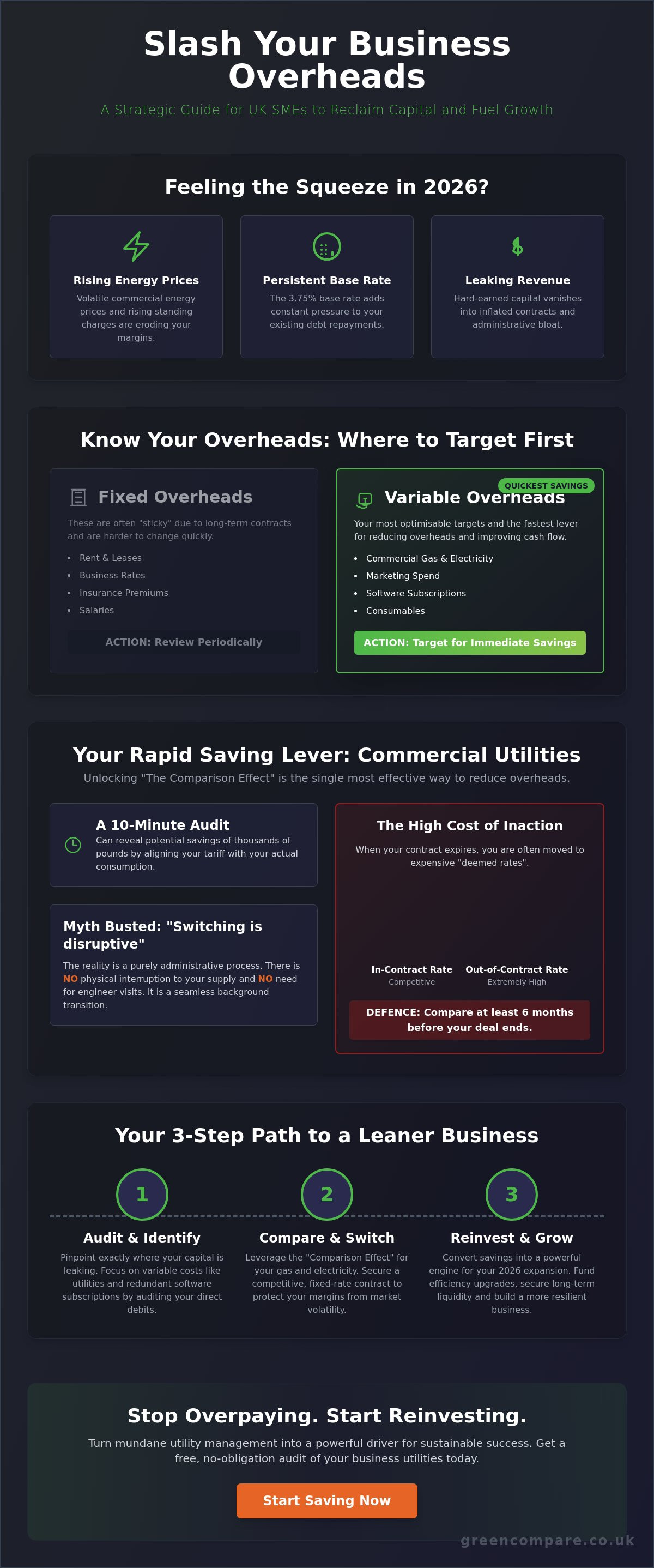
Effective cost reduction starts with categorisation. Fixed overheads like rent and business rates are often sticky because they're tied to long-term contracts. While you should review these periodically, they aren't your fastest levers for change. To reduce business overhead costs uk quickly, focus on your variable expenses. Utilities, marketing spend, and consumables are your most optimisable targets. For instance, commercial gas and electricity contracts can often be renegotiated to better reflect current market dips. Beyond the obvious, look for hidden overheads. Redundant software subscriptions or overlapping digital services act as a silent drain on profitability. Audit your direct debits today. If a tool isn't actively driving your business forward, cut it.
The Impact of Inflation and Utility Volatility on Margins
The 2026 energy market demands constant vigilance. While the extreme spikes of the early 2020s have subsided, volatility remains a core characteristic of the UK energy sector. One major shift involves standing charges. These daily fees have risen, meaning even energy-efficient businesses face higher baseline costs. Adopting a set and forget approach is a significant financial risk. When a contract expires, suppliers frequently move businesses onto out-of-contract or deemed rates. These are some of the most expensive tariffs available. Proactive renewal is your best defence. Start comparing options at least six months before your current deal ends. This ensures you secure a competitive rate that protects your margins from future fluctuations. We're here to guide you through this process, turning a complex administrative task into a streamlined victory for your bottom line.
Auditing Your Commercial Utilities: The Rapid Saving Lever
Commercial gas and electricity represent the most optimisable expenses in your ledger. Unlike rent or long-term lease agreements, these costs are highly fluid and ripe for immediate adjustment. When you look to reduce business overheads, utilities should be your first port of call. We call this the "Comparison Effect". A simple 10-minute audit can often reveal potential savings of thousands of pounds by aligning your tariff with your actual consumption. By leveraging real-time data from smart meters, you can identify precisely where energy is being wasted during out-of-hours periods. This isn't just about finding a cheaper rate; it's about understanding your consumption patterns to drive down the total volume used.
Many business owners hesitate to switch because they fear operational downtime. Let's be clear: switching suppliers is a purely administrative process. There is no physical interruption to your supply and no need for engineers to visit your premises. It's a seamless transition that happens in the background while you focus on growth. To reduce business overhead costs uk effectively, you must treat utility procurement as a strategic priority rather than a chore. Proactive management ensures you never pay more than necessary for the power that fuels your progress.
Business Gas and Electricity Procurement Strategies
Choosing the right contract structure is vital for long-term stability. Fixed-rate contracts offer price certainty, which is invaluable for budgeting in the 2026 market. Flexible contracts allow you to purchase energy in tranches, potentially benefiting from market dips, while pass-through contracts separate the wholesale energy cost from third-party charges. You must monitor your "renewal window" closely. If you miss this period, your current provider will likely move you onto "deemed rates". These are significantly higher than negotiated tariffs. When comparing quotes, look beyond the unit price per kWh. Examine the standing charges and any hidden fees to ensure you're getting the best total value for your specific usage profile.
Green Energy: Aligning Sustainability with Cost Reduction
The shift toward renewable energy is no longer just an ethical choice; it's a financial one. Switching to a green tariff can provide significant brand value, appealing to the modern, eco-conscious UK consumer who values environmental responsibility. Many providers now offer competitive rates for renewable energy that rival traditional fossil fuel options. Additionally, investing in energy-efficient infrastructure can lead to substantial long-term savings and potential tax incentives. By aligning your overhead reduction with sustainability, you position your brand as a forward-thinking leader in your sector. If you're ready to see how much your business could reclaim, a quick commercial utility audit is the most efficient way to start your journey toward a leaner, greener future.
Operational Efficiency: Technology and Resource Optimisation
Administrative bloat is a silent drain on your profitability. It's often invisible until you look at the cumulative hours lost to manual data entry and fragmented processes. To reduce business overhead costs uk, you must transition from manual workflows to automated systems. This isn't about replacing talent. It's about liberating your team from the mundane. By reclaiming time spent on repetitive tasks, you empower your staff to focus on high-value activities that actually drive revenue.
Moving from Capital Expenditure (CapEx) to Operational Expenditure (OpEx) is a strategic shift for 2026. "As-a-Service" models like SaaS for software and HaaS (Hardware-as-a-Service) for equipment allow you to access premium tools without the heavy upfront price tag. This preserves your liquidity. It ensures your cash flow remains agile for expansion rather than being tied up in depreciating assets. You pay for what you use, making your overheads far more predictable and scalable.
Consider the remote versus office debate through a purely financial lens. Maintaining a physical headquarters involves rent, business rates, and the utility costs we analysed in the previous section. If your operations allow for a hybrid or remote model, the savings on square footage can be significant. These funds can then be redirected into your core growth strategies or used to bolster your cash reserves. Efficiency isn't just about spending less; it's about spending smarter.
Automating Administrative Burdens
Focus your automation efforts on three key areas: CRM management, accounting, and customer support. By implementing smart invoicing and payroll systems, many UK SMEs reclaim upwards of 12 hours of administrative time every single week. This is a massive efficiency gain that directly impacts your bottom line. Beyond time, automation virtually eliminates human error. Mistakes in data entry or billing are costly to fix and damaging to client trust. Removing these risks is a direct saving that protects both your capital and your reputation.
Supply Chain and Procurement Rationalisation
Fragmented procurement leads to higher unit costs and complex admin. Consolidate your suppliers to increase your bargaining power. By offering more volume to fewer partners, you can negotiate better terms and loyalty discounts. You should also evaluate your inventory model. Moving from a "Just-in-Case" approach, where capital is locked in stock, to a "Just-in-Time" model reduces storage costs and improves cash flow. Schedule a review with your top five vendors this month. Ask for a loyalty discount based on your consistent payment history and future volume commitments. It's a simple, proactive conversation that often yields immediate results for your annual budget.
Financial Restructuring: Using Loans to Lower Long-Term Costs
Stop viewing all debt as a burden. High-interest liabilities are often a primary driver of inflated monthly outgoings. By using smart finance, you can reduce business overhead costs uk and streamline your balance sheet simultaneously. Think of a commercial loan not as a weight, but as a strategic lever. It provides the immediate liquidity needed to remove more expensive, fragmented debt or to fund infrastructure that lowers your long-term bills. In the 2026 economy, the fastest way to grow is often to refinance the past to protect your future.
The current Bank of England base rate of 3.75% provides a benchmark for your borrowing. If you're still paying rates significantly above this on older credit lines, you're overpaying for your capital. Refinancing these obligations into a single, structured facility can drastically lower your monthly interest expense. This isn't just about the numbers; it's about reclaiming the mental and administrative space required to manage multiple creditors. It turns a complex web of repayments into a single, predictable line item in your budget.
Debt Consolidation for Improved Cash Flow
Identify the warning signs of expensive debt early. High interest rates, varying payment dates, and multiple creditors are clear indicators that your finance is unoptimised. Managing several different lenders takes hours of administrative time every month. Consolidate these liabilities into a single unsecured business loan. You'll likely secure a more competitive overall rate and a single monthly repayment. This move simplifies your financial management and immediately improves your monthly cash position. It's a clean, linear step toward a more manageable overhead structure.
Accessing Capital for Efficiency Investments
Modern lending moves at the speed of your business. Unsecured business loans can often be approved and funded within days, providing the capital you need for efficiency upgrades. Use these funds to invest in energy-efficient machinery or sustainable infrastructure. Installing solar panels or upgrading to air-source heat pumps can drastically cut your reliance on the grid. While the initial cost is a barrier, the long-term reduction in your unit price per kWh makes the finance effectively self-funding.
You aren't just paying off a loan; you're buying your future energy at a significant discount. This "Green Loan" approach turns a monthly repayment into a permanent saving on your utility bills. It aligns your financial strategy with environmental responsibility, a key value for the modern UK consumer. If you're ready to restructure your liabilities and fuel your expansion, explore our tailored business loan options to find a solution that fits your specific growth plan.
The Green Compare Approach: Streamlining Your Path to Profitability
We don't see ourselves as a mere utility platform. We are a proactive partner invested in your long-term development. Our philosophy balances pragmatic commercial finance with an aspirational outlook. We aim to alleviate the stress of rising bills by positioning efficiency as a simple, stress-free solution. To reduce business overhead costs uk, you need more than a list of prices. You need a visionary ally who understands the national utility market and the specific pressures facing UK SMEs in 2026. We provide the expert guidance required to navigate this landscape with confidence.
Transparency is the cornerstone of our service. Our commission-based model means there are zero upfront fees for your business. We only succeed when you save. This alignment of interests ensures we're genuinely focused on finding the most cost-effective gas, electricity, and loan products for your unique needs. With our national reach, we bring industry authority to your doorstep. We provide the same level of expertise regardless of your location or sector. Our goal is to transform your mundane administrative tasks into a broader narrative of business empowerment and collective progress.
Our Signature Efficiency Metric
Time is your most valuable asset. We've refined our process to move your business from a initial quote to a completed switch in record time. Our expert advisors navigate the complexities of commercial energy contracts so you don't have to. We translate industry jargon into clear, linear steps. This efficiency acts as our signature. It allows you to reclaim hours of administrative time and focus on your professional advancement. We grow alongside you. Every pound we help you save is a pound you can reinvest in your company's sustainability and future growth.
Next Steps: Your Cost-Reduction Roadmap
A leaner business is only a few clicks away. Start by gathering your current utility bills and existing finance agreements for a comprehensive review. We encourage a holistic approach. Don't just look at one bill in isolation. Consider how your energy procurement and business loans work together to influence your overall cash flow. Our 10-minute audit can redefine your annual budget and unlock capital you didn't know you had. It's a fast, transparent process designed to match the speed of modern commerce. Take the first step toward a more profitable future today. Start your 2026 overhead audit with Green Compare today and experience the momentum of professional growth.
Power Your Progress Through Strategic Efficiency
Reclaiming your capital starts with a decisive shift in perspective. You've seen how auditing commercial gas and electricity contracts provides immediate financial relief. You've also explored how automation and financial restructuring turn static expenses into dynamic growth opportunities. In the fast-paced 2026 economy, these adjustments aren't just minor savings; they're the essential fuel for your next stage of expansion. Success belongs to those who act quickly to eliminate waste.
To effectively reduce business overhead costs uk, you need a partner who values your time as much as your bottom line. Backed by over 5 years of commercial procurement excellence, our team provides the expert guidance you need to thrive. We offer streamlined access to unsecured business loans from leading lenders and dedicated UK-based utility advisors to handle the heavy lifting for you. This collaborative approach ensures your business remains agile and ready for whatever the market brings next.
Don't let administrative bloat or outdated utility contracts stall your momentum. Securing your company's future requires a proactive approach to every line item on your balance sheet. Slash your overheads and compare business energy rates now. Let's work together to transform your operational efficiency into a lasting competitive advantage. Your professional advancement is our shared priority.
Frequently Asked Questions
What are the most common business overheads in the UK?
Rent, business rates, commercial insurance, and utilities like business gas and electricity are the standard pillars of UK operational costs. You'll also find administrative expenses, such as software subscriptions, professional fees, and office supplies, listed on most balance sheets. Identifying these non-labour expenses is the first step toward reclaiming your capital and fueling growth.
How much can I realistically save by switching business energy suppliers?
Your potential savings depend on your current tariff and annual consumption patterns. Businesses moving from expensive out-of-contract rates to a negotiated deal often see a dramatic reduction in their monthly unit price. Use a comparison audit to reduce business overhead costs uk by identifying the most competitive market rates available for your specific meter type today.
Is it better to have fixed or variable business overheads?
A strategic blend of both is usually the most resilient approach for UK SMEs. Fixed overheads like rent provide budgeting certainty, whilst variable costs like utilities offer the greatest potential for rapid optimisation. Focus your energy on variable costs first. These represent your fastest levers for improving immediate cash flow without impacting your service quality.
Can a business loan actually help me reduce my overheads?
Yes, a business loan acts as a strategic tool to eliminate high-interest debt or fund efficiency projects. Consolidating multiple expensive repayments into a single facility simplifies your admin and lowers your monthly interest expense. You can also use capital to install energy-saving technology, which permanently lowers your utility bills and protects your future margins.
How often should I audit my business overhead costs?
Conduct a comprehensive overhead audit at least once a year to ensure your spending remains lean. You should also trigger a review six months before any major utility or insurance contract expires. This proactive rhythm ensures you never lapse onto expensive deemed rates and keeps your operational efficiency aligned with current market conditions.
Will switching energy suppliers interrupt my business operations?
Switching your business gas or electricity provider involves zero physical interruption to your premises. The process is entirely administrative and handled behind the scenes between the old and new suppliers. Your supply remains constant and no engineers are required to visit. This allows you to focus on your daily operations without any downtime.
What is the "Overhead Ratio" and how do I calculate it?
The Overhead Ratio measures your total operating expenses against your net sales to track efficiency. Calculate it by dividing your total overheads by your total revenue and multiplying by 100 to get a percentage. Monitoring this KPI helps you determine if your non-labour costs are growing at a sustainable rate compared to your income.
How does Green Compare earn money if the service is free for me?
We receive a commission from the utility provider or lender once your switch or loan is successfully completed. This allows us to provide an expert, transparent service to you at no upfront cost. Our interests are aligned with yours because we succeed only when we find a solution that helps you reduce business overhead costs uk.