How to Compare Business Utility Bills in the UK: A 2026 Strategic Guide

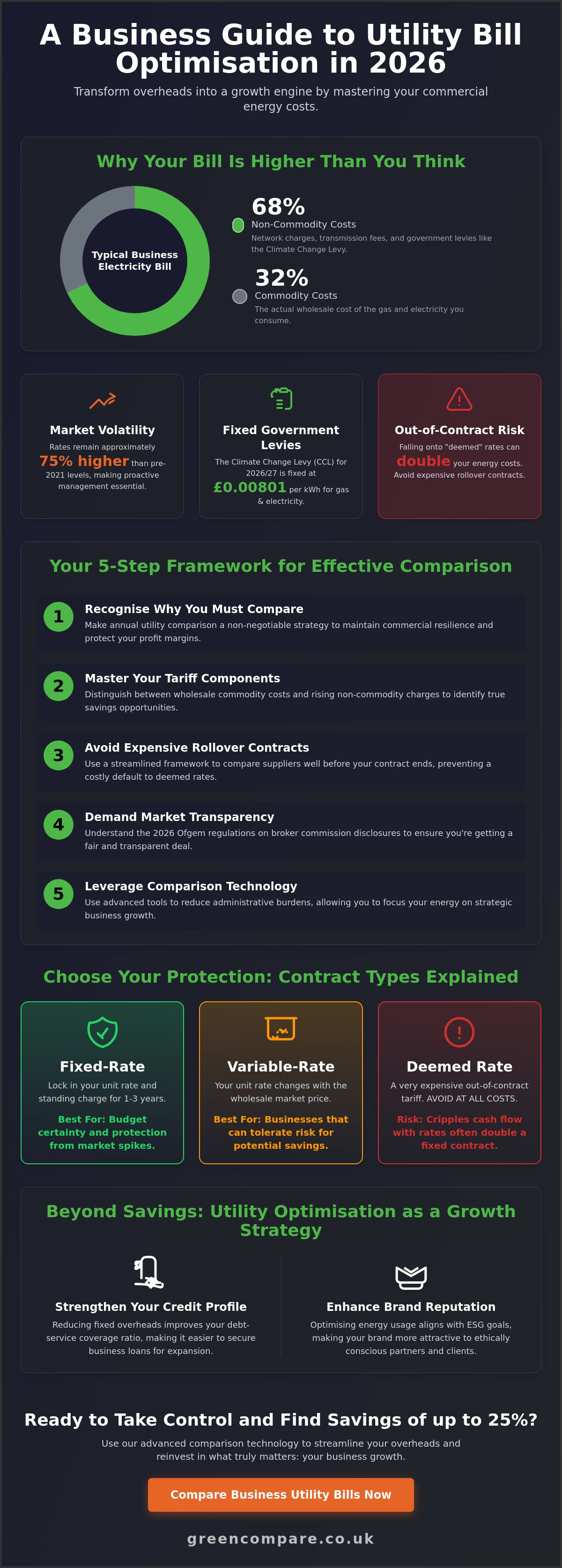
Did you know that non-commodity costs, including network charges and government levies, now account for approximately 68% of your business electricity bill? With the Climate Change Levy for both gas and electricity fixed at £0.00801 per kWh for the 2026/27 period, it's vital to compare business utility bills uk to protect your margins. Managing complex contracts whilst trying to scale your operations is exhausting. You deserve a partner who values your time and provides total transparency in a market often clouded by hidden broker commissions.
Take control of your overheads today. When you adopt a strategic, efficient approach, you transform a mundane task into a powerful engine for growth. This 2026 guide simplifies the process into actionable steps. You'll learn how to leverage new Ofgem broker regulations, understand the impact of the British Industrial Competitiveness Scheme, and secure competitive rates for business gas and electricity. By identifying potential savings of up to 25% through targeted schemes, you protect your bottom line and fuel your future success.
Key Takeaways
- Recognise why annual utility comparisons are now a non-negotiable strategy for maintaining commercial resilience in 2026.
- Master the components of your energy tariff to distinguish between wholesale commodity costs and rising non-commodity charges.
- Use our streamlined 5-step framework to compare business utility bills uk and avoid falling into expensive rollover contracts.
- Benefit from enhanced market transparency by understanding the latest 2026 Ofgem regulations on broker commission disclosures.
- Leverage advanced comparison technology to reduce administrative burdens and focus your energy on strategic business expansion.
Why Comparing Business Utility Bills is a Strategic Priority in 2026
Business utility comparison is the systematic evaluation of your commercial gas and electricity tariffs against the wider market. It is no longer just a box-ticking exercise for the finance team. In 2026, the ability to compare business utility bills uk has become a vital lever for maintaining commercial resilience. You need to move beyond reactive switching. Proactive energy management allows you to identify capital recovery opportunities. This means taking the money previously lost to inefficient rates and reinvesting it directly into your business growth. When you reclaim these funds, you transform a passive cost into an active asset.
The transition from a simple administrative task to a strategic priority is driven by necessity. Market volatility remains a constant threat. While the extreme peaks seen in previous years have subsided, rates are still roughly 75% higher than pre-2021 levels according to recent industry data. Relying on a "switch and forget" mentality is dangerous. Modern enterprises must treat energy as a controllable variable rather than a fixed burden. By auditing your spend regularly, you ensure your operations remain lean and competitive whilst your peers struggle with unoptimised overheads.
The 2026 Energy Market Outlook for UK Businesses
The UK energy landscape remains complex. Wholesale prices have found a new, higher baseline, leaving businesses exposed to sudden fluctuations. For a detailed breakdown of UK electricity bills, understanding the split between commodity costs and levies is essential. This year, the transition to mandatory half-hourly settlement is changing how suppliers bill for usage. If you aren't using smart meter data to inform your strategy, you're likely overpaying. Out-of-contract rates have reached record highs in 2026. Falling onto these "deemed" tariffs can cripple your cash flow overnight. It is vital to secure a fixed-term contract before your current deal expires.
Beyond Savings: Utility Optimisation as Growth Strategy
Efficient utility management does more than lower your monthly outgoings. It actively strengthens your business credit profile. When you reduce fixed overheads, you improve your debt-service coverage ratio. This makes securing Business Loans for expansion much simpler and more cost-effective. Additionally, optimising your energy usage aligns with modern ESG goals. This makes your brand more attractive to ethically conscious partners and clients. Green Compare acts as your visionary partner in this journey. We don't just find cheaper rates; we help you build a leaner, more sustainable financial foundation that supports your long-term ambitions.
Deciphering Commercial Utility Tariffs: Gas, Electricity, and Hidden Charges
Understanding your invoice is the first step to total cost control. To effectively compare business utility bills uk, you must look past the headline unit rate. Your bill is split into commodity costs, which is the actual energy consumed, and non-commodity costs, covering transmission, distribution, and government levies. By 2026, non-commodity costs account for approximately 68% of a typical business electricity bill. This makes the standing charge a critical comparison point. It's the fixed daily fee you pay regardless of usage, and it varies significantly between suppliers.
Taxes and levies also dictate your final spend. The Climate Change Levy (CCL) for the 2026/27 period is set at £0.00801 per kWh for both electricity and natural gas. Most businesses pay VAT at the standard 20% rate, but you might qualify for the 5% de minimis rate if your usage falls below specific thresholds. Checking Ofgem's guidance on business energy contracts will help you identify if your enterprise qualifies for micro-business protections, which offer greater transparency on these hidden line items.
Fixed vs Variable: Choosing the Right Protection Level
Fixed-rate contracts for 12, 24, or 36 months offer price certainty in a volatile market. Whilst longer terms protect against wholesale spikes, they may lock you out of potential price drops. Conversely, variable tariffs leave you exposed to market swings. Avoid 'deemed rates' at all costs. These apply when you move premises without a contract or let a deal expire; they're often double the price of a standard fixed rate. Securing a competitive business electricity rate ensures your overheads remain predictable, allowing you to focus on your next growth milestone.
Understanding KVA and Capacity Charges
For larger sites, KVA (kilovolt-ampere) or 'available capacity' is a major line item. This represents the volume of power the network reserves specifically for your premises. If you over-specify this capacity, you're paying for energy you never use. Right-sizing your requirements before you start a comparison can lead to immediate monthly savings. It's a simple adjustment that removes unnecessary 'dead' costs from your balance sheet. This proactive approach ensures you only pay for the infrastructure your business actually requires.
The 5-Step Framework to Compare Business Utility Bills Effectively
To effectively compare business utility bills uk, you need a repeatable, logical process. Randomly browsing comparison sites often leads to confusion and missed opportunities. Instead, follow this structured framework to secure the best possible terms for your Business Gas or Business Electricity. By taking a systematic approach, you transform a complex administrative burden into a streamlined exercise in capital preservation.
Step 1: Audit your energy profile. Grab your most recent bill. If you have a smart meter, download your usage data for the last 12 months. This provides your baseline consumption and identifies your peak usage periods. Step 2: Identify your contract's renewal window. Most commercial contracts have a specific period where you can terminate or switch. Finding this date is critical. Many suppliers require notice between 30 and 90 days before the contract ends. Miss this, and you'll likely face expensive rollover rates that can last for a full year.
Step 3: Organise your Letter of Authority (LOA). This simple document allows a broker or partner to talk to suppliers on your behalf. It saves you hours of hold music and ensures you get access to "off-market" rates not published on public websites. Step 4: Evaluate quotes based on Total Contract Value (TCV). Suppliers often lead with a low unit rate whilst inflating the standing charge. Calculate the total cost over the full term to see the true financial impact. Step 5: Execute the switch and verify the final bill. Once you sign, your new supplier handles the transition. Always check your final "closing" bill from the old provider to ensure you aren't overcharged during the handover.
Preparing Your Data for an Accurate Quote
Accuracy is your best tool for negotiation. You'll need your MPAN (for electricity) or MPRN (for gas) numbers, which are unique identifiers found on your bill. Providing your exact annual consumption in kWh prevents "estimated bill" shocks later in the year. In 2026, smart meters provide granular insights into your operational behaviour. Use this data to request tailored tariffs that match your actual usage patterns rather than industry averages. This precision ensures you only pay for what you need.
Evaluating Supplier Reliability and Customer Service
Price is important, but reliability is paramount for business continuity. A cheap unit rate loses its value if the supplier has poor billing accuracy or non-existent support. Check independent trust ratings before signing any deal. Prioritise suppliers with UK-based support centres. These teams typically resolve issues faster, ensuring your utility management remains stress-free. For more detail on what to look for, refer to Ofgem's guide on understanding your business energy contract. This foundation ensures you choose a partner that truly supports your long-term growth.
Navigating Broker Commissions and Contract Transparency
Transparency is the foundation of a healthy partnership. Many businesses assume comparison services are entirely free, but it's vital to understand how these platforms generate revenue. Most brokers receive a commission from the supplier once a contract is signed. This is typically added as an 'uplift' to your unit rate. When you compare business utility bills uk, you deserve to see the full picture. Hidden fees shouldn't be a barrier to your growth. In 2026, Ofgem introduced landmark regulations requiring energy brokers and Third-Party Intermediaries (TPIs) to follow a mandatory register and provide transparent disclosure of all commissions for micro-businesses.
Always ask for a clear breakdown of the commission included in your quote. A reputable partner will provide this without hesitation. Beyond the price, you must identify common 'trap' clauses that can restrict your future flexibility. Some commercial contracts include excessive termination notice periods or 'volume tolerance' clauses that penalise you if your energy usage changes significantly. Reviewing these fine-print details ensures your contract remains an asset rather than a liability. By demanding clarity now, you protect your cash flow for years to come.
The Importance of Commission Disclosure
Green Compare prioritises total openness in every procurement exercise. We believe that hidden commissions, which can add thousands of pounds to a multi-year business contract, have no place in a modern partnership. Before signing any agreement, use this checklist to verify your broker's transparency:
- How exactly is your commission calculated?
- Is there a fixed fee or a per-unit uplift included in my rate?
- Are there any additional service fees not mentioned in the headline price?
- Which suppliers did you exclude from this comparison and why?
Avoiding Rollover Contracts and Exit Fees
The 'auto-renewal' trap remains a significant hurdle for UK enterprises. If you fail to serve notice within your specific renewal window, you might be rolled onto a more expensive tariff automatically. Unlike domestic energy, business contracts rarely offer a 'cooling-off' period. Once you sign, you are committed. However, if you are moving premises, you can usually trigger a 'Change of Tenancy' (CoT) to end your current agreement. Understanding these rights allows you to navigate the market with confidence and precision. Secure a transparent deal today. Compare business gas and electricity rates with a partner who values your trust and your time.
Streamline Your Business Overheads with Green Compare
Green Compare represents a shift in how UK enterprises manage their essential costs. We don't just provide a list of prices; we deliver a holistic strategy that integrates utility management with broader financial empowerment. Our rapid comparison technology is designed to save you hours of tedious administration. By automating the data-gathering phase, we move you from a problem to a solution in minutes. When you compare business utility bills uk through our platform, you're investing in a partnership that prioritises your time and your profit margins.
Our 2026 cost-reduction programme is built for speed and precision. We help you audit your current spend, identify inefficiencies, and execute a switch with zero downtime. This proactive stance ensures you never fall victim to the 'deemed rates' or rollover traps mentioned earlier. We handle the complex logistics so you can focus on leading your team. Our onboarding process is simple. Provide your recent bill, and let our experts do the heavy lifting. It's a linear path to a leaner, more resilient balance sheet.
Our Efficient, Expert-Led Comparison Process
We filter the entire UK market to find Business Gas and Business Electricity tariffs that align with your specific growth goals. Having a dedicated partner means you no longer have to chase suppliers or decipher jargon. We manage the entire switching process, ensuring a seamless transition between providers. Our commitment to environmental responsibility is also central to our mission. We offer a range of green energy options that help you meet your sustainability targets whilst reducing your carbon footprint. It is professional advancement through ethical procurement.
Unlocking Capital: From Utilities to Business Finance
Optimising your utilities is the first step toward a healthier financial future. We look at the big picture of your organisation's health. Significant savings on your monthly bills improve your cash flow and strengthen your credit profile. This makes you a more attractive candidate for Business Loans when you're ready to scale. Once your overheads are optimised, we can connect you with unsecured funding options to accelerate your expansion. It's a virtuous cycle of saving and growing. Compare your business utility bills with Green Compare today and start your journey toward professional empowerment.
Secure Your Competitive Advantage in 2026
Mastering your commercial overheads is a strategic necessity for growth. By understanding the split between commodity and non-commodity costs and following our structured framework, you protect your margins from market volatility. You now possess the tools to navigate broker commissions with total clarity and bypass the pitfalls of expensive rollover contracts. It's time to shift from being a passive consumer to a proactive manager of your enterprise's energy profile. This transition ensures your capital remains where it belongs; reinvested in your team and your vision.
When you choose to compare business utility bills uk with a transparent partner, you unlock more than just lower rates. You gain expert UK-based support and a clear path to broader financial success. Our platform provides transparent commission disclosure and direct access to commercial finance solutions, including Business Loans, to fuel your next expansion project. Take the final step toward professional advancement today. Start your 60-second business utility comparison now and transform your overheads into an engine for progress. Your business deserves a partner as invested in your future as you are.
Frequently Asked Questions
Is it better to choose a fixed or variable business energy tariff in 2026?
Choosing a fixed-rate contract is generally the most strategic move for UK businesses in 2026. It protects your budget from wholesale market volatility, which remains approximately 75% higher than pre-2021 levels. Whilst variable tariffs might seem appealing if prices drop, the risk of a sudden spike often outweighs the potential savings. Securing a fixed deal allows you to forecast your overheads with precision and provides long-term financial stability.
How long does it actually take to switch business energy suppliers?
Most business energy switches now take around five working days to complete. This rapid timeline is facilitated by industry-wide improvements, though complex multi-site contracts can occasionally take up to 21 days. Your supply is never interrupted during the transition. The process happens entirely behind the scenes, ensuring your operations remain seamless whilst you move to a more competitive rate that supports your growth.
What is the Climate Change Levy (CCL) and does my business have to pay it?
The Climate Change Levy is a government tax on energy used by businesses to encourage energy efficiency. For the April 2026 to March 2027 period, the rate is set at £0.00801 per kWh for both electricity and natural gas. Most commercial enterprises must pay this, although some energy-intensive industries may qualify for reductions through the British Industrial Competitiveness Scheme or Climate Change Agreements.
Can I switch my business utility provider if I am in a debt position?
You typically cannot switch providers if you have an outstanding debt of more than 28 days with your current supplier. They have the right to object to the transfer until the balance is cleared. If you are struggling with arrears, it's best to agree on a payment plan first. Once the debt is managed, you can freely compare business utility bills uk to find a more sustainable tariff.
What information do I need to provide to get an accurate business energy quote?
To receive an accurate quote, you need a recent utility bill containing your MPAN (for electricity) or MPRN (for gas). You should also provide your annual consumption in kWh and your current contract end date. Providing precise usage data from your 2026 smart meter insights ensures the tariffs you receive are tailored to your operational reality rather than broad industry estimates, preventing future billing shocks.
Are there any 'hidden' fees when using a business utility comparison site?
There are no direct fees for using our comparison service; we receive a commission from the supplier you choose. Under 2026 Ofgem regulations, this commission must be transparently disclosed to micro-businesses. When you compare business utility bills uk with us, we provide a clear breakdown of the uplift included in your rate. This ensures you see the total contract value without any hidden surprises or unexpected costs.
How does the 'Letter of Authority' work in the switching process?
A Letter of Authority (LOA) is a legal document that grants your chosen partner permission to negotiate with suppliers on your behalf. It does not allow them to sign a contract without your final approval. It simply authorises them to gather usage data and request bespoke quotes. This streamlines the procurement process, saving you hours of administrative work and ensuring you get the best possible market terms.
Can I compare business gas and electricity at the same time?
Yes, you can compare both Business Gas and Business Electricity simultaneously. Whilst "dual fuel" discounts are less common in the commercial sector than in residential markets, many suppliers offer incentives for managing multiple meters. Comparing both at once allows you to align your renewal dates. This makes future utility management much simpler and more efficient for your finance team, allowing you to focus on expansion.