Compare Business Electricity Prices: Secure Your 2026 Energy Savings

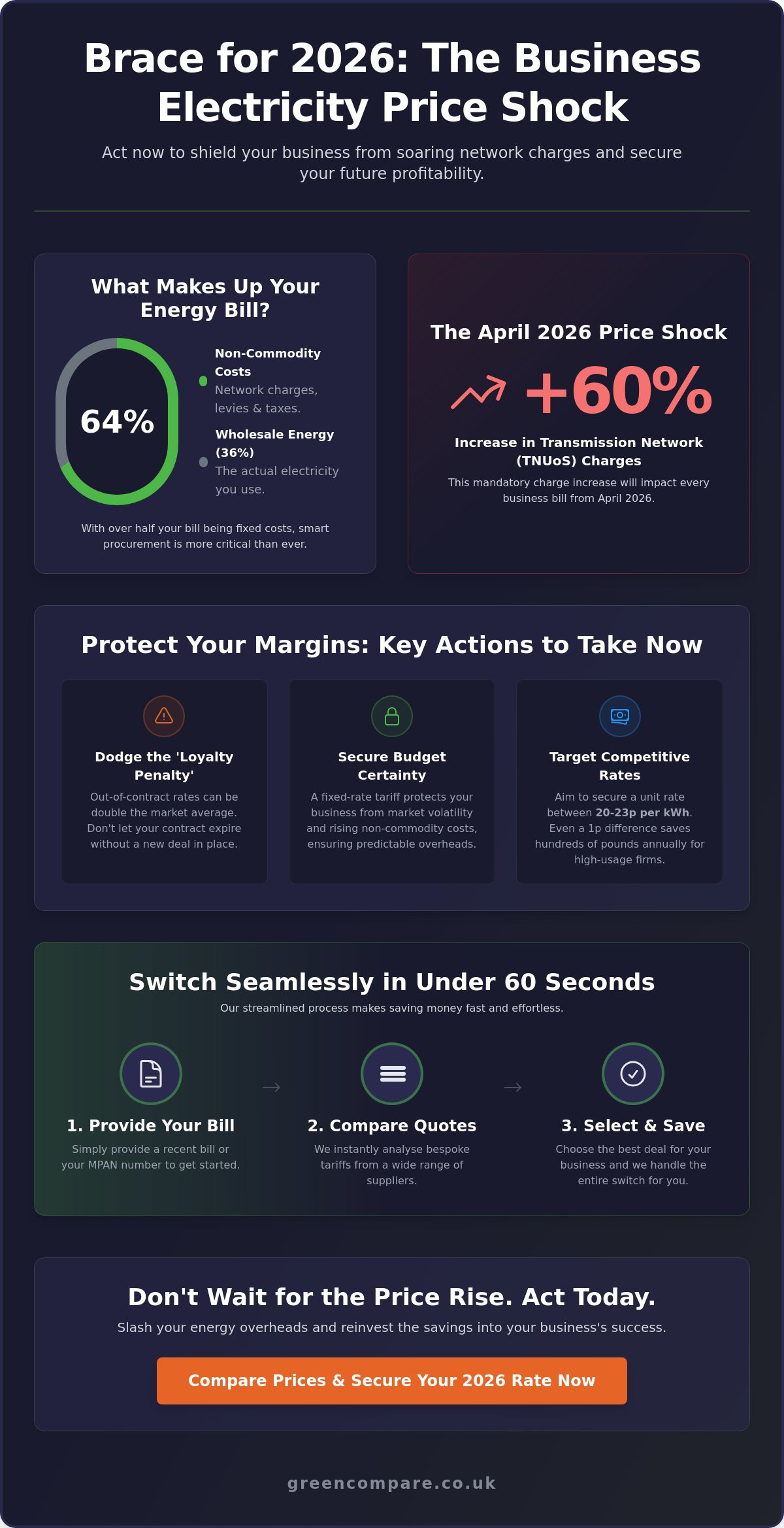
Did you know that transmission network charges are set to soar by 60% from April 2026? With non-commodity costs now making up 64% of your total energy bill, simply accepting your renewal quote is a risk your bottom line cannot afford. You need a proactive strategy to compare business electricity prices and protect your margins before these hikes take effect. We know that deciphering complex tariff structures and rising standing charges feels like a distraction from your real work.
It's frustrating to watch overheads climb when you'd rather be investing that capital into your team or new equipment. We're here to help you navigate the 2026 commercial energy market to slash your costs and fuel your journey to success. This guide reveals how to secure rates as low as 20 pence per kWh and lock in budget certainty today. You'll discover how to bypass the stress of manual comparisons and move quickly toward a greener, more affordable future for your business in under 60 seconds. Help us build a better future together.
Key Takeaways
- Learn how to compare business electricity prices to avoid the 60% hike in transmission charges and secure a competitive rate for 2026.
- Identify the difference between unit rates and standing charges to ensure you aren't overpaying for fixed costs.
- Discover why a fixed-rate tariff offers the budget certainty needed to protect your profit margins from market volatility.
- Simplify your procurement process by switching in under 60 seconds using just your recent bill or MPAN.
- Uncover how slashing your energy overheads provides the vital capital required to reinvest in your business's journey to success.
Why Comparing Business Electricity Prices is Critical for Your 2026 Strategy
The 2026 energy environment has evolved. While wholesale prices have found a new baseline, the structural costs of your bill have shifted significantly. Non-commodity costs, including network charges and policy levies, now account for roughly 64% of a typical business electricity bill. This makes the proactive decision to compare business electricity prices a fundamental pillar of your cash flow health. For most UK companies, energy remains a top three operational expense. Ignoring the market means leaving your margins exposed to unnecessary pressure.
Many SMEs fall into the trap of "out-of-contract" rates. These deemed tariffs are the silent killer of profit margins. If your fixed-term contract expires without a new deal in place, you often face rates that are double the market average. Large suppliers frequently rely on this "loyalty penalty," assuming busy directors won't find time to switch. Don't let inertia drain your capital. Every pound saved on a unit rate is a pound you can reinvest in your journey to success. A quick comparison today ensures your money stays where it belongs: in your business.
The 2026 Market Outlook for UK Businesses
The UK's transition toward net-zero is reshaping how we power our enterprises. Following the publication of final tariffs on January 30, 2026, Transmission Network Use of System (TNUoS) charges rose by approximately 60% in April 2026. This increase helps fund the forecasted £8.9 billion required for grid upgrades this year. While wholesale trends show signs of stability, these rising infrastructure costs and the Nuclear RAB levy of £3.663/MWh mean your total bill could still climb. Some businesses wait for the "bottom" of the market to lock in a deal. This is a risky strategy. Market volatility can wipe out potential gains in hours. Securing a fixed rate now provides the budget certainty you need to build a brighter future together.
Defining Commercial Electricity Comparison
Business electricity comparison is a strategic procurement tool used to identify the most cost-effective energy contracts tailored to a specific company's consumption profile. Commercial contracts differ significantly from domestic ones; for example, there are generally no cooling-off periods in business energy. Once you sign, you're committed. A foundational step in this process involves understanding the electricity market and how it impacts your specific meter type. Because every business has a unique load shape, bespoke quotes are the only way to ensure you aren't overpaying. Compare your options today. It's fast, efficient, and protects your bottom line.
Deciphering Your Commercial Bill: Unit Rates, Standing Charges, and Hidden Costs
Your commercial electricity bill is more than just a final number; it's a map of your operational efficiency. To effectively compare business electricity prices, you must look past the total and examine the specific components. The unit rate, measured in pence per kilowatt-hour (p/kWh), is the variable cost of the energy you actually use. In May 2026, a competitive rate for most UK firms falls between 20p and 23p. Conversely, the standing charge is a fixed daily fee. This covers the maintenance of the physical wires and pipes that bring power to your door. Even if you switch off every light, you still pay this daily amount. It's a cost that varies significantly between suppliers, making careful comparison essential.
You should also be aware of "pass-through" costs. These are fees from third parties, such as the National Grid or regional distributors, that suppliers might pass directly to you. If you choose a flexible or "variable" tariff, these costs can fluctuate mid-contract. With network charges rising by 60% in April 2026, an unhedged tariff could expose your cash flow to sudden shocks. Choosing a fixed-rate contract is often the safest way to lock in these variables and ensure your journey to success remains on track. It provides the predictability you need to plan your next big investment with confidence.
The Unit Rate vs Standing Charge Trade-off
High-usage businesses, such as manufacturers or large offices, should always prioritise the lowest possible unit rate. Even a 1p difference can save hundreds of pounds over a year. Small businesses or those with seasonal operations might find better value in a higher unit rate paired with a significantly lower standing charge. Using your annual consumption data allows you to calculate the true "effective" cost of a contract. You can start your comparison journey in under 60 seconds to see which structure fits your specific load profile best.
Understanding Regulatory Charges (CCL and VAT)
Regulatory costs are the final piece of the puzzle. Most UK businesses pay a standard VAT rate of 20% on their electricity. However, if your business uses less than 33 kWh per day, you automatically qualify for a reduced 5% rate. The Climate Change Levy (CCL) is another factor, designed to encourage energy efficiency. While UK-specific, observing the latest electricity price data from international markets highlights that non-commodity costs are rising globally as nations fund their green transitions. In the UK, these levies and network charges now represent 64% of your bill. Securing a greener tariff or a fixed-rate deal protects you from the volatility of these external taxes. Understanding these figures is vital to your business's growth and environmental responsibility.
Fixed, Variable, or Green? Analysing the Best Business Electricity Tariffs
Choosing the right contract structure is a critical decision for your business's financial health. You shouldn't just look for the lowest number on a screen; you need a tariff that aligns with your operational goals. When you compare business electricity prices, you'll generally choose between fixed, variable, or green options. Fixed-rate tariffs offer a locked-in price for a set period, usually between one and five years. Variable rates, however, fluctuate with the market. These are often the most expensive choice for SMEs because they offer no protection against sudden price spikes. If you aren't on a fixed deal, you're likely paying "deemed" rates, which can drain your cash flow faster than any other overhead.
For large-scale energy users, half-hourly meters are a game-changer. These devices send usage data to your supplier every 30 minutes. This allows you to leverage time-of-use pricing, where electricity is cheaper during off-peak hours. If your operations can shift heavy usage to these times, the savings are substantial. While international comparison models like PA Power Switch highlight the global trend toward energy transparency, our platform focuses specifically on the unique needs of the UK commercial market. We help you find the structure that fits your load profile in seconds.
Why Fixed-Rate Contracts Dominate the 2026 Market
In a market where non-commodity costs are rising, certainty is your best friend. A fixed-rate contract acts as a shield against future energy price spikes. It makes financial forecasting simpler, allowing you to plan your journey to success with a clear view of your overheads. Don't wait until your current deal expires. Most suppliers allow you to secure a new rate up to six months before your current contract ends. This "renewal window" is your best opportunity to lock in savings before the next market shift. Securing your rate early is a pragmatic move that ensures your budget remains stable for years to come.
The Rise of Greener Business Energy
Modern procurement is about more than just pence per kilowatt-hour. It's about values. Greener business energy tariffs, backed by Renewable Energy Guarantees of Origin (REGOs), are now more accessible than ever. Switching to a 100% renewable tariff can significantly boost your brand reputation. It often helps you win B2B contract bids that require proof of environmental responsibility. There's a common myth that green energy always costs more. In reality, many renewable options are now price-competitive with traditional brown energy. Compare your options today and help us build a better future together. It's a simple step that delivers a triple win: lower costs, budget certainty, and a reduced carbon footprint.
How to Organise a Seamless Switch in Under 60 Seconds
Efficiency is the engine of growth. You shouldn't spend hours on hold or days waiting for callbacks from traditional brokers. We've streamlined the process so you can compare business electricity prices and secure your 2026 savings in under 60 seconds. Our platform acts as your proactive ally, moving you quickly from a costly problem to a profitable solution. Follow these four simple steps to take control of your overheads:
- Step 1: Gather your data. Find a recent bill or locate your MPAN (Meter Point Administration Number). This unique 21-digit code identifies your specific connection to the grid.
- Step 2: Scan the market. Input your details into our efficient comparison engine. We instantly filter through dozens of suppliers to find the most competitive tariffs for your region.
- Step 3: Review bespoke quotes. Don't settle for "average" prices. Our system presents quotes tailored to your actual consumption patterns, ensuring you only pay for what you need.
- Step 4: Confirm your selection. Once you've found the right deal, simply click to confirm. We take it from there, managing the transition so you can focus on your business.
The Information You Need to Get Started
Your postcode and current supplier are the primary keys to unlocking better rates. Electricity prices vary by region due to different distribution costs, so being specific is vital. Since April 2026, smart meter data has made this process even faster; it allows suppliers to see your real-time load profile and offer more accurate, lower unit rates. You don't need to be a technical expert or understand every detail of the UK grid to make a smart choice. Simply provide your basic details, and we'll handle the complex calculations for you. Compare business electricity prices now to see how much you could save.
What Happens Behind the Scenes During a Switch?
The handover process is completely seamless. We act as the intermediary, managing the termination of your old contract and the setup of your new one. If you're moving premises, we handle the "Change of Tenancy" paperwork to ensure you aren't charged expensive out-of-contract rates from day one. There is absolutely no risk to your physical supply; the electricity continues to flow through the same wires regardless of which supplier sends the bill. We remove the stress of paperwork and the "loyalty penalty" imposed by big suppliers. This is about more than just switching; it's a strategic move to fuel your journey to success and build a brighter future together.
Fuel Your Business Journey to Success with Green Compare
Energy isn't just an overhead; it's the fuel for your next big project. When you choose to compare business electricity prices, you aren't just cutting costs. You're liberating capital. Every pound saved on your monthly bill is a pound that can be redirected toward innovation, recruitment, or expansion. We view our relationship with you as a partnership. As your proactive ally, we help you manage commercial gas, electricity, and even business loans to ensure your financial foundation is rock solid. Help us build a better future together by making smarter, greener choices for your enterprise.
Our service is built on British pragmatism and modern entrepreneurial energy. We understand that you need solutions, not more problems. By positioning our service as a simple, stress-free solution, we aim to alleviate the pressure of rising operational costs. We don't offer the cold, clinical feel of a traditional brokerage. Instead, we provide a supportive and visionary stance that suggests we're genuinely invested in your growth. It's about moving you quickly from a problem to a solution so you can focus on what you do best.
Reinvesting Savings into Your Future
Consider the impact of a £2,000 annual saving on your bottom line. For a small retail unit, that could fund a targeted digital marketing campaign for three months. For a local workshop, it might cover the deposit on a more efficient piece of machinery. These savings directly improve your cash flow health, which often makes your business more attractive to lenders when applying for business loans. By centralising your overhead strategy with us, you ensure that your procurement is always working in your favour. We don't just find you a cheaper rate; we help you find the financial breathing room to focus on your journey to success.
Start Your 60-Second Comparison Today
Time is your most valuable asset. We've designed our service to be highly efficient because we know you have a business to run. Our "can-do" approach removes the friction from commercial finance, allowing you to move from a high-cost contract to an affordable, greener alternative in seconds. Don't let your growth be stunted by outdated tariffs or complex paperwork. Take the first step toward a more sustainable and profitable future right now. It's quick, transparent, and built for the modern British entrepreneur. Compare business electricity prices now and see the difference a proactive partner makes.
Secure Your Business Growth for 2026 and Beyond
The landscape of commercial energy is shifting rapidly. With transmission charges rising by 60% and non-commodity costs now making up 64% of your bill, the "loyalty penalty" has never been more expensive. You've seen how a fixed-rate tariff provides the budget certainty required to protect your margins and how a greener approach can enhance your brand's reputation. Don't let complex contracts or rising standing charges hold your enterprise back.
It's time to compare business electricity prices and reclaim your capital. We're proud to be trusted by UK SMEs for transparent utility procurement, providing the expert support you need for your journey to success. You can view bespoke quotes in under 60 seconds, moving you instantly from a cost-heavy problem to a streamlined solution.
Start your 60-second business electricity comparison today and take the next step in your business's journey. Let's build a brighter future together.
Frequently Asked Questions
Can I switch business electricity if I am in a fixed-term contract?
You generally cannot switch until your current contract enters its renewal window, which is usually between one and six months before the expiry date. If you try to leave earlier, you'll likely face expensive exit fees. We recommend you compare business electricity prices during this window to secure a new rate before you are rolled onto costly out-of-contract tariffs.
How much can a small business save by comparing electricity prices?
A typical small business might pay between £1,000 and £2,500 per year for electricity based on current market data. By switching to a competitive rate between 20 and 23 pence per kWh, you could save hundreds of pounds annually. These savings provide the vital capital needed to reinvest in your team and fuel your journey to success.
What is a Letter of Authority (LOA) and why is it needed?
A Letter of Authority is a legal document that gives an intermediary permission to speak with energy suppliers on your behalf. It allows procurement experts to gather your usage data and manage the switching process without you needing to handle the technical paperwork. This is a standard part of transparent utility procurement for UK businesses.
What happens if my current energy supplier goes bust?
Your electricity supply will not be interrupted because Ofgem's safety net ensures a Supplier of Last Resort (SoLR) takes over your account automatically. While your power is safe, the new supplier will often place you on a more expensive price plan. It's essential to compare business electricity prices immediately once the new supplier is confirmed to find an affordable deal.
How long does the actual switching process take for a business?
The initial comparison takes under 60 seconds, but the physical switch between suppliers usually takes between 5 and 15 working days. This timeline has improved since the implementation of faster switching regulations in 2022. Your supply remains constant throughout the transition; there is no need for new wires or meter changes unless you request a smart meter upgrade.
Is green business electricity more expensive than standard tariffs?
No, greener tariffs are often price-competitive and can sometimes be cheaper than traditional "brown" energy. Many suppliers now offer REGO-backed renewable energy as their standard offering to support the UK's net-zero transition. Choosing a green plan is a pragmatic way to improve your brand reputation while keeping your operational overheads low.
What is the difference between a unit rate and a standing charge?
The unit rate is the variable cost you pay for each kilowatt-hour (kWh) of electricity used. The standing charge is a fixed daily fee that covers the maintenance of the national grid. As of May 2026, non-commodity costs like network charges account for 64% of your bill, making both figures critical to your total expenditure.
Can I compare prices for multiple business sites at once?
Yes, we can organise multi-site or group contracts for businesses with several locations. This streamlines your procurement by aligning all your contract end dates and provides better visibility of your total energy spend. It's an efficient way for growing companies to manage their overheads and build a brighter future together.