Small Business Energy Comparison: Secure the Best UK Rates in 2026

Most UK entrepreneurs treat their utility bill as an immovable tax on growth, yet it is actually your most powerful lever for immediate reinvestment. It is exhausting to face the "rollover trap" or the complex jargon that often hides true costs. You deserve a partnership built on clarity, not a renewal process that feels like a second full-time job. Performing a small business energy comparison shouldn't be a chore; it should be the moment you take back control of your commercial margins.
Discover how to slash your utility overheads and secure a competitive energy contract in under 30 seconds. By ditching the cold, clinical feel of traditional brokerage, we provide a stress-free transition to lower fixed-rate deals. This guide explores the 2026 market landscape, helps you organise your utility data, and outlines a simple, linear path to powering your business's next phase of progress. Let's move your company forward with efficiency, transparency, and optimism.
Key Takeaways
- Understand how to use energy procurement as a strategic financial lever to protect your profit margins against 2026 market volatility.
- Execute a small business energy comparison in under 30 seconds by organising your MPAN and MPRN details before you begin.
- Discover the benefits of locking in fixed-rate contracts to ensure price certainty whilst avoiding the risks associated with expensive deemed rates.
- Identify the hidden clauses that trigger the "rollover trap" and learn how to navigate notice periods to prevent unexpected cost hikes.
- Learn how aligning your utility management with expert guidance creates a visionary path for long-term business empowerment and sustainable growth.
Why Small Business Energy Comparison is a Strategic Growth Lever in 2026
Energy isn't just an overhead; it's a strategic choice. In June 2026, with wholesale gas at 118.5p per therm and power at £97.00 per MWh, the market remains tight. Geopolitical shifts in the Middle East have pushed prices higher, making every penny of your margin count. A proactive small business energy comparison allows you to reclaim capital that would otherwise vanish into a supplier's profit. This isn't just about finding the "cheapest" deal. It's about securing contract flexibility and service quality that matches your growth trajectory.
When you lower your utility bills, you improve your cash flow profile. This directly supports your ability to secure Business Loans or fund new equipment. It transforms "bill anxiety" into a sense of monthly management. You stop reacting to invoices and start directing your resources. We view this as a partnership in progress. By streamlining your costs, you create the financial breathing room needed for genuine innovation and expansion.
The Real Cost of Sticking with Your Current Supplier
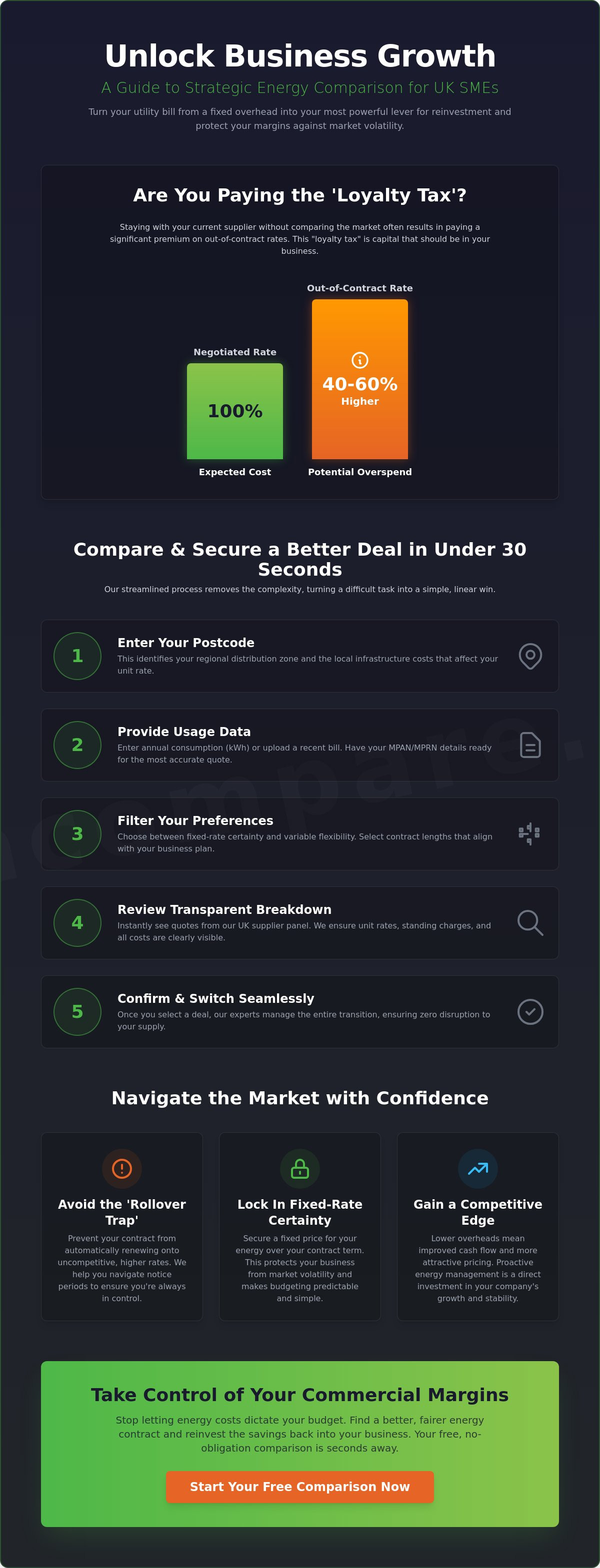
Loyalty rarely pays in the commercial sector. Many suppliers rely on "inertia profit," where businesses simply let contracts roll over. Understanding UK energy market history shows that competition only benefits those who actively seek it. If you don't switch, you'll likely hit the "loyalty tax." Out-of-contract rates are typically a 40-60% premium over negotiated deals. That is capital that should be in your bank account, not theirs. Staying with the same provider without checking the market is a drain on your long-term resources.
Energy Efficiency as a Competitive Advantage
Operational efficiency gives you the room to be aggressive. If your overheads are lower than your nearest competitor, you can price your products more attractively. It's a simple, linear advantage. Aligning your procurement with modern corporate social responsibility (CSR) goals also builds trust with your customers. Many of the best 2026 tariffs now include renewable energy as standard, allowing you to meet environmental targets whilst protecting your bottom line. By making small business energy comparison a regular part of your financial health check, you ensure your enterprise development is built on a foundation of proficiency and smart resource management.
How to Compare Business Energy Prices in Under 30 Seconds
Modern entrepreneurship moves at breakneck speed. You don't have hours to waste on phone calls or manual spreadsheets. A digital-first small business energy comparison leverages advanced algorithms to scan the entire UK supplier panel in moments. This approach eliminates human error and ensures you're viewing the most current 2026 rates instantly. By having your MPAN (Meter Point Administration Number) and MPRN (Meter Point Reference Number) ready, you turn a complex procurement task into a simple, linear win. Speed is the ultimate currency for the proactive business owner.
Ready to see how your current rates stack up against the market? You can compare business electricity and gas in seconds to find your next growth-enabling contract.
The 5-Step Rapid Comparison Process
- Step 1: Enter your postcode. This identifies your regional distribution zone, which dictates the local infrastructure costs included in your unit rate.
- Step 2: Provide usage data. Enter your annual consumption in kWh or upload a recent bill. In 2026, a small business typically uses between 10,000 and 50,000 kWh of electricity per year.
- Step 3: Filter your preferences. Choose between fixed-rate certainty or variable flexibility. You can also select contract lengths that align with your long-term financial planning.
- Step 4: Review the breakdown. Look for transparent commission disclosure and clear unit rate pricing. We ensure every cost is visible before you commit.
- Step 5: Confirm and transition. Once you select a deal, the heavy lifting begins. Our experts manage the switch, ensuring a stress-free transition without any interruption to your supply.
Data Accuracy: Ensuring Your Quote Reflects Reality
Precision is the foundation of a reliable quote. Relying on estimated bills can lead to "catch-up" invoices that disrupt your cash flow later. In 2026, smart meters have revolutionised the speed of comparison by providing real-time usage data. This technology allows for a highly personalised quote that reflects your actual behaviour rather than a generic industry average. Accuracy at this stage prevents surprises during the contract term. An accurate MPAN number is the key to a 30-second quote because it acts as a unique digital passport that instantly links our system to your specific meter profile and historical usage data. By providing this single number, you bypass manual data entry and move straight to the solution.
Evaluating the Best Commercial Energy Tariffs for SMEs
Choosing the right tariff is a balance between risk appetite and financial predictability. In 2026, the absence of a domestic-style price cap means businesses are fully exposed to market swings. A robust small business energy comparison allows you to filter through these complexities with ease. Whether you manage a single boutique or a growing chain with multi-site requirements, your choice of tariff will define your operational stability for years to come. We believe in providing the clarity you need to make these decisions with total confidence.
Fixed vs. Variable: Which Strategy Wins in 2026?
Locking in a fixed-rate contract remains the most popular choice for UK SMEs seeking certainty. With good electricity rates for small businesses currently sitting between 20 and 23 pence per kWh, a fixed deal protects you from the sudden spikes seen in recent years. A 12-month contract offers agility if you expect prices to drop, whilst a 36-month term provides long-term insulation against inflation. Variable rates often appear tempting during brief market dips, but they are a dangerous gamble for cash-strapped startups. One geopolitical event can send your monthly bills spiralling. For most, the "sweet spot" in 2026 is a 24-month fixed term, balancing competitive rates with a manageable commitment period.
The Rise of 100% Renewable Business Tariffs
Green energy is no longer a niche luxury; it's a corporate standard. Aligning your procurement with sustainable values through a small business energy comparison can significantly enhance your brand reputation. Modern 100% renewable tariffs are backed by REGO (Renewable Energy Guarantees of Origin) certificates, ensuring your power comes from wind, solar, or hydro sources. This transparency is vital for meeting your broader corporate social responsibility (CSR) goals. Beyond the ethical benefits, there's a growing trend of future tax breaks and incentives for businesses that prioritise sustainable procurement. Transitioning to green power isn't just good for the planet. It's a visionary move that positions your business as a leader in a modern, ethically conscious economy.
If your business operates across several locations, multi-site contracts are the ultimate tool for efficiency. Instead of juggling dozens of individual renewal dates, you can align all your premises under a single, streamlined agreement. This reduces administrative friction and often unlocks more competitive volume-based rates. It's about organising your utility management to match your professional advancement, ensuring your energy strategy grows as fast as your footprint.
Avoiding the 'Rollover Trap' and Hidden Contract Clauses
The "rollover trap" is a predatory mechanism designed to capitalise on the hectic schedules of UK entrepreneurs. When your fixed-term contract expires, many suppliers automatically move you onto "deemed" or "out-of-contract" rates. These prices are significantly higher than negotiated deals, often acting as a silent drain on your monthly profit margins. Avoiding this trap requires vigilance and a proactive approach to your next small business energy comparison. Suppliers rely on your inertia; breaking that cycle is the first step toward reclaiming your commercial autonomy.
Ofgem provides specific protections for micro-businesses and small businesses to prevent the most egregious contract terms. In 2026, a small business is defined as an entity employing fewer than 50 people with an annual turnover of at most £6.5 million. These regulations ensure that suppliers must provide clear information about contract end dates and notice periods. However, the responsibility to act remains with you. Missing a notice window by just one day can cost your business thousands in inflated rates, as you may be locked into an expensive bridge contract whilst you scramble to find a new provider.
A Proactive Switching Checklist
Success in utility management is built on preparation. Follow these linear steps to ensure you never pay a penny more than necessary:
- Identify your end date: Locate your current contract expiry date at least six months in advance. Mark it clearly in your financial calendar.
- Verify notice requirements: Every supplier has different rules. Check if you need to give 30, 60, or 90 days' notice to terminate your current agreement.
- Compare early: Start your small business energy comparison approximately 90 days before your deal expires. This gives you ample time to review the market and organise the transition.
Transparency and Ethics in Energy Brokerage
We believe that a visionary partnership is built on total honesty. Many traditional brokers hide their fees within the unit rate, making it difficult to see the true cost of their service. Green Compare advocates for full commission disclosure because you deserve to know exactly where your money is going. How to spot "hidden" fees? Always ask for a breakdown of the "standing charge" versus the "unit rate" and request a written statement of the broker's remuneration. A reputable broker should always be able to quantify their commission within the unit rate. This transparency ensures that the advice you receive is motivated by your growth, not just a supplier's kickback. Ready to take control? You can secure your commercial energy savings today with a partner that values your transparency as much as your bottom line.
Beyond the Quote: Why Green Compare is Your Long-term Partner
Securing a competitive rate is just the start of our journey together. We don't view utility procurement as a one-off administrative task. Instead, we position ourselves as a visionary ally invested in your long-term enterprise development. A small business energy comparison is the first step in a broader strategy to optimise your commercial overheads and protect your margins. By organising your energy portfolio with us, you ensure you never overpay again, allowing you to focus on what you do best: running your business.
Our commitment to your growth extends beyond the meter. We provide rapid results and stress-free administrative support to match the pace of modern entrepreneurship. When you partner with us, you gain access to an expert guide who navigates the complexities of the 2026 market on your behalf. This proactive stance transforms a mundane bill into a strategic financial asset. We are here to ensure your transition to a new supplier is seamless, transparent, and aligned with your corporate values. It is a partnership built on reassurance and the shared goal of collective progress.
A Holistic Approach to Business Overhead Management
True financial proficiency comes from seeing the big picture. The savings you generate through a smarter energy contract can significantly improve your credit profile and cash flow. This creates a powerful synergy with our business loan options. By reducing your monthly costs, you demonstrate the fiscal responsibility required to secure competitive capital for expansion. Whether you need to fund new equipment or hire additional staff, we help you secure the necessary funding whilst simultaneously cutting your utility spend. Having a single partner for both utilities and commercial finance simplifies your management and accelerates your progress.
The Green Compare Efficiency Benchmark
Speed is our signature. Our streamlined, digital-first experience is designed to value your time above all else. In a 2026 market characterised by volatility and shifting regulations, having expert guidance is essential for making informed choices. We break down complex financial procedures into simple, linear steps, moving you from problem to solution in moments. This efficiency benchmark is not just about technology; it is about a partnership built on reliability and shared success. Take the final step toward professional advancement and business empowerment. Start your 30-second comparison today and discover how a smarter approach to energy can empower your business for years to come.
Take Control of Your Commercial Energy Future
Securing your business's financial health requires more than just passive management. You've seen how proactive utility procurement acts as a strategic lever for growth, protecting your margins against 2026 market volatility. By avoiding the expensive rollover trap and demanding full commission transparency, you reclaim capital for essential reinvestment. Expert guidance on 2026 market trends ensures you stay ahead of the curve whilst focusing on your professional advancement.
Trusted by thousands of UK SMEs, we provide a streamlined, stress-free solution to complex overheads. We believe in rapid results and a partnership-oriented approach that values your time above all else. Don't let administrative friction hold back your enterprise development. Performing a small business energy comparison is the simplest way to empower your company's next phase of progress. We're ready to assist you in building a more sustainable and profitable future.
Compare business energy and start saving in 30 seconds
Frequently Asked Questions
How long does a small business energy switch actually take?
A small business energy switch typically takes between 15 and 30 days to complete. Whilst our digital comparison tool provides your tailored quotes in under 30 seconds, the administrative transfer between suppliers requires a standard notice period. This timeline ensures a seamless transition without any interruption to your supply or daily operations.
What information do I need to compare business energy prices?
You need your business postcode, your annual energy consumption in kWh, and your current contract end date. Having your MPAN or MPRN numbers to hand ensures the highest level of accuracy. These unique identifiers are located on your recent utility bills and allow us to pull precise data for your small business energy comparison instantly.
Can I switch my business energy if I am currently in a contract?
You cannot usually switch mid-contract without incurring significant exit fees, but you can secure your future rate today. Most suppliers allow you to arrange a new contract during your renewal window, which typically opens 90 days before your current deal expires. Securing a deal early protects you from market volatility and prevents you from falling into the rollover trap.
What is the difference between business energy and domestic energy?
Business energy contracts do not have a price cap, meaning your rates are determined by market conditions and your specific usage profile. Unlike domestic deals, commercial contracts are fixed-term and do not usually offer a cooling-off period once signed. This makes it vital to use a professional small business energy comparison service to ensure your chosen tariff supports your long-term growth.
Do business energy prices include VAT and the Climate Change Levy (CCL)?
Commercial energy quotes are typically provided excluding VAT and the Climate Change Levy. In 2026, the standard VAT rate for business electricity is 20%, whilst the CCL is charged at 0.775p/kWh. Some micro-businesses with very low energy consumption may qualify for a reduced VAT rate of 5% and exemption from the CCL, so it's important to check your eligibility.
Will my power be cut off during the switching process?
Your power will never be cut off during the transition to a new supplier. The switch is entirely administrative, involving the transfer of billing data rather than physical infrastructure. The same wires and pipes will continue to deliver energy to your premises, ensuring your business remains fully operational whilst you move to your more competitive rate.
What happens if my business moves to a new premises?
Moving premises triggers a "Change of Tenancy" (CoT) process, which allows you to end your current contract at that specific location. You are not obligated to stay with the supplier used by the previous occupant. This move provides a perfect opportunity to compare the market and start your journey at the new site with a cost-effective, fixed-rate contract.
How much can a small business save by comparing energy rates in 2026?
Savings depend on your annual usage, but the most significant reductions come from avoiding out-of-contract rates. Moving from a deemed rate to a negotiated fixed-term contract can reduce your unit costs by 40% to 60% in many cases. With average small business bills estimated at £5,259 in 2026, a proactive comparison is a powerful tool for reclaiming your profit margins.