Business Energy Rates per kWh UK: 2026 Commercial Price Guide

Are you certain that the 'competitive' rate you signed last year isn't quietly draining your 2026 growth budget? With wholesale markets still around 75% higher than pre-2021 levels, finding the best business energy rates per kwh uk wide requires more than just a quick glance at a comparison site. Hidden standing charges and complex billing structures often mask the real impact on your bottom line. This makes it difficult to know if you're actually getting a fair deal or simply paying for a supplier's inefficiency.
We understand that navigating volatile markets and endless supplier negotiations is an exhausting drain on your time. You deserve a clear, transparent path to securing your firm's future. This guide provides the exact benchmarks you need for 2026, breaking down electricity and gas unit prices by business size so you can stop second-guessing your overheads. We'll simplify the total contract value and show you how to lock in stability whilst others remain exposed to market shifts. Take control of your commercial utilities today and ensure your business is powered for progress, not just survival.
Key Takeaways
- Identify the latest 2026 benchmarks to determine if your current business energy rates per kwh uk are truly competitive.
- Decode the relationship between unit rates and standing charges to understand the total value of your supply contract.
- Master the timing of your renewal window and gather essential data like MPAN numbers to streamline your negotiation process.
- Discover how the 2026 shift towards renewable generation is creating new opportunities for daily price optimisation.
- Learn how a strategic partnership can simplify overhead management and help you secure long-term budget stability for your business electricity and gas.
The 2026 UK Business Energy Landscape: Current Market Trends
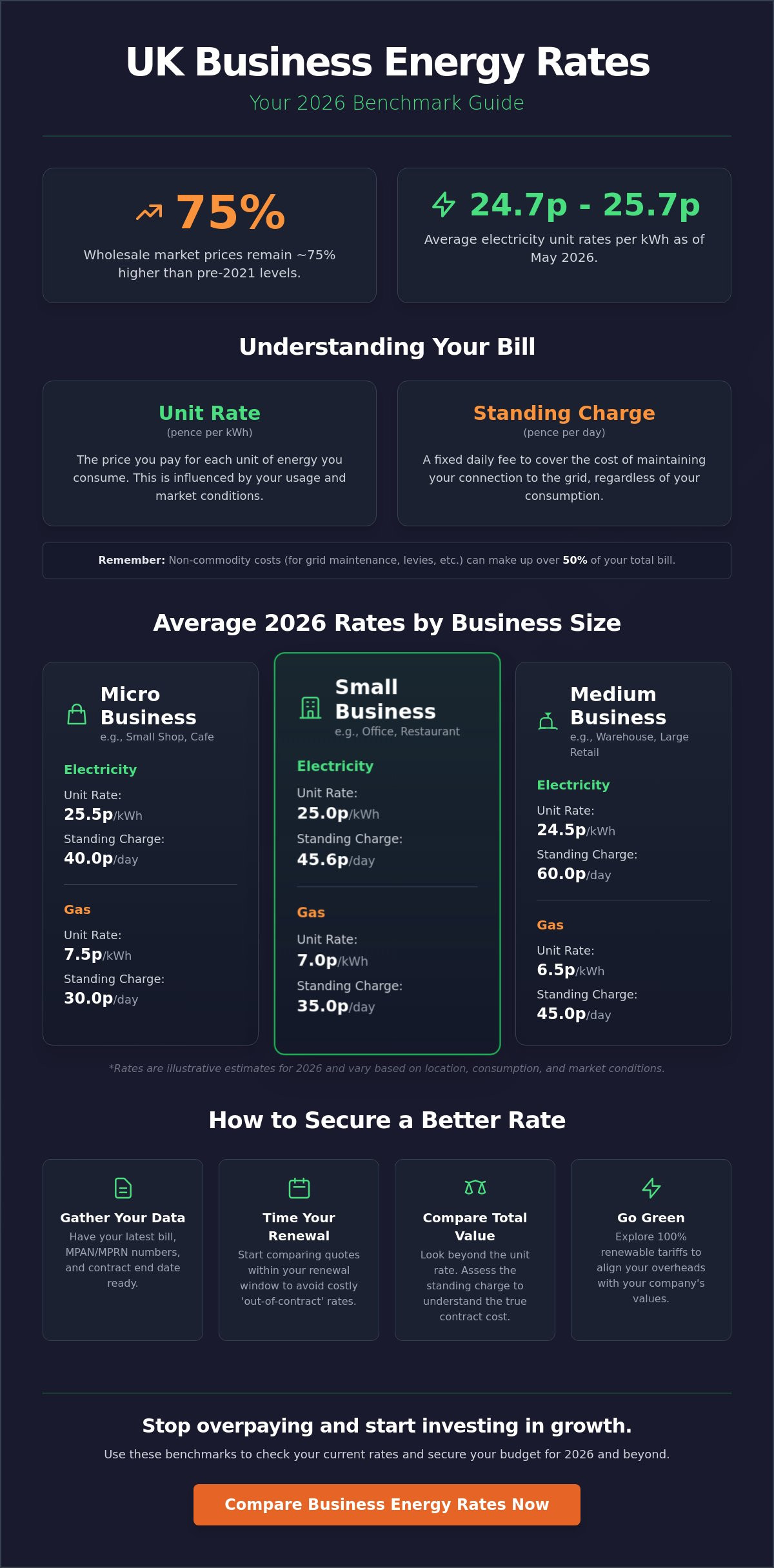
The UK energy market in 2026 remains a complex environment for any growing enterprise. Whilst we have moved past the extreme peaks of previous years, business energy rates per kwh uk are still roughly 75% higher than pre-2021 benchmarks. This baseline shift means that "normal" now looks very different for your balance sheet. Recent data from May 2026 shows average electricity unit rates sitting between 24.7p and 25.7p per kWh. With the domestic price cap rising by 13% in July 2026, wholesale pressures are clearly filtering through to the wider commercial market.
National Grid infrastructure upgrades are currently modernising how power moves across the country. These essential works ensure long-term reliability but also impact the non-commodity costs on your monthly bill. As the UK accelerates its shift towards renewable generation, daily price fluctuations have become more pronounced. Solar and wind output now dictate wholesale availability on an hourly basis. For your business, this volatility makes timing your renewal critical. Avoid "deemed" or out-of-contract rates at all costs. These variable tariffs are significantly more expensive than negotiated fixed terms and can erode your profit margins overnight.
Wholesale vs. Retail: Why Your Quote Differs
Your quote rarely mirrors today's live wholesale price. Suppliers use "hedging" to buy energy months or years in advance, creating a vital buffer against sudden global spikes. This process leads to a natural time lag; retail rates don't drop the moment wholesale prices dip. To get a clear picture of your costs, start by Understanding Your Bill: Unit Rates vs. Standing Charges. Whilst larger industrial users often opt for "spot market" pricing to track live fluctuations, most SMEs prefer the security of a fixed-rate contract. Suppliers must factor in their own operational costs and risk premiums, which explains why two quotes on the same day can vary wildly.
The Impact of Net Zero Targets on 2026 Rates
Net Zero targets are no longer just a policy goal; they are embedded in your unit price. Green levies and carbon taxes are integrated into every business energy rates per kwh uk quote you receive. However, 2026 has brought a surge in genuine 100% renewable tariffs for SMEs. Regulators are now more strictly policing "greenwashing," ensuring that the renewable claims on your contract are backed by real investment in clean generation. Choosing a green tariff is a proactive step that aligns your overheads with modern corporate values. It transforms a standard utility cost into a badge of environmental responsibility for your brand.
Understanding Your Bill: Unit Rates vs. Standing Charges
Your bill isn't just a single number. It's a combination of two distinct charges that dictate your monthly spend. The unit rate is the price you pay for every kilowatt-hour of energy you actually use. In 2026, finding competitive business energy rates per kwh uk means looking beyond the headline figure. This rate fluctuates based on wholesale availability and your supplier's hedging strategy. It's the variable part of your bill that you can directly influence by reducing consumption or improving efficiency.
The standing charge is a fixed daily fee. It covers the cost of maintaining your connection to grid infrastructure and reading your meter. It applies even if you don't use a single watt of power on a given day. In early 2026, small businesses saw average daily standing charges of around 45.6p. For micro-businesses with low consumption, a high standing charge can quietly inflate your costs even if the unit rate looks attractive. Total Contract Value is the sum of your unit consumption, daily standing charges, and VAT over the full duration of your agreement.
To make an informed decision, you should consult official data such as The 2026 UK Business Energy Landscape: Current Market Trends. This helps you understand how non-commodity costs influence your final quote. Understanding these components ensures you aren't misled by a low unit rate that hides a predatory fixed fee.
The "Hidden" Non-Commodity Costs
Non-commodity costs often make up over 50% of your total bill. TNUoS (Transmission Network Use of System) and DUoS (Distribution Use of System) charges cover the physical delivery of power through national and local networks. You'll also see the Climate Change Levy (CCL); this is a government tax designed to encourage energy efficiency. Whilst most firms pay 20% VAT, your business might qualify for a 5% reduced rate if your usage is very low or you run a charity.
Fixed vs. Variable: Which Architecture Wins in 2026?
Fixed-rate contracts for 12, 24, or 36 months provide essential budget certainty. They shield you from wholesale spikes, which is vital in the current market. Conversely, flexible 'pass-through' contracts allow you to benefit from price drops but expose you to significant risks. Always track your end date to avoid expensive 'rollover' rates. These default tariffs are often the most expensive business energy rates per kwh uk available. If you're unsure which structure fits your growth plans, you can compare tailored business electricity and gas options to find the right balance.
Average Business Energy Rates per kWh by Company Size
Benchmarking your spend is a vital step toward operational efficiency. In 2026, business energy rates per kwh uk vary significantly based on the scale of your consumption. Larger corporations typically command lower unit rates because they offer suppliers high-volume, predictable revenue. This bulk purchasing power allows them to absorb non-commodity costs more effectively than a local independent shop. However, every business can find a "good" rate by understanding where they sit in the market hierarchy.
Your geographical location also influences your final quote. Network distribution costs aren't uniform across the UK; a business in North Wales may face different charges than one in London or the Midlands. Beyond location, your Annual Quantity (AQ) estimate is a primary factor in the rates you're offered. This figure represents your total expected consumption for the year. Ensure your AQ is accurate before requesting quotes. Overestimating can lead to paying for capacity you don't need, whilst underestimating might result in reconciliation charges or less favourable terms.
Micro-Businesses and SMEs (0–50,000 kWh)
Small offices, independent cafes, and high-street shops usually fall into this category. In early 2026, average electricity unit rates for small businesses hovered between 24.7p and 25.7p per kWh. Whilst these rates are higher than those for industrial giants, SMEs now have more leverage. You can access Ofgem's business energy guidance to see how micro-businesses are afforded protections similar to domestic users. These include clearer contract terms and more transparent cooling-off periods, making it easier to switch and save.
Large Commercial and Industrial Users (>100,000 kWh)
Large-scale facilities operate with a different set of rules. If your consumption exceeds 100,000 kWh, half-hourly (HH) metering is likely a requirement. This technology records your usage every thirty minutes, allowing suppliers to offer granular pricing based on when you use power. You'll often encounter "Maximum Demand" charges, which are fees based on the peak amount of electricity you draw from the grid. For industrial users, 2026 is the year to move away from generic tariffs. Negotiate bespoke contracts directly with major suppliers to ensure your business energy rates per kwh uk reflect your specific load profile and operational peaks.
How to Compare and Negotiate Better Energy Rates
Negotiation starts with high-quality data. To secure the most competitive business energy rates per kwh uk, you must first gather your recent bills and identify your unique meter identifiers. For electricity, this is your MPAN (Meter Point Administration Number); for gas, it is your MPRN (Meter Point Reference Number). These numbers allow suppliers to see your actual consumption history rather than relying on generic estimates. Without this precision, you risk receiving quotes that don't reflect your true operational needs.
Timing is your greatest asset in a volatile market. The "renewal window" typically opens six months before your current contract expires. Start your search early to avoid the pressure of a looming deadline. When you review quotes, ensure you are comparing like-for-like. Some providers might omit non-commodity assumptions to make their headline unit rate look more attractive. Always insist on seeing the "fully loaded" price that includes all third-party charges. If you decide to work with an expert guide, you'll need to sign a Letter of Authority (LOA). This simple document empowers a partner to negotiate directly with suppliers, saving you hours of administrative effort.
Avoiding Common Pitfalls in Energy Comparison
Transparency is vital when reviewing new terms. Always ask for a full breakdown of any commissions or brokerage fees built into your unit rate. You should also be wary of "verbal contracts" over the phone. Whilst they are legally binding in the energy sector, you must insist on receiving written terms immediately to verify the details. Check your "termination notice" requirements too. Many suppliers require 30 to 90 days' notice to prevent you from being automatically moved onto expensive rollover rates. If you want to simplify this entire process, you can compare tailored business electricity and gas quotes here to see exactly where you can save.
Using Finance to Lower Energy Costs
True cost reduction goes beyond finding a cheaper supplier; it involves lowering your total consumption. Investing in energy-efficient infrastructure is a visionary move for any growing business. A targeted business loan for LED lighting upgrades or modern HVAC systems can drastically reduce your annual kWh usage. Whilst switching suppliers might save you a small percentage on your unit rate, reducing your demand can cut your total spend by a much larger margin. At Green Compare, we believe in a holistic approach. We help you calculate the ROI of these upgrades, ensuring your capital is invested where it creates the most progress for your firm's future.
Why Green Compare is Your Strategic Energy Partner
Securing the most competitive business energy rates per kwh uk shouldn't be a solo endeavour. At Green Compare, we act as your proactive ally, moving beyond the role of a traditional broker to become a long-term partner in your commercial growth. Our commitment to transparency is absolute. We clearly disclose how we work with our panel of suppliers, ensuring you always understand the architecture of your quote. This openness builds a foundation of trust, allowing you to make financial decisions with total confidence and clarity.
The Green Compare Efficiency Metric is our signature of proficiency. This internal benchmark allows us to analyse your current spend against the 2026 market reality, identifying exactly where your overheads can be trimmed. We don't just look at Business Electricity; we integrate Business Gas and Business Loans into a single, cohesive strategy for operational progress. This philosophy extends to managing your internet connectivity via broadbandfreedom.co.uk. By handling the complex administrative burden of switching and renewals, our expert guides free up your schedule. This allows you to focus on what matters most: scaling your enterprise and leading your team.
A Streamlined Process for Busy Directors
Speed and precision define our service. We move your firm from initial quote to finalised contract in a single, linear progression that respects your time. If you manage a multi-site portfolio, your dedicated account manager will coordinate every connection, ensuring consistency across your entire estate. Don't let administrative friction stall your momentum. Organise your business energy comparison today and experience a faster way to secure your utility future.
Supporting the UK’s Sustainable Future
Ethical procurement is a cornerstone of modern business empowerment. In 2026, we prioritised partnerships with green energy suppliers who offer genuine 100% renewable tariffs. These providers aren't just chosen for their competitive business energy rates per kwh uk, but for their commitment to the UK's net-zero transition. We help you align your overheads with contemporary corporate values, transforming your utility bill into a statement of environmental responsibility. Join the thousands of UK firms who have already simplified their path to sustainability. Together, we can power a cleaner, more efficient future for every sector of the British economy.
Power Your Business Progress in 2026
The 2026 energy landscape demands a proactive approach to overhead management. You now understand how to distinguish between unit rates and standing charges, ensuring your total contract architecture remains lean and predictable. By identifying the current benchmarks for business energy rates per kwh uk, you've taken the first step toward reclaiming your budget from market volatility. Knowledge is your most powerful tool in securing the long-term financial health of your enterprise.
Green Compare is here to simplify the next stage of your journey. Since our founding in 2019, we've utilised over seven years of market expertise to act as your transparent, independent guide. We provide a clear, rapid comparison across top UK suppliers with absolute commission transparency and no hidden brokerage fees. Stop overpaying for your essential utilities and start directing those vital savings back into your firm's professional advancement and sustainable growth.
Compare 2026 Business Energy Rates Now and lock in the stability your business deserves. We're ready to help you reach your next milestone with confidence and ease.
Frequently Asked Questions
What is the average business electricity rate per kWh in the UK for 2026?
In May 2026, average electricity unit rates for UK firms ranged between 24.7p and 25.7p per kWh. These business energy rates per kwh uk are heavily influenced by your company's annual consumption and geographical location. Smaller enterprises typically see rates at the higher end of this spectrum, whilst industrial users leverage bulk buying power to secure lower unit prices. Always compare the total contract value rather than just the headline unit rate to ensure you're getting a fair deal.
Can I switch my business energy supplier if I am currently in a contract?
Most commercial energy agreements are fixed-term contracts that don't allow you to switch until your renewal window opens. This window usually starts six months before your current end date. Whilst you can't usually terminate early without significant exit fees, you can secure a new rate today that begins the moment your current one expires. This proactive approach protects you from future price spikes whilst ensuring a seamless transition between suppliers when your term concludes.
What is a standing charge and why does it vary so much between suppliers?
A standing charge is a fixed daily fee that covers the cost of maintaining the physical wires, pipes, and meters that supply your premises. It varies between suppliers because of differing operational costs and regional network charges. Some providers offer low unit rates but inflate the standing charge to compensate. For micro-businesses with low energy usage, a high standing charge can significantly increase the effective business energy rates per kwh uk they pay each month.
Do business energy prices include VAT and Climate Change Levy (CCL)?
Most commercial energy quotes are presented exclusive of VAT and the Climate Change Levy (CCL). Standard VAT for business energy is 20%, but you might qualify for a 5% reduced rate if your usage is below the "de minimis" threshold or if you have charitable status. The CCL is a government tax on energy used by businesses to encourage efficiency. Always check if these statutory costs are included in any final price comparison you receive from a broker or supplier.
How long does it take to switch business energy suppliers in 2026?
Switching your supplier can now take as little as five working days once your new contract is processed. However, the actual start date depends on when your current fixed-term agreement concludes. We recommend starting the process at least three months before your contract ends. This allows ample time for your new supplier to organise the transfer and ensures you don't accidentally slip onto expensive out-of-contract rates during the transition between providers.
What happens if my business energy contract expires and I haven’t renewed?
If you let your contract expire without renewing, your supplier will move you onto "out-of-contract" or "deemed" rates. These are variable tariffs that are often the most expensive rates in the market, sometimes double the price of a negotiated fixed term. You aren't tied into a long-term deal on these rates, but they will drain your budget quickly. Act fast to secure a new agreement and stop the financial leak that these variable tariffs create.
Is green business energy more expensive than standard "brown" energy?
Green energy is no longer a premium-priced luxury and is often comparable to standard "brown" energy. In 2026, the increasing supply of renewable generation has brought prices into parity with fossil fuel alternatives. Some green tariffs even offer better long-term value because they are shielded from certain carbon taxes. Choosing a renewable contract is a simple way to align your overheads with your company's environmental and social responsibility goals without sacrificing your profit margins.
How do I find out who my current business energy supplier is?
You can find your current supplier by checking your most recent utility bill or looking at the meter itself for a supplier logo. If you've recently moved premises and don't have a bill, you can contact your local Distribution Network Operator (DNO). They maintain a database of every Meter Point Administration Number (MPAN) and can confirm which supplier is currently registered to your address. This is a vital first step before requesting new quotes for your next contract.