Guide to Business Energy Standing Charges for UK Firms
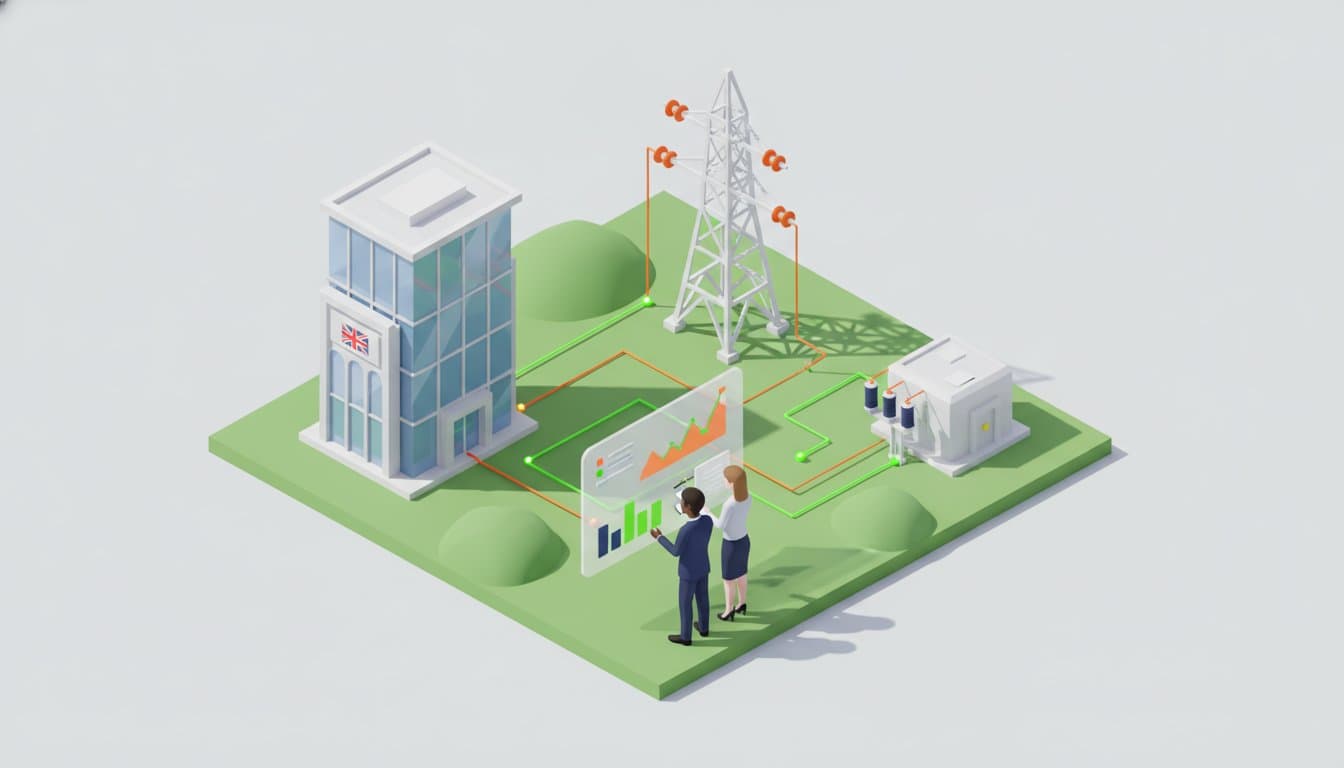
Why are you paying your energy supplier every single day, even when your office lights are off and the heating is powered down? It feels like a hidden tax on your progress. You likely find unpredictable monthly overheads frustrating, especially when bill terminology remains intentionally confusing. With network charges rising by over 60% since April 2026, those daily fees are no longer a minor detail. They are a significant drain on your bottom line.
Mastering the art of understanding business energy standing charges is your first step toward total financial clarity. You deserve to know exactly where every penny goes. This guide empowers you to uncover hidden savings and take total control of your commercial overheads. We will break down the latest 2026 pricing data, compare high versus low standing charge tariffs, and show you how to align your energy contract with your actual usage patterns. Let's turn your utility bills from a source of stress into a streamlined part of your business growth.
Key Takeaways
- Identify why you pay a fixed daily fee regardless of usage and how these costs maintain the essential national grid infrastructure.
- Apply the "Golden Rule" of energy procurement to choose between low unit rates or low standing charges based on your specific consumption profile.
- Gain a competitive advantage by understanding business energy standing charges and how the 2026 rise in network costs impacts your monthly overheads.
- Learn to navigate Ofgem's latest regulatory reviews to ensure your firm is protected from unfair pricing in the commercial energy market.
- Simplify your search for better gas and electricity rates by breaking down complex quotes into clear, actionable steps for immediate savings.
What is a Business Energy Standing Charge and Why Does it Exist?
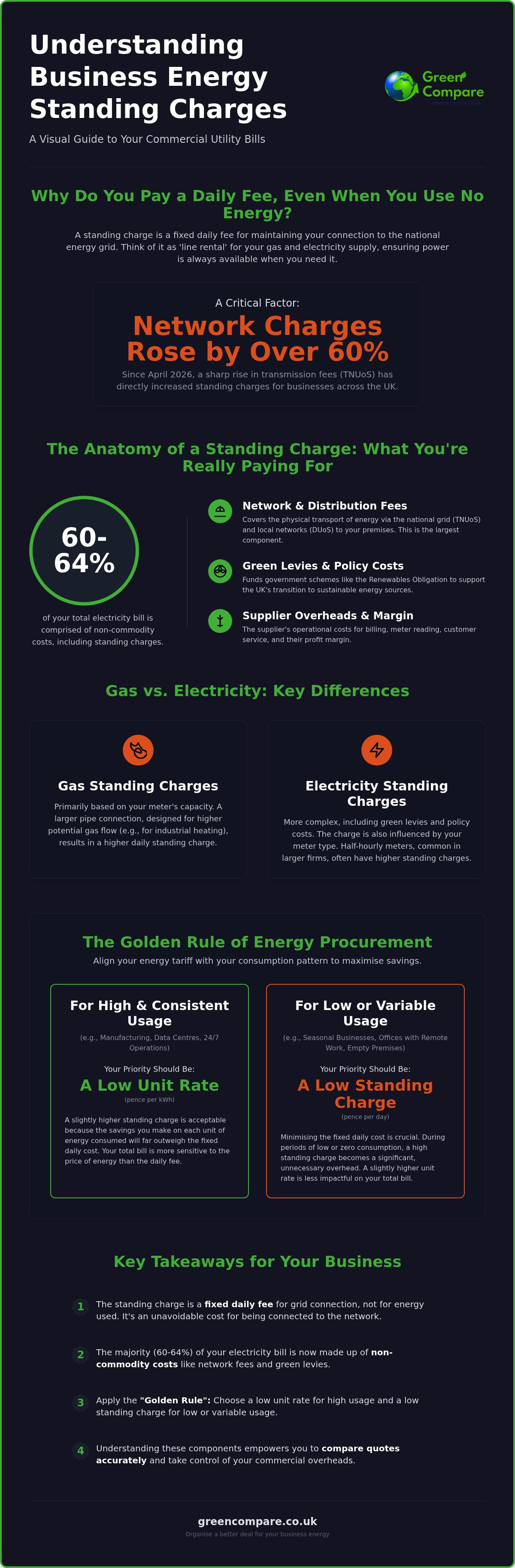
A business energy standing charge is a fixed daily fee. It doesn't matter if you use 100 kWh or zero. The price stays the same. Understanding business energy standing charges is vital because these costs cover the privilege of being connected to the UK's energy infrastructure. Think of it as "line rental" for your building. Just as you pay for a broadband connection regardless of how many emails you send, you pay for the wires and pipes that deliver power to your premises. This fee ensures the lights stay on whilst you focus on growth.
Commercial standing charges are usually higher than those for households. This is because businesses often require a more robust connection to handle sudden surges in demand. Suppliers must reserve capacity on the grid specifically for your site. This incurs a higher maintenance cost that reflects the scale of your operations and the reliability your firm requires to function without interruption.
The Core Purpose of the Charge
The primary goal is to fund the physical transport of energy from power stations to your door. This money supports the Distribution Network Operators (DNOs) who maintain local lines and the National Grid operators who manage long-distance transmission. When reviewing the components of an electricity bill, the standing charge represents the cost of reliability. It guarantees a 24/7 supply even during periods of peak national demand. Additionally, it covers the administrative overheads of managing your commercial account and processing your data.
Gas vs. Electricity: Key Differences in Standing Charges
Gas standing charges are primarily based on your meter's capacity. If your building requires a high-volume gas supply for industrial heating or manufacturing, your daily fee will be higher to reflect that potential demand. It is a pragmatic calculation based on the physical size of the connection and the volume of gas it can safely deliver at any given time.
Electricity charges are often more intricate. They frequently include "green" subsidies that support the UK's transition to renewable energy and help fund sustainable infrastructure projects. Your meter type also dictates the cost. Half-hourly meters, which are standard for larger firms, usually carry higher standing charges. These meters provide more granular data but require more complex network management. Choosing the right setup is a strategic decision that can impact your long-term overheads.
The Anatomy of a Standing Charge: What are You Actually Paying For?
Your energy bill is more than just a price for the gas or electricity you burn. It is a complex assembly of infrastructure maintenance, policy funding, and service delivery fees. By understanding business energy standing charges, you can see exactly how your money supports the UK's energy stability. In 2026, non-commodity charges, which include these network and policy costs, now account for approximately 60-64% of a typical business electricity bill. This means the majority of what you pay is decided by the system before you even flip a light switch.
Network and Distribution Fees (DUoS & TNUoS)
Think of these as the delivery fees for your energy. DUoS (Distribution Use of System) covers the "last mile" of cables and substations in your local area. These are managed by regional Distribution Network Operators. TNUoS (Transmission Network Use of System) represents the long-distance haulage across the high-voltage national grid. From April 2026, TNUoS charges rose by more than 60%, a shift that has directly pushed up standing charges for firms across the country. Your geographic location also plays a part; businesses in remote areas often face higher fees because it costs more to maintain the infrastructure that reaches them.
Green Levies and Government Policy
National policy dictates that a significant portion of your daily fee funds the UK's transition to a greener future. This includes the Renewables Obligation, which incentivises large-scale renewable electricity generation. You are also likely still contributing to the legacy costs of the Feed-in Tariff, a scheme that supported earlier adopters of solar and wind technology. Even if you choose a 100% renewable energy contract, these levies remain part of the standing charge structure. This system is designed to share the cost of national decarbonisation across all commercial users. To get a clearer picture of how these regulations are governed, you can review Ofgem's role in standing charges and how they balance consumer protection with infrastructure investment.
The final piece of the puzzle is the supplier's margin. This covers billing systems, customer service, and the basic cost of doing business. Whilst most of the standing charge is dictated by external factors, this is the area where suppliers can offer competitive advantages. Finding a partner that manages these overheads efficiently is a smart way to protect your bottom line. You can easily compare business electricity rates to see which suppliers are offering the most transparent value today.
Strategic Comparison: Low Standing Charge vs. Low Unit Rate
Choosing between a low standing charge and a low unit rate is the most critical calculation you will make during procurement. It is not about finding the lowest number on the page. It is about finding the lowest total cost for your specific consumption profile. Understanding business energy standing charges allows you to pivot your strategy based on how your firm operates. For some, the daily fee is a minor detail; for others, it is the primary driver of their annual expenditure.
The "Golden Rule" of commercial energy is simple. High-consumption businesses must prioritise low unit rates. When you are burning through thousands of kilowatt-hours every month, a single penny difference in the unit rate can save you hundreds of pounds. Conversely, low-consumption or seasonal businesses should prioritise low standing charges. If your premises sit empty for parts of the year, a high daily fee will drain your bank account even when you aren't using a single spark of power. This strategic decision is supported by House of Commons Library analysis of energy standing charges, which highlights how variations in these fees impact different types of consumers across the UK.
Case Study: The Small Office vs. The Large Warehouse
Consider a small professional services office using 5,000 kWh per year. At this level of usage, the standing charge can represent nearly 15% of the total bill. For this firm, paying a slightly higher unit rate to secure a lower daily fee is often the most efficient path. Every penny saved on the daily charge goes straight back into their operating budget. They don't have the volume to make a low unit rate worth a high fixed entry cost.
Now, look at a large warehouse consuming over 55,000 kWh annually. In this scenario, an extra 10p on the daily standing charge is almost irrelevant. If that higher fixed fee allows them to drop their unit rate by even half a penny, the annual savings are substantial. Visualising the cost impact over a 12-month contract period is essential. You must calculate the "break-even" point where the benefits of a lower unit rate finally outweigh the cost of a higher standing charge.
The Pitfalls of Zero Standing Charge Tariffs
Suppliers often market "Zero Standing Charge" tariffs to businesses looking to simplify their bills. It sounds like a perfect solution, but you must look closer. Suppliers hide the fixed cost by significantly inflating the unit rate. You might avoid the daily fee, but you will pay a massive premium for every kilowatt-hour you consume. These tariffs are rarely the best choice for active SMEs because the inflated unit rates often outstrip any savings within the first few months of operation. They are generally only cost-effective for truly unoccupied buildings or sites with almost zero electricity demand.
Managing Costs in 2026: Market Trends and Ofgem Regulations
The 2026 energy landscape is defined by a significant transition in how infrastructure costs are distributed. Whilst wholesale prices have stabilised since the 2022 peak, standing charges have risen amongst all major UK suppliers. This trend is largely driven by the start of Ofgem's RIIO-3 price control period in April 2026, which allows network operators to increase investment in the grid. Understanding business energy standing charges in this environment is no longer optional. It is a fundamental requirement for any firm looking to maintain a lean operation. With non-commodity charges now making up over 60% of your total bill, the daily fee has become a primary lever for cost management.
The Targeted Charging Review (TCR) Explained
The Targeted Charging Review represents a massive regulatory shift in how you pay for the wires and pipes. Historically, businesses could reduce their "use of system" charges by shifting consumption away from peak periods. The TCR has effectively ended this practice for many. It moved these costs from variable unit rates into fixed daily standing charges. This means you can no longer "avoid" certain network costs simply by turning off equipment during peak hours. The cost is now tied to the fact that you have a connection at all. For your 2026 procurement strategy, this means you must focus on the total daily cost rather than relying on load-shifting to save money.
Ofgem is currently conducting an ongoing review into the fairness of these charges for commercial users. There is a growing recognition that the smallest businesses are being disproportionately affected by rising fixed fees. Whilst this review may lead to future adjustments, the current reality remains one of high fixed overheads. You must adapt your budget to account for these non-negotiable daily costs whilst waiting for potential regulatory relief. Wholesale market volatility remains a factor, but the stability of your standing charge is now the anchor of your energy contract.
Future-Proofing Your Energy Contract
Protect your business from further spikes by considering multi-year fixed contracts. In a rising charge environment, locking in your standing charge today prevents your overheads from creeping up over the next 24 to 36 months. Smart meters are also essential tools in this process. They provide the granular data needed to justify your meter class and ensure you aren't being overcharged based on estimated capacity requirements. Looking further ahead, prepare for "Time of Use" standing charge variations. These may eventually offer lower daily rates for businesses that can prove they place less strain on the local network.
Take the first step toward long-term stability and compare business gas and electricity rates to lock in your 2026 overheads today.
How to Organise a Better Deal with Green Compare
Efficiency is the cornerstone of a successful enterprise. At Green Compare, we believe that procurement should be a catalyst for growth, not a source of administrative stress. Our comparison tool is built to strip away the complexity of the commercial market, breaking down every quote into clear, comparable parts. We don't just show you a headline price. We provide a transparent view of the unit rates and fixed fees, ensuring that understanding business energy standing charges becomes a straightforward part of your decision-making process.
Finding a competitive quote shouldn't take days of back-and-forth emails. We value your time above all else. Our platform delivers rapid results, allowing you to secure a market scan in minutes. We disclose exactly how we work because we are invested in your long-term development. By moving beyond the "cheapest" headline rate, we help you find the best total value that aligns with your specific consumption patterns and operational goals. This expert guidance ensures you aren't caught out by hidden costs later in your contract.
Our 3-Step Switching Process
We have simplified utility procurement into a linear, stress-free sequence designed for maximum speed. Follow these steps to take control of your overheads today:
- Step 1: Provide your current usage data and postcode. This allows us to perform a tailored market scan based on your precise geographic location and specific meter requirements.
- Step 2: Review a curated list of tariffs. We present options where standing charges are optimised for your consumption, highlighting the trade-offs between fixed fees and unit rates.
- Step 3: Receive direct assistance. Our experts manage the transition with your new supplier to ensure zero downtime for your operations, keeping your business powered and productive throughout the switch.
Beyond Energy: Holistic Business Support
Your energy strategy is a vital component of your broader financial health. By understanding business energy standing charges and reducing unnecessary expenditure, you free up vital capital. This found money can be reinvested into new equipment, staff training, or marketing initiatives that drive your company forward. We view ourselves as your proactive partner in this journey of professional advancement, helping you turn mundane administrative tasks into a narrative of empowerment.
Our support extends beyond utility management. If you are looking to further empower your enterprise, explore our business finance solutions. Whether you require Business Gas, Business Electricity, or Business Loans to fund your next stage of growth, we provide the tools to make it happen. We are not merely a utility platform; we are a knowledgeable ally ready to assist in your collective progress toward a sustainable and profitable future.
Compare business energy prices now with Green Compare
Take Control of Your Commercial Overheads
Managing your firm's energy costs is no longer about accepting the first quote you see. It is about strategic alignment. By mastering the balance between daily fixed fees and unit rates, you can protect your bottom line from the volatility of the 2026 market. Understanding business energy standing charges is the foundation of a proactive procurement strategy; it allows you to turn a complex administrative burden into a source of competitive advantage. You now have the knowledge to navigate regulatory shifts and choose the tariff that truly reflects your consumption profile.
Green Compare has been trusted by UK SMEs since 2019 to simplify the complexities of the commercial sector. We provide expert commercial utility procurement through a rapid, transparent switching service that values your time and your growth. Stop overpaying for your connection and start investing in your future. Start your business energy comparison today and join a community of forward-thinking enterprises that value efficiency and progress. Let's build a more sustainable, cost-effective future for your business together.
Frequently Asked Questions
Can I negotiate my business energy standing charge?
You can negotiate the overall terms of your energy contract, but the standing charge itself is largely composed of fixed infrastructure costs. Whilst suppliers have a small margin they can adjust, your best strategy is to compare the total cost across multiple providers. Focus on finding a tariff where the balance between the daily fee and the unit rate matches your usage profile. A proactive approach to procurement is the most effective way to secure a deal that supports your long-term growth.
Why is my business standing charge higher than my home one?
Business standing charges are higher because commercial connections often require greater capacity and more robust infrastructure than domestic ones. Suppliers must reserve space on the grid to handle your peak demand, which increases maintenance costs. Additionally, businesses are not protected by the domestic Ofgem price cap, which was set at £1,663 per year in 2026 for typical households. This leaves commercial rates subject to the pragmatism of the open market.
Are there any business energy tariffs with no standing charge?
Zero standing charge tariffs do exist, but they are rarely the most cost-effective choice for active SMEs. Suppliers usually compensate for the lack of a daily fee by significantly increasing the unit rate for every kilowatt-hour you consume. These are best suited for buildings that remain empty for most of the year or have extremely low energy requirements. For most operational firms, understanding business energy standing charges is the better path to finding true value.
How much is a typical standing charge for a UK small business in 2026?
As of August 2026, a typical small business electricity standing charge is 70.6p per day. For gas, the average for a small business is 40.6p per day. These rates have increased recently due to the 60% rise in Transmission Network Use of System charges that took effect in April 2026. These figures represent the baseline for maintaining a reliable connection to the national grid whilst you focus on your enterprise.
Will my standing charge change if I install a smart meter?
Installing a smart meter will not automatically change your standing charge rate, but it provides the data needed for more accurate billing. Understanding business energy standing charges becomes easier when you have a precise, automated view of your consumption. This data can help you justify a move to a different tariff or meter class that better suits your actual requirements, ensuring you only pay for the capacity your business truly needs.
Does the location of my business affect the standing charge I pay?
Your geographic location directly impacts your standing charge because the UK is divided into different Distribution Network Operator regions. It costs more to maintain cables and pipes in remote or rural areas compared to densely populated urban centres. These regional variations are a standard part of the UK energy infrastructure and are passed on to your firm through the daily fee. This is why quotes can vary significantly even between identical businesses in different postcodes.
What happens to my standing charge if my business is seasonal and closes for winter?
You must continue paying the standing charge even if your business is closed for the winter and your energy usage drops to zero. The fee covers the ongoing maintenance of the physical connection and the reservation of grid capacity for your site. If your business is highly seasonal, you should prioritise tariffs with a lower standing charge. This strategy minimises your fixed overheads during periods of inactivity and keeps your financial momentum steady throughout the year.