Compare Business Energy Prices: The 2026 Guide to Commercial Savings

Did you know that network transmission charges surged by over 60% this April, quietly inflating your overheads regardless of wholesale market shifts? For many UK enterprises, the start of the RIIO-3 price control period has turned utility management into a complex maze of shifting tariffs and hidden costs. It’s frustrating to watch your margins shrink whilst you're stuck decoding jargon or fearing expensive rollover rates. You deserve a transparent way to compare business energy prices without the manual headache or the lack of clarity surrounding broker commissions.
We're here to change that narrative and turn your energy procurement into a strategic growth lever. This guide reveals how to master the 2026 energy market, secure competitive rates, and ensure long-term stability for your organisation. Discover a streamlined approach that moves you from confusion to a confirmed contract in minutes. Let’s simplify your path to progress and lock in the savings your business needs to thrive.
Key Takeaways
- Master the 2026 energy landscape by identifying how new regulatory changes and transmission charges affect your bottom line.
- Use our streamlined framework to compare business energy prices and secure transparent, competitive rates in under sixty seconds.
- Learn to distinguish between complex contract types to ensure your business enjoys long-term price stability and avoids costly rollover traps.
- Simplify your switching journey with a linear, four-step guide that removes the stress of administrative jargon and manual data entry.
- Empower your organisation's future by integrating utility procurement with strategic finance options for holistic commercial growth.
Why Comparing Business Energy Prices is Critical in 2026
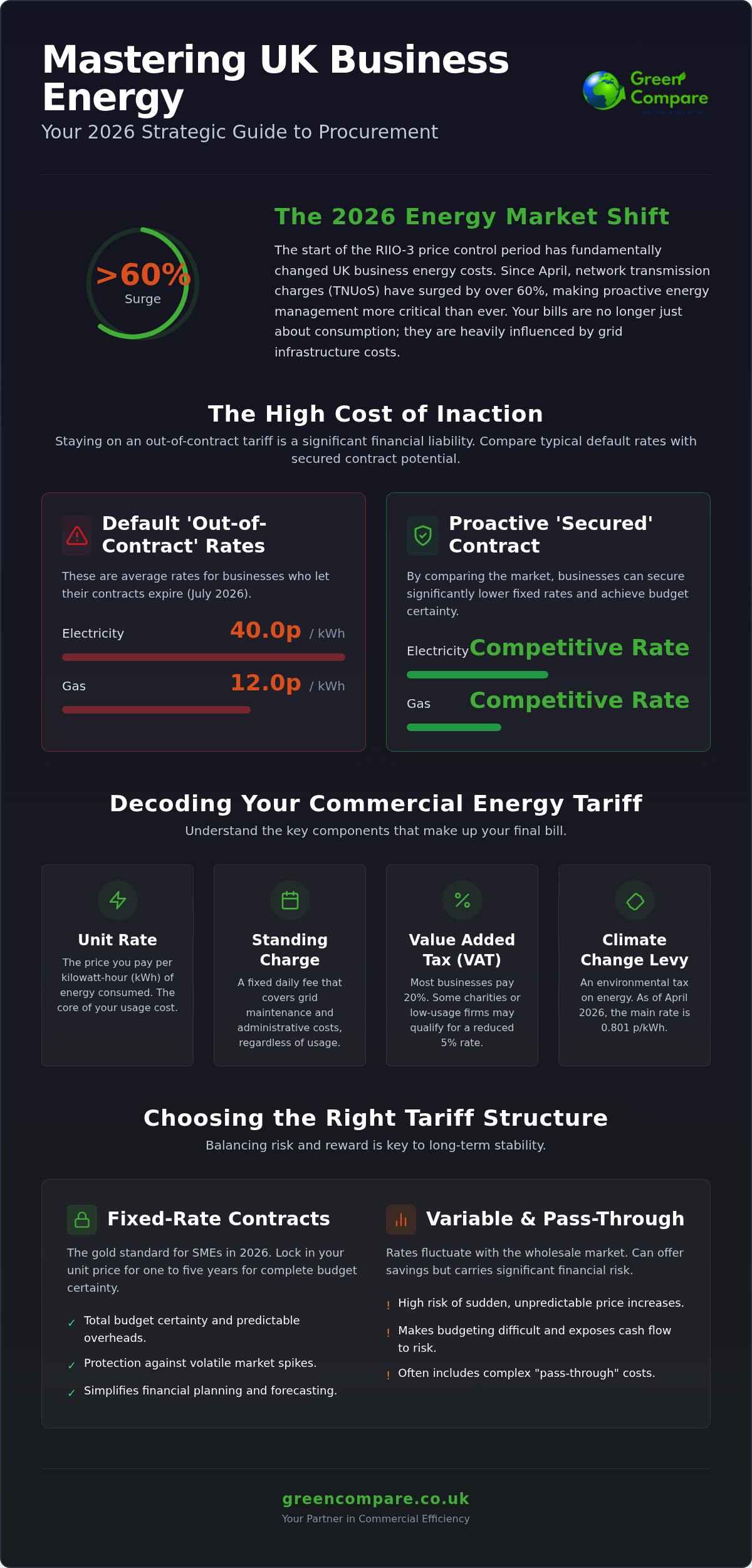
The UK commercial energy market in 2026 is defined by a fundamental shift in how costs are structured. While wholesale prices have stabilised since the peaks of the early 2020s, non-commodity costs have taken centre stage. Since April 2026, the RIIO-3 regulatory framework has triggered a significant increase in network charges to fund grid modernisation. Transmission Network Use of System (TNUoS) charges alone surged by over 60%, directly impacting your bottom line. This means your bill is no longer just about the energy you use; it’s about the infrastructure that delivers it. Understanding how the energy market works is now essential for every business owner. If you don't actively compare business energy prices, you risk absorbing these infrastructure costs through outdated, expensive tariffs.
Inertia is the silent killer of commercial margins. In July 2026, average out-of-contract electricity rates hit approximately 40.0p per kWh, whilst gas reached 12.0p per kWh. Staying with your current supplier by default is no longer a safe bet; it’s a financial liability. UK SMEs across sectors like manufacturing and hospitality are feeling the pinch of volatility differently. A sudden spike in wholesale gas costs, as seen in March 2026, can devastate a business on a variable rate. Moving from a "cheapest at all costs" mindset to a "best value" strategy ensures you secure a partner that offers both stability and transparency.
The 2026 Regulatory Landscape and Ofgem Changes
Transparency is the new standard for the industry. As of 2026, Ofgem has tightened rules regarding energy broker commissions, ensuring you see exactly what you’re paying for in every quote. These changes empower microbusinesses with stronger switching rights and clearer contract terms. You should also prepare for the mandatory shift towards half-hourly settled contracts. This change allows for more precise billing based on real-time usage, rewarding businesses that can shift their demand away from peak times. It’s an opportunity to turn a passive cost into an active saving.
Future-Proofing Your Business Against Price Spikes
Securing your organisation's future requires a proactive stance. Long-term fixed contracts are gaining massive favour in 2026 as a shield against geopolitical uncertainty. Don't ignore the power of smart meters; they are the backbone of accurate billing and usage monitoring, preventing the "estimated bill" shocks that disrupt cash flow. Organise your energy strategy to align with seasonal demand peaks. By locking in a rate now, you transform a volatile overhead into a predictable, manageable expense that supports your broader professional advancement. To further strengthen your financial position, Fair View Accounting Services can help you manage these reduced overheads and ensure your accounting strategy supports your long-term commercial objectives.
Understanding Commercial Energy Tariffs: Key Components
Decoding your energy bill is the first step toward reclaiming your budget. Unlike domestic accounts, commercial energy prices are highly bespoke and influenced by your industry, location, and consumption patterns. When you compare business energy prices, you'll notice that unit rates are often lower than residential ones. However, businesses don't benefit from a price cap. This makes every penny in the unit rate and standing charge vital to your overall efficiency. Action leads to savings.
Most organisations pay a standard VAT rate of 20% on their energy, though some charities or low-usage firms may qualify for a 5% reduction. You must also account for the Climate Change Levy (CCL), a tax designed to encourage energy efficiency. As of April 1, 2026, the main rate for both electricity and gas is 0.801p/kWh. A Deemed Contract is the default high-rate agreement for businesses that move premises without a contract or let their current agreement expire without a renewal.
Standing Charges vs. Unit Rates: Finding the Balance
Your standing charge is a daily fee that covers the cost of maintaining the power grid and reading your meter. These charges vary significantly by region; a business in London might face different daily costs than one in Glasgow. If you're a low-volume user, like a small boutique, a high standing charge can quickly cancel out a competitive unit rate. Conversely, high-volume manufacturers should prioritise the lowest possible unit rate, even if it means a slightly higher daily standing charge. Look out for "pass-through" costs, as these can be unbundled and added to your bill separately, often leading to unexpected totals.
Fixed-Rate vs. Variable and Pass-Through Tariffs
Choosing the right tariff structure is about balancing risk with reward. Fixed-rate contracts remain the gold standard for SMEs in 2026. They lock in your unit price for one to five years, providing total budget certainty whilst protecting you from sudden market spikes. This article from Forbes explains the UK energy market and the inherent risks of variable-rate options in greater detail. Variable-rate or out-of-contract tariffs are almost always the most expensive route and leave you vulnerable to geopolitical shifts. For larger enterprises with significant demand, pass-through contracts offer a way to pay wholesale prices directly, though they require a high tolerance for market fluctuations. It's often more efficient to compare business energy prices now rather than waiting for your current deal to lapse into a variable rate.
The Ultimate Comparison Framework for UK Businesses
Price is the headline, but value is the story. When you look to compare business energy prices, it’s easy to get tunnel vision on the unit rate. However, a cheap tariff becomes expensive if the supplier’s billing is inaccurate or their customer service is unresponsive. You need a partner that values your time. High-quality billing accuracy prevents the administrative nightmare of correcting overcharges; robust support ensures that any issues are resolved before they impact your operations. Efficiency is found in the details of the service, not just the numbers on the quote.
Assess the financial stability of your potential supplier, especially amongst smaller niche providers. Whilst these innovators often lead the market in green technology, you must ensure they have the staying power to support your long-term growth. Our platform makes it simple to compare business energy prices based on these deeper metrics, allowing you to prioritise reliability alongside cost. We act as your expert guide, helping you weigh up these variables to find a solution that matches your organisation’s unique rhythm and professional goals.
The Growing Importance of Green Energy Credentials
Sustainability is no longer a corporate luxury; it’s a competitive advantage. Comparing REGO-backed (Renewable Energy Guarantees of Origin) tariffs allows you to prove your commitment to the environment. This transparency builds trust with your customers and can significantly enhance your brand reputation. Choosing sustainable energy solutions may also align your business with future tax incentives, helping you stay ahead of environmental regulations whilst contributing to our shared progress towards a net-zero future.
Evaluating Contract Flexibility and Length
Deciding between a 12-month and a 36-month deal is a balance of agility and security. Short-term contracts allow you to pivot quickly if market conditions improve. Long-term deals provide the peace of mind needed for accurate three-year forecasting. You must also keep a sharp eye on termination windows. Missing a notice period is the most common reason businesses are rolled onto expensive default rates. If you manage multiple premises, organise them under a single multi-site contract to streamline your administration. This approach simplifies your procurement and ensures all your sites move forward together in a unified strategy.
How to Switch Business Energy Suppliers in Four Simple Steps
Moving your organisation to a more cost-effective tariff should be a milestone of progress, not a source of stress. Now that you understand the 2026 market dynamics, it’s time to take action. Transitioning to a new provider is a linear, logical process designed to protect your cash flow and secure your future. Follow these four steps to move from an expensive default rate to a competitive, transparent agreement.
- Preparation: Gather your most recent utility bills. Locate your Meter Point Administration Number (MPAN) for electricity and your Meter Point Reference Number (MPRN) for gas. These unique identifiers ensure your quotes are 100% accurate for your specific location.
- Comparison: Input your consumption data into our platform. When you compare business energy prices with us, you see a side-by-side view of the market's leading offers in seconds.
- Selection: Analyse the results. Look for the balance of standing charges and unit rates we discussed earlier to find the perfect partnership for your usage profile.
- Confirmation: Finalise your choice. You will need to sign a Letter of Authority (LOA). This essential document empowers us to handle the administrative heavy lifting, from notifying your old supplier to validating the new contract details.
Avoiding Common Pitfalls in the Switching Process
Success lies in the details. Your current supplier might object to a switch if there is outstanding debt on the account or if you are still within a protected contract window. Always check your status before initiating the move. To prevent double-charging during the handover, provide a final meter reading on the day of the switch. Stay vigilant for "hidden" clauses in competitor contracts that might allow for mid-term price adjustments; choosing a fixed-rate deal through a transparent partner is the best way to safeguard your budget.
The Role of an Expert Broker in Your Procurement
We act as your professional guide, removing the friction from commercial utility management. Our experts negotiate directly with suppliers to secure rates that aren't always available on the open market. In line with 2026 transparency standards, we clearly disclose our commissions, ensuring you have total clarity on the value we provide. By letting us handle the administrative legwork, you reclaim your time to focus on what matters most: growing your business. Ready to see how much you could save? Compare business energy prices today and experience a more efficient way to manage your overheads.
Why Green Compare is Your Partner in Commercial Efficiency
Choosing a partner for your utility procurement is a decision that impacts your long-term trajectory. We don't just provide a list of numbers; we offer a pathway to operational excellence. Our commitment to rapid results ensures you don't waste hours on administrative tasks that don't drive your mission forward. By choosing to compare business energy prices with a focus on transparency, you align your organisation with a brand that values reliability and shared progress above all else. Since our foundation in 2019, we have served as an established expert guide for UK enterprises navigating the complexities of the commercial utility sector.
We believe in a partnership-oriented approach that looks beyond the next bill. Our service is designed to alleviate the stress of business overheads by positioning utility management as a simple, stress-free solution. We avoid the cold, clinical feel of traditional brokerage. Instead, we adopt a supportive and visionary stance, suggesting that your success is our success. This collaborative growth is the heartbeat of our service, moving you quickly from a problem to a solution with regional pragmatism and modern entrepreneurial energy.
Integrating Energy Savings into Your Growth Strategy
Efficiency is fuel for expansion. Every pound saved on your gas or electricity bill is a pound that can be reinvested into your team, your technology, or your physical expansion. Lowering your fixed overheads does more than just boost your monthly cash flow; it fundamentally improves your financial profile. This focus on cost-effectiveness should extend to all operational areas, including logistics and corporate travel provided by Ports Transfer. When you reduce your outgoings, your business becomes a more attractive prospect for commercial funding. We support this transition by offering access to business loans, creating a synergy between utility savings and strategic capital investment. This holistic view of commercial finance allows you to build a sustainable and efficient enterprise that is ready for the challenges of 2026 and beyond.
If you are a landlord or business owner looking to reinvest these savings into physical property upgrades, click here to discover how specialist retrofit consultancy can further improve your building's energy efficiency.
Beyond building efficiency, navigating the complexities of site development requires expert logistical oversight. To ensure your planning applications meet all transport and parking requirements, learn more about ML Traffic Engineers UK and how they assist developers with technical documentation.
Take the Next Step Toward Operational Excellence
Operational excellence is within reach. You can compare business energy prices in under sixty seconds, gaining immediate clarity on how to optimise your expenditure. This rapid insight allows you to make informed decisions that propel your organisation toward a more sustainable and profitable future. Our suite of tools is designed to move you quickly from a problem to a solution, ensuring your time remains your most valuable asset. We are more than a utility platform; we are your proactive ally in professional advancement. Take control of your overheads and unlock the potential for collective progress today.
To further protect your time and ensure your business remains financially sound, you can explore Fixed-fee accountancy and tax compliance services with Mazuma, allowing you to focus on your core mission while your financial compliance is handled by experts.
Compare business energy prices and start your journey to efficiency today
Take Control of Your Commercial Future
You now have the tools to master the 2026 energy landscape. You've learned how to decode complex tariffs, navigate the RIIO-3 regulatory shifts, and avoid the silent drain of out-of-contract rates. More importantly, you've seen how utility savings can be the catalyst for your next stage of professional advancement. It's time to move from administrative burden to strategic advantage. Efficiency isn't just a goal; it's the foundation of your growth.
When you choose to compare business energy prices with Green Compare, you gain more than a quote; you gain a partner invested in your long-term success. We provide expert guidance as a UK-based commercial utility specialist, offering access to a wide panel of leading and niche UK energy suppliers. Our transparent procurement process ensures there are no hidden fees, just clear results in seconds. Compare business energy prices now and save on your overheads to unlock your organisation's full potential. Let's build a more efficient, sustainable, and prosperous business together. Your journey to operational excellence starts today.
Frequently Asked Questions
How long does it take to compare business energy prices?
It takes less than 60 seconds to compare business energy prices using our streamlined platform. We value your time above all else, so we've removed the manual hurdles of traditional brokerage. Simply enter your basic details to see a side-by-side view of the most competitive rates available for your organisation.
Can I switch my business energy supplier if I am in a fixed-term contract?
You can usually only switch once you enter your contract's renewal window, which is typically six to twelve months before your current deal expires. Whilst you can't leave a fixed-term contract early without significant exit fees, you can lock in a future rate today to protect against upcoming price spikes. This proactive approach ensures a seamless transition when your current agreement ends.
What information do I need to get an accurate business energy quote?
To secure the most accurate quote, you'll need a recent energy bill that shows your annual consumption in kWh. You should also have your Meter Point Administration Number (MPAN) for electricity or Meter Point Reference Number (MPRN) for gas. These unique identifiers allow us to provide bespoke rates tailored to your specific location and meter type.
What is the difference between a unit rate and a standing charge?
The unit rate is the price you pay for every kilowatt-hour (kWh) of energy your business consumes. The standing charge is a fixed daily fee that covers the cost of maintaining the national grid and supplying energy to your premises. Balancing these two components is essential for finding the most cost-effective deal for your specific usage profile.
Is it better to choose a fixed or variable business energy tariff in 2026?
A fixed tariff is generally the superior choice in 2026 to provide total budget certainty against market volatility. With the 60% surge in transmission network charges observed this April, a fixed contract shields you from further unpredicted rises. This stability allows you to forecast your overheads with confidence and focus your energy on professional advancement.
How does Green Compare earn money from the switching process?
We earn a commission directly from the energy supplier once your switch is successfully completed. This means there is no direct fee for you to compare business energy prices or use our expert guidance. In line with 2026 Ofgem regulations, we maintain total transparency regarding these commissions to ensure you feel confident in our partnership.
What happens if my current energy supplier goes bust?
Your energy supply will continue without interruption thanks to Ofgem’s safety net. If a provider ceases trading, the regulator automatically moves your account to a new supplier. Whilst your supply is safe, you might be moved to an expensive "deemed" rate; it's vital to compare new options immediately to regain control of your costs.
Will there be any interruption to my power supply when I switch?
There is absolutely no risk of a power cut or service interruption during the switching process. The transition is purely administrative, as the same wires and pipes deliver energy to your business regardless of which supplier you choose. We handle the technical handover with your new provider to ensure the entire journey is stress-free and efficient.