Commercial Energy Comparison: The 2026 Guide to Reducing Business Overheads

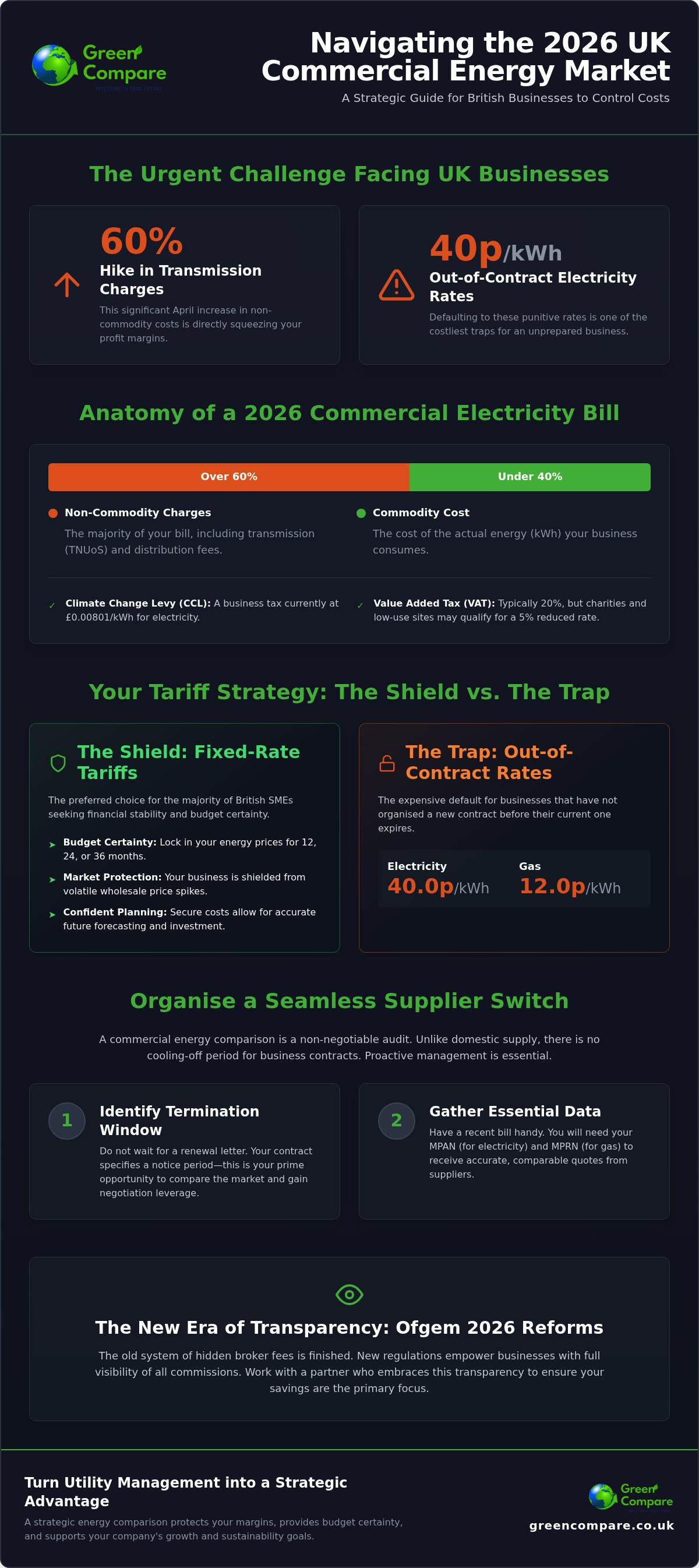
If you think your overheads are high now, wait until you see the 60% hike in transmission charges that hit British businesses this April. Managing utility costs often feels like a full-time job where the rules change every month. You're likely tired of opaque commission structures and the dread of being rolled onto out-of-contract rates that now reach 40p per kWh for electricity. Performing a thorough commercial energy comparison is the only way to escape these traps and protect your margins.
It's time to take control. We promise to help you master the complexities of the 2026 UK market so you can secure the most competitive fixed rates available. This guide breaks down the latest July 2026 market data; it shows you how to align your energy procurement with your corporate sustainability goals. Let's transform your utility management from a source of stress into a strategic advantage for your business. Follow these steps to secure budget certainty and fuel your professional advancement.
Key Takeaways
- Understand why a strategic commercial energy comparison is now a non-negotiable audit for protecting your 2026 profit margins.
- Discover the critical differences between fixed-term and variable-rate tariffs to ensure your business maintains long-term budget certainty.
- Learn how to use a multi-point framework to evaluate supplier financial stability and avoid the risks of market-wide disruptions.
- Master the two-step process for a seamless supplier switch by identifying your termination window and essential meter data.
- Find out how to align your utility procurement with sustainability goals to drive professional advancement and collective progress.
The 2026 UK Commercial Energy Landscape: Why Comparison is Non-Negotiable
A commercial energy comparison is a strategic audit of your utility procurement. It's the first step toward reclaiming control over your overheads. In July 2026, market volatility is a reality that demands "energy agility" from every British enterprise. Don't wait for a renewal letter to arrive; that's the most expensive strategy you can adopt. These letters often land after your best negotiation window has closed. Instead, view your energy as a growth lever. Act now to secure competitive rates that protect your profit margins and support your long-term development.
The End of Opaque Brokerage: New Transparency Standards
The April 2026 Ofgem reforms have finally dismantled the old, clinical world of hidden broker fees. These new standards empower you to see every penny of commission. This transparency is vital for collective progress and ethical procurement. Work with a partner that embraces these rules. Avoid traditional brokers who still attempt to hide costs behind complex jargon. Choosing a transparent ally ensures your savings are always the primary focus, helping you move quickly from a problem to a solution. Proficiency in this area is no longer optional; it is a requirement for professional advancement.
Commercial vs Domestic Energy: The Critical Differences
Business contracts lack the safety nets found in domestic supply. There is no statutory cooling-off period. Once you agree to a deal, you're locked in. This makes understanding your electricity bill essential for every decision-maker. Your bill includes specific taxes like the Climate Change Levy (CCL), currently set at £0.00801 per kWh for electricity. Most enterprises pay 20% VAT, though charities and low-use sites may qualify for 5%.
Remember that non-commodity charges now make up over 60% of your electricity costs after the massive TNUoS hike in April 2026. Commercial deals are usually multi-year and fixed; rolling onto out-of-contract rates is a risk you can't afford. In July 2026, these rates have climbed to 40.0p per kWh for electricity and 12.0p for gas. Secure your next contract early to maintain your momentum and ensure budget certainty. Our process is designed for speed, moving you from a high-cost trap to a cost-effective solution in record time.
Decoding Commercial Energy Tariffs: Finding Your Perfect Fit
Choosing the right tariff is a critical decision because commercial contracts differ fundamentally from domestic ones. Most importantly, business energy deals have no statutory cooling-off period. Once you sign, you are committed. This lack of a safety net makes a comprehensive commercial energy comparison essential before you put pen to paper. You must get the details right the first time to protect your cash flow and ensure your business remains on a path of steady growth.
Your total bill is comprised of two main elements: the unit rate and the standing charge. The unit rate is what you pay for the energy you actually use, whilst the standing charge is a fixed daily fee for maintaining your connection. High-volume users should prioritise a lower unit rate to see the biggest impact on their overheads. Conversely, micro-businesses with low consumption might find more value in minimising the daily standing charge. Identifying the right balance is a simple way to move your business toward greater financial proficiency.
Avoid "deemed" or "out-of-contract" rates at all costs. These are the default prices suppliers charge when your previous deal expires and you haven't organised a new one. In July 2026, these rates have soared to 40.0p per kWh for electricity and 12.0p per kWh for gas. These are amongst the most expensive rates in the market and can quickly derail your budget. To prevent this, learn how to switch your energy supplier well before your current term ends. Proactive management is the hallmark of a visionary enterprise.
Fixed-Rate Tariffs: The Shield Against Volatility
Fixed-rate contracts are the preferred choice for the majority of British SMEs. By locking in your price for 12, 24, or 36 months, you create a shield against wholesale market spikes. This provides absolute budget certainty, allowing you to plan your future investments with confidence. Whilst you won't benefit if market prices drop during your term, the security of a fixed rate usually outweighs the risks of exposure to a volatile market.
Green Tariffs: Sustainability as a Competitive Advantage
Aligning your procurement with ethical values is no longer just a "nice to have" feature. Renewable energy contracts, often backed by Renewable Energy Guarantees of Origin (REGOs), improve your brand reputation and appeal to eco-conscious clients. These deals also help future-proof your business against potential carbon taxes. Whilst some green deals carry a slight price premium, many are now highly competitive with standard "brown" energy. You can easily organise a quote to see how sustainable options fit your current budget.
The 2026 Commercial Energy Comparison Framework
Mastering your procurement requires a structured approach. A commercial energy comparison is more than just a search for the lowest number on a screen. It is a rigorous evaluation of how a supplier aligns with your operational goals and corporate values. Use this multi-point checklist to filter your options and identify a partner that facilitates your professional advancement.
- Financial Stability: Review the supplier's market position. In a volatile 2026 landscape, choosing a financially robust partner prevents the operational chaos of supplier failure.
- Digital Proficiency: Prioritise suppliers offering comprehensive digital account management. Rapid results depend on your ability to access data and resolve queries without waiting in phone queues.
- Payment Flexibility: Opt for Monthly Direct Debit. Most suppliers offer lower unit rates for automated payments compared to BACS or cheque, providing an immediate win for your bottom line.
- Service Ratings: Look for high third-party validation scores. Reliable customer service is the backbone of a stress-free utility solution.
Selecting a supplier is a visionary act. Beyond the cost, consider how their energy mix contributes to collective progress. Many modern suppliers now provide detailed carbon reporting as standard. This data is a powerful tool for your ESG (Environmental, Social, and Governance) strategy, transforming a mundane utility bill into a badge of corporate responsibility.
Calculating the Total Cost of Ownership (TCO)
The unit rate is only half the story. To find the true value of a quote, you must calculate the Total Cost of Ownership. This means looking beyond the headline figures to find your "effective p/kWh". You calculate this by adding your total annual unit costs to your total annual standing charges and dividing by your total consumption. For larger industrial sites, check for capacity charges or reactive power penalties. These hidden costs can significantly inflate your bill if your site's electrical demand exceeds your agreed limits. Transparency here is essential for budget certainty. For those in the petrochemical or power sectors looking to improve technical efficiency, visit OG VALVES LTD. for their guide on industrial valve selection.
Smart Data and Half-Hourly Metering
Modern billing is driven by precision. P272 regulations mean most mid-sized businesses are now billed on an actual, half-hourly basis. This shift away from estimated readings is a massive advantage for your next commercial energy comparison. Smart meters provide the granular data needed to build an accurate usage profile. Use these insights to identify waste and shift heavy consumption to off-peak periods. By integrating data-driven management into your routine, you turn energy from a fixed overhead into a variable cost you can actively influence. This level of control is the ultimate goal of any efficient procurement strategy.
How to Organise a Seamless Supplier Switch
Switching your supplier is a linear, logical process that should never disrupt your daily operations. By following a structured sequence, you can move from a high-cost contract to a competitive rate with minimal effort. This transition is a vital part of your commercial energy comparison strategy, ensuring your business overheads remain lean whilst you focus on growth. Efficiency is the key; a well-organised switch can be completed rapidly when you have the right data to hand.
Follow these five steps to secure a better deal for your enterprise:
- Step 1: Audit your current contract. Locate your agreement and identify the "Termination Window". This is the specific period during which you must notify your supplier of your intent to leave.
- Step 2: Collect your meter data. Find your most recent bill. You will need your MPAN (Meter Point Administration Number) for electricity and your MPRN (Meter Point Reference Number) for gas. These unique identifiers ensure your quotes are accurate.
- Step 3: Issue a Letter of Authority (LOA). Sign a formal LOA to grant your partner permission to negotiate with suppliers on your behalf. This simple document is the engine that drives your procurement forward.
- Step 4: Evaluate the market. Perform a commercial energy comparison to find tariffs that align with your 2026 expansion plans. Look for fixed rates that provide long-term budget certainty.
- Step 5: Navigate the objection period. Your current supplier has a window to "object" to the switch, usually due to an outstanding balance or a contract technicality. Resolve these quickly to maintain your momentum.
Ready to streamline your utility procurement? You can start your comparison today and see how much your business could save.
Avoiding the "Rollover" Trap
Suppliers are legally required to send renewal reminders, but these letters often arrive with uncompetitive rates. Don't let your contract roll over by default. You can issue a termination notice even if you haven't selected a new deal yet. This prevents you from being locked into another year of expensive prices. Negotiated deals are consistently more cost-effective than the "deemed" rates you face if your contract expires without a replacement. Proactive termination is a visionary move that keeps your options open.
Managing Multi-Site Energy Contracts
If your business operates across several locations, managing multiple end dates is an administrative burden. Consider a "basket" approach. This strategy allows you to align all your contract end dates, giving you greater leverage when negotiating with suppliers. Centralising your billing into a single account reduces complexity and improves your financial oversight. It is a simple way to foster collective progress across your entire organisation whilst ensuring every site benefits from the same proficiency in procurement. For businesses that also require specialised industrial gases, check out Secure Supplies Group for a strategic guide on high-purity helium supply.
Green Compare: Your Partner in Professional Advancement
Green Compare acts as your dedicated guide through the volatile July 2026 market. We understand that managing overheads is a pragmatic necessity, but we view it as a gateway to your larger ambitions. By conducting a thorough commercial energy comparison through our platform, you aren't just cutting costs. You are choosing a partner invested in your long-term development. We align our success with yours. Every tariff we present prioritises your savings and operational stability, helping you stay ahead of the competition.
Transparency is our foundation. The 2026 Ofgem regulations regarding commission disclosure for all business sizes have transformed the industry. We embrace these changes. We believe you deserve to see exactly how your procurement works. Our commission-based model is designed to incentivise the best outcome for your business, not the supplier. This ethical stance distinguishes us from purely profit-driven competitors. It fosters a culture of collective progress where trust is the primary currency.
Efficiency as a Signature
Our streamlined process is designed to match the speed of modern enterprise. We move you from a complex problem to a linear solution in record time. The "Green Compare Metric" is our internal benchmark; it ensures your procurement is handled with maximum proficiency and zero unnecessary filler. By breaking down financial procedures into simple steps, we save you hours of administrative burden. This time-saving metric is our signature of efficiency. It allows you to reclaim your schedule and focus on what you do best: leading your organisation toward its next milestone.
A Holistic Approach to Commercial Growth
We look beyond the meter. Reducing your commercial energy comparison to a simple price check ignores the larger narrative of business empowerment. Lowering your utility bills for Business Gas and Business Electricity creates immediate cash flow. This newfound capital can be the catalyst for your next expansion. We also provide expert assistance with Business Loans, creating a synergy between cost reduction and capital injection. To explore more ways to optimise your finances, visit PaySelect for guidance on cross-border payment solutions. Join a community of forward-thinking British enterprises that use smart procurement as a springboard for professional advancement.
In addition to energy and loans, businesses with an international presence can further optimise their overheads by exploring specialised employee benefits. For those with staff in Australia, using a platform like Novated Lease Quotes helps in selecting the right experts to manage salary packaging efficiently.
Furthermore, for those in the catering and hospitality sectors, managing the procurement of specialised supplies is just as vital as energy efficiency. Sourcing high-quality cooking fuel from The BBQ Experts allows professional kitchens to maintain high standards while keeping a close eye on their total operational expenditure.
Start your 2026 comparison today. Take the first step toward a more sustainable, profitable, and empowered future for your organisation. Let's build something remarkable together. Use our platform to secure the rates you need and the service you deserve.
Secure Your Strategic Advantage Today
The 2026 energy landscape is challenging, but it offers a unique opportunity for businesses ready to lead. You now have the tools to decode complex tariffs and navigate the transparency standards that empower your procurement. By avoiding expensive out-of-contract rates and aligning your utility spend with sustainability goals, you're doing more than saving money. You are building a resilient foundation for collective progress and professional advancement.
Don't let market volatility dictate your profit margins. Performing a regular commercial energy comparison ensures your overheads remain lean and your growth remains steady. Our platform provides transparent fee disclosure, UK-based expert support, and immediate access to exclusive 2026 commercial rates. We're here to guide you through every step with proficiency and speed.
Start your rapid commercial energy comparison now and join a community of forward-thinking British businesses. We're ready to help you turn utility management into a source of long-term strength. Let's work together to fuel your next milestone.
Frequently Asked Questions
How long does a commercial energy switch actually take in 2026?
Most business energy switches now complete within five working days. Once you have selected your new tariff, your new and old suppliers coordinate the administrative transfer behind the scenes. This streamlined process ensures you move quickly toward your goal of cost reduction without any manual intervention required from your side. It is an efficient way to foster collective progress across your organisation.
Will my business suffer a power cut during the switching process?
No, your energy supply remains continuous throughout the entire transition. The switch is purely administrative; the same wires and pipes deliver your gas and electricity regardless of which company bills you. You won't experience any downtime or disruption to your daily operations during a commercial energy comparison or the subsequent transfer. We ensure the process is stress-free and reliable.
Do I have to pay a fee to use a commercial energy comparison service?
You don't pay a direct fee for our comparison service. We operate on a commission-based model where the energy supplier pays us a fee once your contract is live. In line with 2026 Ofgem regulations, we provide full transparency regarding these commissions. This ensures you see exactly how our service is funded whilst we prioritise your savings and professional advancement.
What is a Letter of Authority (LOA) and why is it required?
A Letter of Authority is a formal document that gives us legal permission to act on your behalf. It allows us to gather your usage data from current suppliers and negotiate competitive rates for your next commercial energy comparison. Signing an LOA is a vital step for business empowerment, as it allows our experts to handle the complex administration whilst you focus on growth.
Can I switch my business energy if I am currently in debt to my supplier?
You generally cannot switch if you have an outstanding debt that is more than 28 days old. Your current supplier possesses the right to object to the transfer until the balance is cleared. We recommend settling any arrears before starting the switching process to ensure your journey toward lower overheads remains seamless. Proficiency in managing these balances is the first step toward reclaiming your budget certainty.
How does a smart meter affect my commercial energy comparison?
Smart meters provide the granular, real-time data needed for a highly precise comparison. Instead of relying on estimated bills, we use your actual consumption patterns to identify the most cost-effective tariffs for your specific behavior. This data-driven approach helps you identify waste and shift usage to off-peak periods, securing better long-term rates and supporting your corporate sustainability goals.
Is green energy always more expensive for businesses?
Renewable energy is no longer a premium-only product for the British enterprise. In July 2026, many green tariffs are highly competitive with standard "brown" energy deals. Investing in sustainable procurement is a visionary choice that improves your brand reputation and future-proofs your enterprise against carbon-related taxes. It is a simple way to align your procurement with a modern, ethically conscious vocabulary.
What happens if my energy supplier goes bust after I switch?
Ofgem's "Supplier of Last Resort" process protects your business if a supplier fails. You will be automatically moved to a new provider, and your energy supply will not be interrupted. Whilst you might be placed on a temporary rate, we will act as your proactive partner to help you compare and secure a new fixed-term contract immediately. This ensures your momentum and budget certainty are restored rapidly.