Business Electricity Prices 2026: The Ultimate UK Comparison Guide

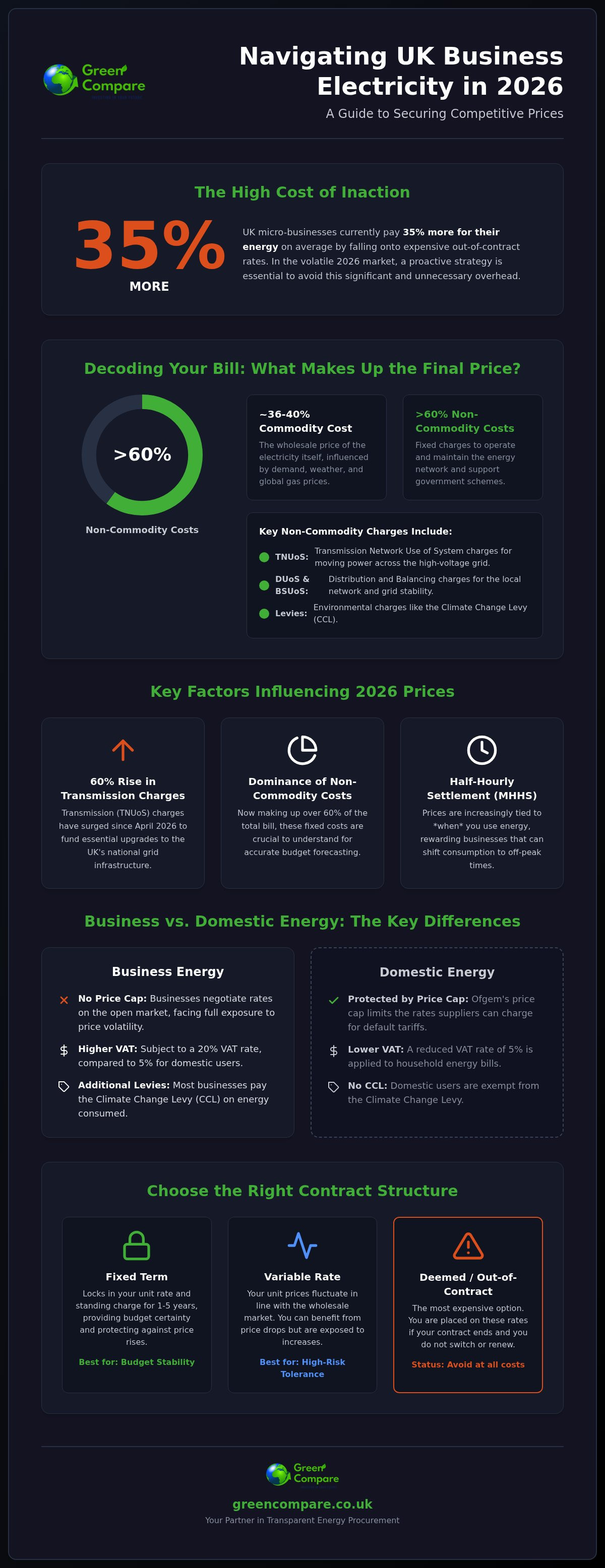
Did you know that UK micro-businesses are currently paying 35% more for their energy just by falling onto out-of-contract rates? It is a staggering figure that reflects the extreme volatility of the 2026 market. You likely feel the pressure of rising transmission costs and the exhaustion of deciphering complex bills that seem designed to confuse. Managing your overheads should not involve dodging aggressive brokers or wasting valuable hours on manual comparisons. Your time is better spent growing your enterprise and focusing on your team.
We believe in a transparent, efficient approach to securing competitive business electricity prices for your company. This guide provides the clarity you need to take control of your energy strategy and protect your long-term growth. We will break down the latest July 2026 benchmarks, explain the impact of the 60% increase in transmission charges, and show you a streamlined path to total price stability. Let us replace the stress of utility management with a simple, expert-led solution that puts your business first and helps you move forward with confidence.
Key Takeaways
- Recognise why 2026 market volatility demands a proactive procurement strategy to avoid expensive out-of-contract rates.
- Identify the most competitive business electricity prices by learning to separate unit rates from regional standing charges on your bill.
- Evaluate fixed versus variable contract structures to secure long-term budget certainty and protect your profit margins.
- Streamline your switching journey by mastering the Letter of Authority (LOA) process and gathering the correct data for rapid results.
- Leverage transparent broker commission disclosures to build a trustworthy partnership that supports your long-term business growth.
The Landscape of Business Electricity Prices in 2026
The UK energy market in 2026 is a complex ecosystem, driven by a push for net-zero and the aftermath of global supply shifts. For any enterprise, understanding business electricity prices is the first step toward securing financial resilience. Unlike the domestic market, commercial energy isn't a one-size-fits-all product; it's a bespoke financial agreement tailored to your specific operational profile. This year, the stakes are higher as network costs rise, making it vital to distinguish between what you pay for the power itself and what you pay to get it to your premises.
Business electricity prices are a combination of commodity costs, which reflect the wholesale price of power, and non-commodity costs, such as grid maintenance and government environmental levies.
In 2026, wholesale energy costs remain the primary driver of your unit rate. These prices fluctuate daily based on gas availability, weather patterns affecting renewables, and international demand. Relying on a reactive strategy in this environment is risky. You must anticipate these shifts to avoid the 35% premium often seen on out-of-contract rates. A proactive procurement strategy allows you to lock in rates when the market dips, rather than being forced to sign during a peak. For a broader perspective on how these dynamics have evolved, you can explore this UK energy sector overview to see the historical context of production and policy.
Why Business Rates Differ from Domestic Prices
Domestic customers benefit from a universal price cap, but commercial entities don't have this safety net. While micro-businesses have some protections, larger enterprises must negotiate in a completely open market. The tax structure is also different. Most businesses pay 20% VAT compared to the 5% domestic rate, alongside the Climate Change Levy (CCL), currently charged at 0.775p/kWh. However, your high consumption volume is a strength. It gives you significant bargaining power that households simply don't possess. Use this leverage to secure a deal that reflects your business electricity prices goals.
Key Factors Influencing 2026 Market Trends
Several specific factors are reshaping the landscape this year. The RIIO-3 price control period, which began in April 2026, has led to a 60% increase in Transmission Network Use of System (TNUoS) charges as the UK upgrades its infrastructure. As we integrate more wind and solar, non-commodity costs now make up over 60% of your total bill to fund grid stability. Additionally, the shift toward Market-wide Half-Hourly Settlement (MHHS) means your 2026 prices are increasingly tied to exactly when you use power, rewarding those with flexible operations. Stay ahead by monitoring these trends and using the data to inform your next contract negotiation.
Decoding Your Bill: What Makes Up the Final Price?
Your electricity bill is more than just a single number; it's a technical document that reflects your business's operational efficiency. In 2026, business electricity prices are heavily influenced by the delivery of power, not just the generation of it. If you've looked at your latest invoice and felt overwhelmed, you aren't alone. Most commercial energy bills are divided into two main pillars: the unit rate and the standing charge, which often varies significantly depending on your region's infrastructure costs.
The unit rate, measured in pence per kilowatt-hour (kWh), covers the actual power you consume. However, non-commodity charges now account for 60-64% of a typical bill. These include Transmission Network Use of System (TNUoS) charges, which have surged by 60% since April 2026, alongside Distribution (DUoS) and Balancing (BSUoS) costs. These fees pay for the upkeep of the national grid and the regional cables that serve your premises. Understanding how electricity bills are calculated is essential for spotting errors and identifying where you can save.
Your Standard Industrial Classification (SIC) code also plays a role in your final costs. Suppliers use this to assess the risk and consumption patterns of your specific sector. Some tariffs are only available to certain industries, meaning your business type directly impacts your eligibility for the most competitive business electricity prices. Ensuring your business is correctly classified can prevent you from being overcharged or placed on an unsuitable tariff.
The Unit Rate vs Standing Charge Debate
If you run a micro-business with low usage, a high standing charge can disproportionately inflate your costs. In this case, prioritise a lower daily fee. Conversely, high-consumption firms should focus almost exclusively on the unit rate, as even a fraction of a penny difference can save thousands annually. Be wary of flexible contracts that pass through non-commodity costs directly; these can leave you exposed to seasonal spikes in network fees.
Taxes and Levies Every UK Business Should Know
Don't overlook the Climate Change Levy (CCL), currently charged at 0.775p/kWh to encourage energy efficiency. Whilst most businesses pay the standard 20% VAT, some charities or low-usage sites may qualify for a reduced 5% rate. Environmental obligations like the Green Gas Levy also add small but consistent amounts to your total. If you find these technicalities draining, you can review your business electricity rates with a partner who handles the heavy lifting for you.
Fixed, Variable, or Deemed? Choosing Your Contract Structure
Choosing your contract structure is a strategic decision that dictates your financial agility for years. In the 2026 market, the right choice acts as a shield against the volatility we explored earlier. You aren't just buying power; you're buying a specific level of risk. Whether you prioritise absolute budget certainty or want to chase market dips, your contract type is the engine behind your business electricity prices.
The most dangerous position for any company is the "Deemed Rate" trap. If your contract expires without a new agreement, you'll be moved to out-of-contract rates. As of July 2026, these rates have climbed to 40.0p per kWh with a daily standing charge of 254.0p. This is not a minor oversight. Micro-businesses pay 35% more when they fall out of contract, whilst small businesses see a 36% hike. Avoid this by tracking your renewal window with military precision.
Regulatory shifts like P272 and the move toward Market-wide Half-Hourly Settlement (MHHS) have also changed the game. Most businesses now have their usage settled every thirty minutes. This means your price is increasingly tied to the time of day you consume energy. If your operations allow for flexibility, you can use this to your advantage; if not, a fixed structure remains the most reliable way to stabilise your business electricity prices.
Fixed-Price Contracts: The Safe Bet for SMEs
Fixed contracts remain the gold standard for small and medium enterprises. You can choose terms of 12, 24, or even 36 months depending on your outlook. Longer terms offer maximum protection against future price spikes, whilst 12-month deals keep you agile. Start your comparison at least six months before your current deal ends. This gives you the widest possible window to strike when the market is favourable. Never wait for the supplier to send a renewal letter; those offers rarely represent the best value.
Flexible Procurement for High-Volume Users
Large enterprises often outgrow fixed deals. Flexible procurement allows you to buy energy in "tranches" or chunks throughout the year. You can purchase a portion of your load when prices are low and leave the rest for later. This strategy requires a dedicated energy manager or a sophisticated desk to monitor market movements daily. For a typical small business, the complexity and potential for loss outweigh the rewards. Stick to a structure that lets you focus on your core operations rather than the energy trading floor.
The Step-by-Step Guide to Comparing and Switching
Securing the best business electricity prices requires a structured approach. Start by gathering your most recent bill. This document is your roadmap; it contains your Meter Point Administration Number (MPAN) and your exact annual consumption. Without these details, any quote you receive is merely an estimate that could change once the supplier sees your actual data. Precise information ensures that the rates you are quoted are the rates you actually pay.
Once you have your data, you will likely encounter the Letter of Authority (LOA). Think of this as a temporary bridge. It grants your chosen partner the legal right to request data from suppliers and your current provider on your behalf. It doesn't sign you into a new contract. A transparent partner will explain exactly what they're doing with this access. This is the stage where you should demand a full broker commission disclosure. Ethical intermediaries will tell you exactly how they're remunerated. This ensures there are no hidden markups on your unit rate and builds a foundation of trust for your future growth.
How to Read a Commercial Energy Quote
Don't be blinded by a low unit rate. Check if the quote is "fully fixed" or "pass-through". A pass-through quote might look cheaper today, but it leaves you vulnerable to the rising network charges we discussed earlier. Verify the contract length and the specific termination notice period. Some suppliers require 90 days' notice, whilst others are more flexible. Always look for a clear breakdown of the standing charge to ensure it aligns with your regional benchmarks. This level of detail prevents unexpected costs from eroding your budget later.
Avoiding Common Switching Pitfalls
Verbal contracts are legally binding in the commercial energy sector. Never agree to a deal over the phone unless you're certain of the terms. Ask for a written summary first. Your new supplier should manage the termination of your old contract, but you must confirm this in writing. Your current provider might raise an "objection" if there's outstanding debt or if you're still within a fixed term. Resolve these issues immediately to prevent your switch from stalling. A proactive approach here keeps your transition smooth and stress-free.
The entire process typically takes between 14 and 28 days. Once you sign the new agreement, your partner should handle the administrative heavy lifting, leaving you free to focus on your enterprise. To start your journey toward better business electricity prices, compare your commercial energy rates today. Let us help you turn a complex administrative task into a strategic advantage for your company's future.
Why Efficiency and Transparency Define Green Compare
Green Compare operates on a simple principle: your time is your most valuable asset. We don't just provide a platform; we act as a proactive partner in your company's development. Our approach to business electricity prices is built on total transparency. This starts with our unwavering commitment to broker commission disclosure. You deserve to know exactly how your agreement is structured, ensuring that every penny you spend contributes to your enterprise's progress rather than hidden intermediary fees.
Our 2026 efficiency benchmark is designed to move you from problem to solution in minutes, not days. We've streamlined the comparison process to provide rapid, accurate results that reflect the live market. This speed doesn't come at the expense of depth. We integrate ethically conscious energy choices into our recommendations, helping you align your utility strategy with modern corporate values. By choosing renewable tariffs, you aren't just reducing your carbon footprint; you're future-proofing your brand in an increasingly green economy.
We look beyond the meter. Our expertise extends to supporting your broader business growth through tailored Business Loans. By reducing your utility overheads, we help you unlock the capital needed for expansion, equipment upgrades, or new hires. For businesses considering onsite renewable infrastructure, SolarPorts Development offers an excellent example of how solar carports can transform commercial spaces into energy-generating assets. This holistic view of commercial finance distinguishes us from traditional brokers who see energy as an isolated cost. We see it as a catalyst for your professional advancement and collective progress.
A Partnership Approach to Utility Management
We favour long-term progress over one-off switches. An expert guide is essential in a market where transmission charges can rise by 60% overnight. Our service model is designed to alleviate the stress of overheads by providing a constant, reliable presence. We monitor your contract windows and market trends so you don't have to. This collaborative growth model ensures you always have the most competitive business electricity prices without the administrative burden. We are invested in your journey from day one.
Securing Your Business Future Today
There is a strong link between energy efficiency and commercial lending. Lenders increasingly look at a firm's sustainability credentials and overhead management when assessing risk. By mastering your utility costs today, you improve your financial profile for tomorrow. Follow this final checklist for a successful procurement:
- Verify your MPAN and annual consumption from a recent bill.
- Demand full commission disclosure from any intermediary.
- Choose a contract structure that matches your risk appetite.
- Ensure your new supplier handles the termination of your old deal.
Take control of your overheads and join a community of forward-thinking UK enterprises. Organise your business electricity comparison with Green Compare today. Take the first step toward a more efficient, transparent, and profitable future for your enterprise.
Empower Your Enterprise with Smarter Energy Choices
Mastering your utility overheads is a vital step toward long-term commercial resilience. By understanding the technicalities of unit rates and avoiding the expensive trap of out-of-contract fees, you protect your profit margins and fuel collective progress. Remember that whilst market volatility remains high, your consumption volume and industrial classification are powerful tools for negotiation when used correctly. A proactive approach today ensures you aren't caught out by the shifting landscape of network charges later this year.
Securing competitive business electricity prices doesn't have to be a drain on your schedule. We provide a fast-paced, streamlined comparison process backed by expert UK-based support and full broker commission disclosure. This transparency ensures you remain in total control of your energy strategy whilst focusing on your core operations. We're here to act as your knowledgeable ally, turning mundane administration into a strategic advantage.
Take the first step toward a more sustainable and cost-effective future for your company. Compare business electricity prices and start saving in minutes. Let us help you transform your utility management into a driver for professional empowerment and shared growth.
Frequently Asked Questions
How much does business electricity cost per kWh in the UK in 2026?
A competitive rate for business electricity in July 2026 sits between 20p and 23p per kWh for contracted customers. Specific unit rates vary by business size; micro-businesses typically pay 29.7p per kWh, whilst large enterprises can secure rates around 25.9p. It is vital to avoid out-of-contract rates, which are currently 40.0p per kWh. Tracking these business electricity prices allows you to lock in a deal when the market dips.
Can I switch business electricity suppliers if I am in a fixed contract?
You cannot switch to a new provider until your current fixed-term contract reaches its end date. Unlike domestic energy, there is no 14-day cooling-off period for commercial agreements. However, you can secure a new deal up to six months before your current term expires. This proactive strategy ensures a seamless transition and protects your business from falling onto expensive deemed rates when your fixed term concludes.
What is the Climate Change Levy and does my business have to pay it?
The Climate Change Levy (CCL) is a government tax on commercial energy use, currently charged at 0.775p/kWh. Most UK businesses pay this tax to encourage better energy efficiency and support national carbon reduction goals. Some charities and very low-usage sites may qualify for an exemption or a reduced rate. Check your recent bill or speak with an expert to verify if your enterprise is eligible for tax relief.
How do I find out who my current business electricity supplier is?
The simplest way to identify your supplier is by checking your most recent invoice or looking at the MPAN number on your meter. If you have recently moved into a new premises and don't have a bill, contact your local Distribution Network Operator (DNO). They can confirm which supplier is registered to your meter. Having this information is the first step toward comparing business electricity prices and securing a better deal.
What is a Letter of Authority (LOA) and why does a broker need it?
A Letter of Authority (LOA) is a legal document that gives an intermediary permission to act on your behalf with energy suppliers. It allows your partner to gather usage data and request live quotes, which saves you hours of manual administration. An LOA does not give a broker the power to sign a new contract without your final approval. Ensure your chosen partner uses this access transparently and discloses all commission structures.
Why are business electricity prices higher than residential rates?
Commercial rates are often higher because they include the Climate Change Levy and a standard 20% VAT rate, compared to 5% for households. Businesses also lack the protection of the Ofgem price cap. Furthermore, non-commodity charges now make up over 60% of a typical commercial bill. This includes a 60% increase in transmission network charges seen since April 2026, making strategic procurement essential for managing your company's overheads.
How long does it take to switch commercial electricity providers?
The switching process typically takes between 14 and 28 days from the moment you sign your new agreement. Your new supplier handles most of the administrative transition, including the notification of your previous provider. We recommend starting your search at least six months before your current deal ends. This timeframe allows you to resolve any potential objections from your current supplier and ensures a smooth move to your new rate.
Is green energy more expensive for businesses in 2026?
Renewable energy is no longer significantly more expensive than traditional fossil fuel tariffs in the 2026 market. Many suppliers now offer green options as standard to help UK firms meet their sustainability targets. In some instances, renewable tariffs can even be more cost-effective due to various environmental subsidies and shifting wholesale demand. Integrating green energy into your strategy is a smart way to future-proof your brand whilst supporting collective progress.