Finding Cheap Business Electricity: The 2026 Commercial Energy Buying Guide

Finding cheap business electricity in 2026 isn't a matter of luck; it's a strategic execution of timing and transparency. You likely feel the weight of opaque pricing structures and the constant threat of being rolled over onto expensive deemed rates. It's frustrating to waste hours on manual comparisons when you should be focusing on your next big project. We understand that your time is your most valuable asset. This guide provides the clarity you need to master the complex 2026 energy market and secure the most cost-effective rates for your UK business. You'll discover how to navigate the 60% increase in transmission charges, understand the latest Ofgem broker transparency rules, and lock in price security for up to 36 months. We'll show you how to target the current market "good" rate of 20p to 23p per kWh whilst avoiding common contract traps. Let's transform your energy procurement from a stressful overhead into a streamlined success story that supports your long-term growth. Stop guessing and start gaining the contractual security your business deserves.
Key Takeaways
- Identify 2026 market benchmarks and understand why commercial energy requires a distinct procurement strategy compared to domestic supply.
- Uncover the "Unit Rate Trap" and learn how to calculate total contract value to secure genuine cheap business electricity.
- Gain full transparency on broker commissions by leveraging the latest Ofgem regulations designed to protect your business interests.
- Optimise your renewal window by starting the comparison process six months early to lock in the most favourable rates for the next 36 months.
- Reinvest your utility savings into your company's long-term development by switching to a more cost-effective and collaborative energy partnership.
Navigating the 2026 Business Electricity Market: What Defines "Cheap" Today?
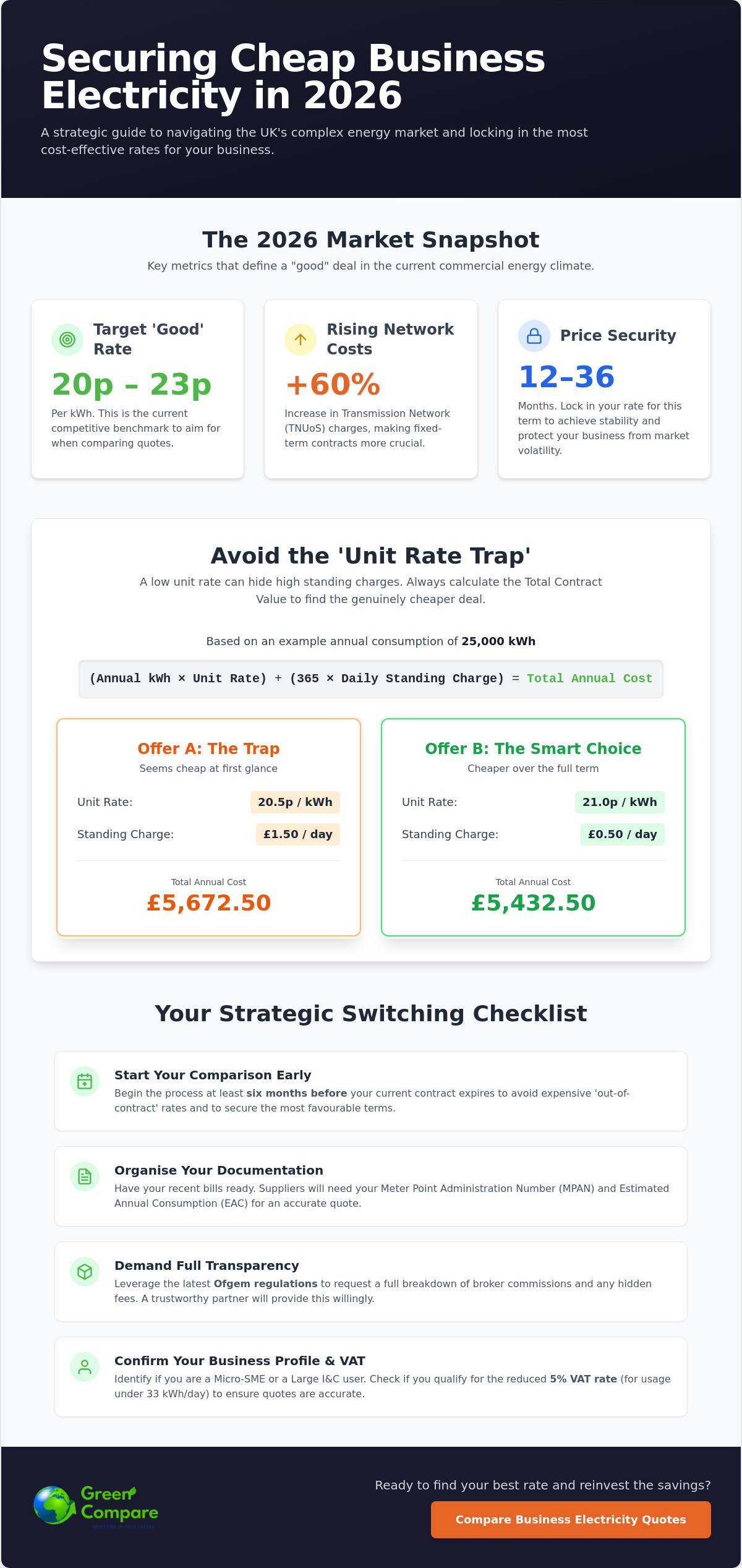
Securing cheap business electricity in 2026 requires a sharp shift in perspective. You cannot simply hunt for the lowest number on a flyer and expect it to stick. In the current climate, "cheap" is defined by how effectively your contract outpaces wholesale volatility and geopolitical shifts. Unlike the domestic sector, UK businesses operate without the safety net of an Ofgem price cap. This means your rates are tied directly to the live electricity market, where prices fluctuate based on global events, including recent tensions in the Middle East. Commercial electricity procurement is the strategic alignment of consumption patterns with market lows. To find a truly cost-effective deal, you must balance three critical pillars: the unit rate, the daily standing charge, and your total contract length. Focus on the total cost over the full term rather than a single enticing figure.
The 2026 Wholesale Landscape and Your Bill
The UK's transition to renewable energy has fundamentally altered how suppliers price their contracts. Wind and solar now dictate peak-time pricing, creating significant opportunities for businesses that can shift their usage. Interestingly, "green" electricity has moved from being a luxury add-on to often being the most competitive entry point in the market. You should also prepare for rising non-commodity costs that sit outside the wholesale price. As of April 2026, Transmission Network Use of System (TNUoS) charges have increased by over 60%. These infrastructure levies are passed through to your bill, making it vital to lock in a tariff that manages these fluctuations whilst protecting your bottom line. Look for suppliers who offer transparency on these mandatory network fees to avoid nasty surprises mid-contract.
Why Business Size Dictates Your Rate
Your energy profile determines how suppliers view your risk and value. Micro-SMEs typically face higher unit rates but lower standing charges, whilst Large Industrial and Commercial (I&C) users benefit from economies of scale. If your site uses half-hourly metering, often referred to as P272, your quotes will be far more precise. Suppliers use this granular data to offer bespoke pricing based on your actual consumption behaviour. High-volume consumers often secure lower unit rates because their predictable demand allows suppliers to hedge energy more efficiently. Identify your category early to ensure you're comparing relevant benchmarks for your specific sector. Use your data to your advantage. By understanding your peak demand times, you can negotiate from a position of strength and secure a deal that reflects your actual needs rather than an industry average.
Locking in a 12 to 36-month contract now provides the stability needed to plan your commercial growth. Avoid the trap of rolling onto expensive out-of-contract rates by acting at least six months before your current deal expires. Efficiency is your greatest ally in this process. By streamlining your comparison, you move from a position of vulnerability to one of strategic control.
Comparing Business Electricity Quotes: Moving Beyond the Unit Rate
Don't be seduced by a headline unit rate. Many businesses fall into the "Unit Rate Trap" where a seemingly low price per kilowatt-hour is undermined by an inflated daily standing charge. To secure genuine cheap business electricity, you must evaluate the Total Contract Value. This calculation is simple: multiply your annual consumption by the unit rate, then add 365 days of standing charges. Only then can you see the true impact on your cash flow. Efficiency in this analysis prevents you from overpaying for a tariff that looks good on paper but costs more in practice.
Before requesting quotes, organise your recent bills to ensure data accuracy. Suppliers require your Estimated Annual Consumption (EAC) and your Meter Point Administration Number (MPAN) to provide precise figures. Accuracy at this stage prevents mid-contract price adjustments that could derail your budget. You also need to consider your tax obligations. Whilst most firms pay 20% VAT, those using less than 33kWh per day qualify for the 5% de minimis rate and are exempt from the Climate Change Levy (CCL). Small details like this significantly alter your final bill and your overall procurement strategy.
Unit Rates vs. Standing Charges: Finding the Balance
Your consumption volume dictates which part of the quote matters most. High-usage businesses, such as manufacturers or data centres, should always prioritise the lowest unit rate. Even a 1p difference results in thousands of pounds in annual savings. Conversely, for seasonal businesses, the standing charge is the primary cost driver. A daily charge of 146.3p for a large site adds over £530 to your annual bill before you've even switched on a light. Run a scenario analysis to find your specific break-even point.
Fixed-Rate vs. Flexible Tariffs in 2026
Budget certainty is a powerful tool for commercial growth. Fixed-rate contracts lock in your unit price for 12 to 36 months, protecting you from market volatility. As the UK explores various procurement options, some firms use flexible tariffs to capitalise on price drops. Smart or time-of-use tariffs are also viable for businesses with flexible shifts. Taking a moment to compare your current tariff ensures you aren't overpaying for your essential utilities.
Locking in the right structure today allows you to focus on your long-term business development. By treating your energy contract as a strategic asset rather than a mere utility, you create a more resilient and profitable organisation.
Ensuring Transparency: Broker Commissions and Hidden Fees
Transparency is the foundation of any successful partnership. You deserve to know exactly how your energy procurement works, especially regarding broker fees. Many businesses are wary of hidden costs, but the 2026 regulatory environment has brought much-needed clarity to the sector. Since October 2024, energy brokers have been required to disclose their commission in writing before any contract is signed. This shift ensures you can secure cheap business electricity without wondering about undisclosed markups. At Green Compare, we champion this openness. We believe that an informed client is a more successful one, and we're committed to clear, honest communication at every step of your journey.
Trust is built through action, not just words. By understanding the mechanics of energy pricing, you protect your business from predatory practices that often hide in the fine print. The UK government has appointed Ofgem as the regulator for energy brokers, with new rules being enforced throughout 2026 to ensure mandatory registration and robust consumer protections. This move elevates the industry, moving away from the cold feel of traditional brokerage toward a supportive, visionary stance that values your long-term development. Efficiency in your energy strategy starts with knowing exactly where every penny of your utility spend is going.
Understanding Broker Commission Disclosure
Brokers typically receive payment through an "uplift" included in your unit rate. This usually ranges from 0.5p to 2.0p per kWh depending on your business size and consumption volume. Before you sign a Letter of Authority (LOA), ask your broker for a full breakdown of this fee. A transparent broker provides value by accessing wholesale prices and niche suppliers that aren't available to the general public. This often results in a lower total cost than going direct to a "Big Six" supplier. Whilst you focus on your core operations, you can also implement Energy-Saving Tips to further reduce your demand and maximise the impact of your new rate.
The Danger of Deemed and Rollover Rates
Missing a contract deadline is one of the costliest mistakes a business can make. When your fixed term ends without a new agreement, your supplier will move you onto "deemed" or "out-of-contract" rates. These are often 80% to 100% more expensive than negotiated tariffs. Check your most recent bill for terms like "Deemed" or "Standard Variable" to see if you're overpaying. The "Rollover" trap occurs when a supplier automatically renews you for another year because you missed the termination window. To avoid this, identify your contract end date today. We suggest starting your search six months early to ensure you have the leverage to walk away if a deal isn't right. Don't let administrative oversight drain your annual budget.
Secure your future by demanding total clarity. By partnering with a transparent expert, you transform a complex administrative task into a strategic advantage for your company's growth. We are here to guide you through the process with speed and proficiency, ensuring your overheads are minimised whilst your potential is maximised.
Strategic Switching: How to Secure the Best Commercial Rates
Timing is everything. To secure truly cheap business electricity, you must act long before your current contract expires. We recommend entering your renewal window six months ahead of time. This proactive approach gives you the leverage to walk away from poor offers and wait for market dips. A successful business electricity switch requires no physical changes to your wires or meters, only a digital transfer of the billing responsibility. By starting early, you move from a position of necessity to one of strategic power.
Don't let the complexity of the market stall your progress. By using a Letter of Authority (LOA), you empower us to handle the heavy lifting. This simple document allows experts to gather data and negotiate with suppliers on your behalf whilst you focus on growing your company. It's a partnership built on efficiency and shared goals. We navigate the technical jargon and supplier hurdles so you don't have to. This streamlined process ensures you never miss a deadline or fall onto expensive deemed rates.
The Ideal Time to Lock In Your Next Contract
Wholesale prices are highly reactive to seasonal demand. Historically, signing a contract in the middle of winter is a mistake as prices often peak during the coldest months. Instead, look for dips in the spring or summer. You can also "Forward Purchase" your energy. This involves locking in a rate today for a contract that starts in 12 or 18 months. It provides absolute budget certainty against future geopolitical shocks and ensures your long-term development remains on track.
What You Need for an Instant, Accurate Quote
Accuracy is the enemy of overspending. To get a precise quote, you need three pieces of information:
- Your MPAN (Meter Point Administration Number), found on your recent bill.
- Your actual annual consumption in kWh.
- Your current contract end date and notice period requirements.
Relying on estimates often leads to "Back-billing" if your actual usage is higher than predicted. Check your meter readings regularly to ensure your data is solid. Having these details ready allows for a rapid, proficiency-led comparison that respects your time. Ready to take control? Compare your business electricity rates now and see how much you could save in minutes.
Follow this five-step process for a zero-downtime switch: compare your options, select your tariff, sign the digital agreement, allow the new supplier to manage the termination notice, and go live on your scheduled date. It is a simple, linear path to reduced overheads and increased business empowerment.
Beyond Electricity: Streamlining Your Business with Green Compare
Success in the 2026 market isn't just about finding the lowest unit rate. It's about what you do with those savings. Reducing your overheads through cheap business electricity frees up vital capital for your next phase of growth. Whether you're upgrading your equipment or expanding your team, every pound saved on utilities is a pound earned for your future. We don't just see ourselves as a broker. We are a proactive partner invested in your long-term advancement. By streamlining your Business Gas and electricity procurement simultaneously, we help you build a more resilient financial foundation through collaborative growth.
Our approach balances pragmatic financial management with a visionary outlook. We believe that securing a cost-effective energy contract is a milestone in a larger narrative of business empowerment. When you reduce the friction of administrative tasks, you create space for innovation. This is why we focus on delivering rapid results that align with your specific commercial goals. We're here to ensure your utility strategy supports your broader mission, rather than acting as a drain on your resources.
The Green Compare Efficiency Benchmark
Our platform is built for speed and high readability. We understand that as an entrepreneur, your time is your most precious resource. Our streamlined comparison process is designed to save you hours of administrative legwork, moving you from a problem to a solution in a fraction of the time it takes for manual research. We combine regional pragmatism with modern entrepreneurial energy to deliver results that matter. Thousands of UK firms trust us to organise their commercial utilities because we prioritise transparency and reliability. We remove the stress of utility management so you can focus on leading your company toward its next achievement.
Fueling Growth with Integrated Finance
Lowering your monthly outgoings does more than just help your bank balance. It improves your overall credit profile, making it easier to access competitive Business Loans when you need them most. We offer integrated finance solutions that go beyond simple utility comparison. For instance, many of our clients use unsecured business loans to fund solar panel installations or energy-efficient machinery. This creates a powerful cycle of sustainability where your initial savings fund the tech that lowers your future bills even further. It is a visionary approach to commercial finance that balances current needs with future aspirations.
Take the first step toward a more efficient future today. Our team is ready to assist you in navigating the complexities of the 2026 market with proficiency and ease. Don't let high overheads hold your company back from its true potential. Join a community of forward-thinking businesses that value sustainability and collective progress. It's time to get a business electricity quote today and see how a collaborative partnership can accelerate your growth.
Powering Your Business Growth into 2026
Mastering the 2026 energy market means moving beyond simple unit rates to calculate total contract value. You now understand how to leverage the six-month renewal window and the absolute necessity of full commission transparency. These strategic moves transform your utility procurement into a vital tool for commercial empowerment. Securing cheap business electricity is no longer a manual burden; it is a streamlined process that fuels your long-term success. Since 2019, we've specialised in commercial utility procurement, providing access to over 20 UK energy suppliers. Our commission transparency is guaranteed because we value your trust as much as your time. Take the final step toward operational excellence and secure your cheapest business electricity quote in minutes. Your business deserves a partner that is genuinely invested in your development. Let's build a more sustainable, profitable future together.
Frequently Asked Questions
How can I find out who my current business electricity supplier is?
Check your most recent paper or digital bill to identify your current provider. If you cannot locate a bill, you can find the name of your supplier by contacting your local Distribution Network Operator (DNO). They maintain a database of every Meter Point Administration Number (MPAN) in your region and can confirm which company is currently billing your premises.
What is the average cost of business electricity per kWh in 2026?
As of June 2026, average rates vary based on your annual consumption. Micro-businesses typically see rates around 30.0p per kWh, whilst small businesses average 27.9p. For medium and large enterprises, rates generally range between 27.0p and 27.6p. To secure cheap business electricity, you should target a benchmark rate between 20p and 23p per kWh, which is currently considered a competitive market low.
Can I switch my business electricity if I am in a fixed-term contract?
You cannot usually leave a fixed-term contract before its end date without paying substantial termination fees. However, you can start the procurement process and sign a new agreement up to six months before your current deal expires. This allows you to lock in a favourable rate today that will automatically begin the moment your existing contract concludes, ensuring a seamless transition.
How much can a typical UK SME save by switching electricity suppliers?
Savings vary depending on your usage, but businesses moving from "deemed" or out-of-contract rates can reduce their bills by 80% to 100%. Because these standard rates are significantly higher than negotiated tariffs, switching to a fixed-term agreement is the most effective way to free up capital. This simple move transforms a high overhead into a manageable cost that supports your company's long-term development.
What is a Letter of Authority (LOA) and do I need one to compare rates?
A Letter of Authority is a document that grants an energy expert permission to gather consumption data and request quotes from suppliers on your behalf. You need one if you want to streamline the comparison process and let a partner handle the administrative legwork. It does not commit you to a contract; it simply empowers us to find the most proficiency-led solutions for your specific needs.
Are green business electricity tariffs actually cheaper than standard ones?
In the 2026 market, green tariffs are frequently the most cost-effective entry point. Due to the massive expansion of UK renewable infrastructure, many suppliers now price renewable energy as their primary, most competitive offering. Choosing a green tariff often results in cheap business electricity whilst simultaneously aligning your company with modern, ethically conscious corporate values and collective environmental progress.
How long does it take to switch business electricity providers?
The digital transfer of billing responsibility usually takes between 15 and 30 days from the moment you sign your new agreement. There is absolutely no interruption to your power supply and no physical work is required at your premises. We manage the entire timeline with the suppliers to ensure the switch is efficient, stress-free, and perfectly timed with your contract renewal window.
What happens if my business electricity supplier goes bust?
Ofgem will activate the "Supplier of Last Resort" (SoLR) process to ensure your business remains powered without any downtime. You will be automatically moved to a new supplier, and any credit balance on your account is legally protected. Once you are moved, you will likely be on a standard variable rate, so you should immediately compare new fixed-term deals to avoid overpaying.