Business Gas Comparison 2026: The Ultimate Guide to Commercial Energy Procurement

With wholesale gas prices sitting 21.56% higher than this time last year and new RIIO-3 network charges arriving this April, the cost of staying on a rollover contract has never been more damaging to your margins. You already know that energy is not just a utility; it is a strategic overhead that requires precise management. Performing a thorough business gas comparison shouldn't feel like a second job or a gamble with hidden broker fees. You deserve a clear path to price stability that respects your time and your budget.
We understand that navigating the 2026 market reforms and the new Ofgem broker regulations feels overwhelming. It is frustrating to face rising operational costs while trying to decipher complex contract jargon or the latest Green Gas Levy increases. This guide is your roadmap to securing fixed-price certainty for the next 12 to 36 months with total commission transparency. We will walk you through the latest regulatory changes, explain how to avoid expensive out-of-contract rates, and show you how to start a hassle-free switch in under 10 minutes. Let's turn your energy procurement from a burden into a competitive advantage for your long-term growth.
Key Takeaways
- Transform energy procurement from an administrative chore into a strategic financial lever to safeguard your business against 2026 market fluctuations.
- Learn to decode your gas bill by identifying the specific factors that influence your quotes, from regional location to your current credit profile.
- Protect your bottom line by securing fixed-price certainty for up to 36 months; this effectively eliminates the risk of predatory rollover rates.
- Execute a rapid business gas comparison using our streamlined five-step process to access the most competitive whole-of-market rates in minutes.
- Leverage expert insights to ensure total commission transparency and move your business towards a more sustainable, cost-effective future.
Navigating the 2026 Business Gas Market: Why Comparison is Vital for Growth
Commercial gas procurement is not a simple administrative task; it's a strategic financial lever. In the current climate, treating your energy bill as a fixed, unchangeable cost is a mistake that can stifle your company's expansion. A professional business gas comparison is a bespoke procurement process rather than a standard retail transaction. It allows you to align your energy spend with your long-term operational goals, turning a static overhead into a source of "Utility Efficiency." By minimising waste and securing lower unit rates, you unlock capital that is better spent on new equipment, staff training, or marketing campaigns.
The UK energy market in 2026 remains complex. Wholesale prices are currently 21.56% higher than they were twelve months ago, and European storage levels are only 40% full. These metrics suggest that price stability is not guaranteed. You need a proactive partner to help you navigate these shifts and ensure your procurement strategy is robust enough to withstand sudden market movements. Efficiency is the key to progress, and that starts with your utility contracts.
Commercial vs. Domestic Gas: Key Differences
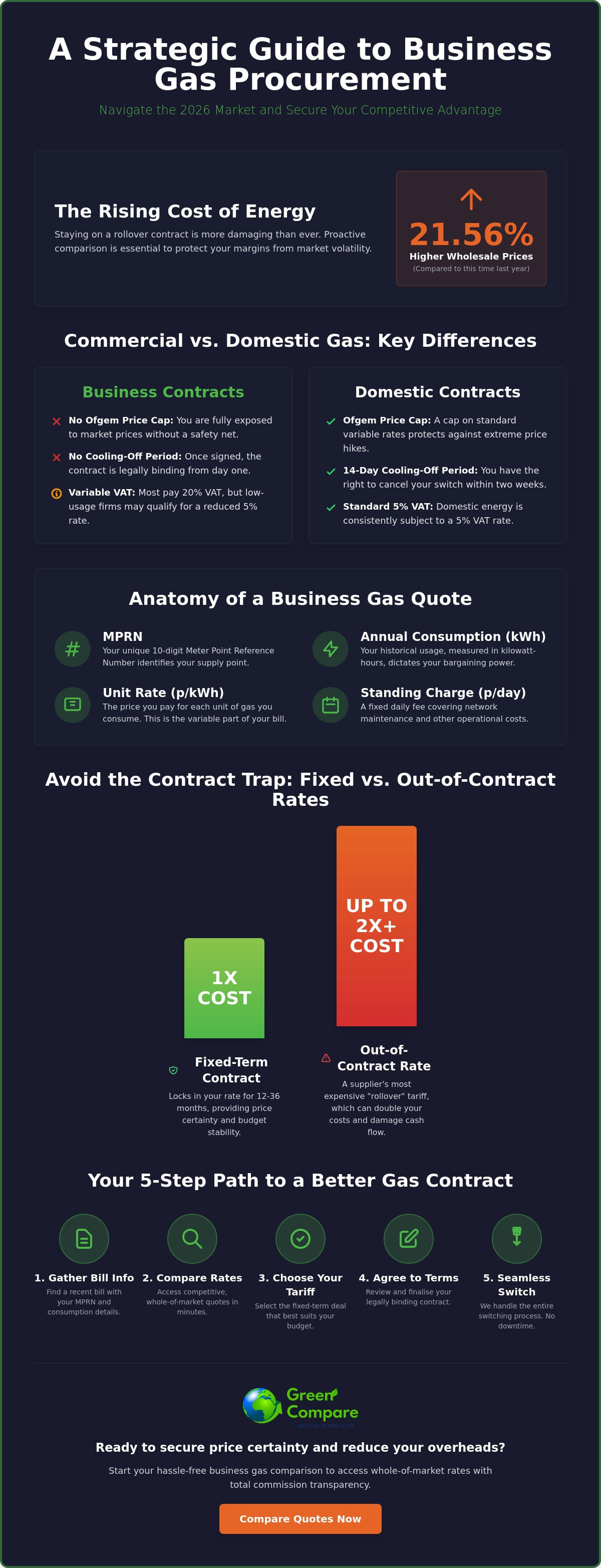
It's vital to understand that the rules for business energy are entirely different from those in your home. Ofgem does not provide a price cap for commercial users. This means there is no "Standard Variable Rate" to protect you if you fail to renew your contract. You are exposed to the full force of the market. Additionally, commercial contracts do not include a "cooling-off period." Once you agree to a deal, you are legally bound to its terms. You should also audit your VAT status; whilst most businesses pay 20%, those with very low usage may qualify for the 5% reduced rate.
The 2026 Energy Landscape
The move into the RIIO-3 price control period on 1 April 2026 has triggered a new wave of investment in the UK's gas distribution networks. Whilst these upgrades are essential for infrastructure resilience, they often lead to higher non-commodity costs on your bill. Knowing the factors that influence business gas prices will help you spot when a quote is genuinely competitive or simply inflated by these network charges.
In 2026, market volatility represents the rapid, unpredictable price shifts in energy futures driven by geopolitical tensions and supply-chain constraints. Staying on "out of contract" or "deemed" rates during these periods is a critical financial error. These rates can be double the cost of a fixed-term agreement, causing immediate and unnecessary damage to your cash flow. Start your business gas comparison early to ensure you never pay more than necessary for the fuel that powers your progress.
The Anatomy of a Business Gas Quote: Understanding Your Bill
Before you begin a business gas comparison, you must understand the DNA of your energy statement. Your bill is not just a single figure; it is a composite of several variables that suppliers use to assess risk and reward. The starting point is always your Meter Point Reference Number (MPRN). This unique ten-digit code identifies your specific connection to the grid. Unlike a serial number on a meter, the MPRN stays with the property. Accurate identification ensures that your quotes are based on your actual supply point rather than a generic estimate.
Your annual consumption, measured in kilowatt-hours (kWh), dictates your bargaining power. High-volume users often access lower unit rates because they represent more significant accounts for suppliers. Just as the U.S. commercial gas market relies on granular data to drive competitive pricing, UK providers use your historical usage to categorise your business. If you use over 10,000 kWh, you move beyond the micro-business threshold, which can alter the contract terms available to you.
Unit Rates vs. Standing Charges
Every quote consists of two primary costs. The unit rate is what you pay for every kWh of gas you consume. The standing charge is a fixed daily fee that covers the cost of maintaining the pipes and reading your meter. Choosing the right balance depends entirely on your operational habits. If your business operates seasonally, a "No Standing Charge" tariff might look attractive. However, these usually come with significantly higher unit rates. Most consistent users find that a lower unit rate offers better long-term value, even with a standard daily fee.
| Business Type | Priority Metric | Cost Impact |
|---|---|---|
| High Usage (e.g., Industrial) | Low Unit Rate | Saves more as volume increases. |
| Low Usage (e.g., Office) | Low Standing Charge | Reduces fixed daily overheads. |
Taxes and Levies: The Hidden Extras
Your final quote will include the Climate Change Levy (CCL). This is a tax designed to encourage energy efficiency. Whilst most businesses must pay this, you might qualify for an exemption if you use very small amounts of gas or if your business is a charity. VAT is another critical factor. Standard businesses pay 20%, but micro-businesses using less than 33 kWh of gas per day qualify for a reduced rate of 5%. Always check if your quote is "VAT exclusive" to avoid surprises during your business gas comparison. To ensure you are seeing the most transparent figures for your specific sector, you can compare business gas rates using our streamlined platform.
Your credit score and geographic location also play silent roles in your pricing. Suppliers view businesses in certain regions as more "expensive" due to local distribution network charges. Similarly, a strong credit score can unlock "Pass-Through Contracts," where non-commodity costs are separated from your energy rate, offering a higher level of transparency for savvy finance directors.
Decoding Contract Types: Avoiding the Trap of Rollover Rates
Choosing the wrong contract type is the fastest way to drain your operational budget. In the 2026 energy market, where wholesale prices remain 21.56% higher than the previous year, your choice of tariff determines your ability to forecast growth. Most SMEs find that fixed-rate tariffs are the gold standard for security. These agreements lock in your unit rate for 12, 24, or even 36 months, protecting you from the price spikes that often follow geopolitical shifts. Whilst market dips might occur, the value of budget certainty usually outweighs the risk of waiting for a lower price that may never arrive.
If you let a contract lapse, you fall into the "Danger Zone" of Deemed or Out-of-Contract rates. These are often twice as expensive as a negotiated deal. Suppliers use these rates to cover their own risk when you haven't committed to a term. Avoid this at all costs. To stay informed, consult Ofgem's advice for businesses regarding your rights and the latest regulatory protections. Being proactive is your best defence against unnecessary overheads.
The Fixed-Rate Advantage in 2026
Timing your business gas comparison is critical. If you see a softening in the market, lock in your rate immediately. A 24-month fix is currently the "sweet spot" for many UK businesses. It provides a balance between long-term stability and the flexibility to renegotiate if infrastructure upgrades lower costs in the future. Don't wait until the final week of your contract to act. Securing a deal early ensures a seamless transition without a single day on expensive emergency rates.
How to Spot and Avoid Rollover Clauses
A rollover contract is an automatic extension that triggers if you miss your termination window. Suppliers are legally required to send a "Statement of Renewal" letter at least 60 days before your contract ends. This letter marks your "Window of Opportunity." Use this time to compare the market and issue a formal notice of intent to switch. Use this checklist when reviewing any new agreement:
- Verify the exact contract end date: Mark this in your calendar six months in advance.
- Check the notice period: Most suppliers require 30 to 90 days of notice to prevent a rollover.
- Identify termination fees: Know the cost of exiting early if your business circumstances change.
- Confirm the Deemed Rate: Know exactly how much your bill will jump if you fail to renew on time.
For larger enterprises with high consumption, flexible or pass-through contracts might be more suitable. These allow you to buy energy in "tranches" or separate your commodity costs from the rising Green Gas Levy and network charges. However, for the majority of businesses, a simple, transparent fixed-rate deal remains the most efficient path to progress. Start your business gas comparison today to ensure you never fall into a rollover trap again.
The 5-Step Process to Compare Business Gas and Switch
Securing a better energy deal is a rapid, high-impact task that protects your cash flow. You don't need to spend hours on the phone with multiple suppliers. By following a streamlined sequence, you can move from a high-cost rollover rate to a competitive, fixed-price agreement in minutes. This process is designed to be linear and stress-free, allowing you to focus on your core business goals whilst we handle the market complexity. Follow these five steps to take control of your procurement strategy.
- Step 1: Gather your data. Have a recent bill to hand. You will need your Meter Point Reference Number (MPRN) and your current contract end date to ensure the quotes are accurate.
- Step 2: Access the "Whole of Market" view. Use a professional platform to perform a business gas comparison. This ensures you aren't limited to a handful of suppliers but are seeing the most competitive rates available across the entire grid.
- Step 3: Evaluate the Total Contract Value. Look beyond the headline unit rate. Consider the standing charge and the total cost over the full 12 to 36-month term to find the genuine best value for your specific usage profile.
- Step 4: Confirm your Letter of Authority (LOA). This simple document empowers your broker to manage the administrative heavy lifting. It allows them to negotiate directly with suppliers and resolve any objections on your behalf.
- Step 5: Finalise and notify. Once you select a deal, your new provider handles the communication with your old supplier. You simply need to provide a final meter reading on the day of the switch.
Start your journey toward lower overheads right now. You can compare business gas rates in minutes and lock in your 2026 budget certainty today.
Preparing Your Data for an Accurate Quote
Your Estimated Annual Consumption (EAC) is the foundation of your quote. If this figure is based on outdated estimates rather than actual meter readings, your quotes will be inaccurate. Suppliers use the EAC to determine your risk profile and unit rate. If you cannot find your MPRN on your bill, it is often located near the supply address section or can be obtained by calling the National Grid's Meter Number Helpline. Providing a fresh meter reading during your business gas comparison prevents "catch-up" bills and ensures your new contract starts on a precise footing.
Managing the Transition Period
One of the most common concerns for business owners is the fear of a supply interruption. Rest assured that there is no physical change to your gas supply. The same pipes and infrastructure, managed by the National Gas Grid, continue to deliver fuel to your premises. The switch is purely an administrative change in who bills you and at what rate. On "Switch Day," you simply submit a final reading to your outgoing supplier to ensure your closing statement is accurate. This seamless transition ensures your operations continue without a second of downtime.
Streamline Your Utilities with Green Compare: Efficiency Meets Expertise
Success in the 2026 commercial landscape requires more than just hard work; it demands the right partnerships. Green Compare acts as a proactive ally, ensuring your energy procurement is a source of strength rather than a source of stress. We respect the value of your time. Our streamlined platform allows you to compare the market in minutes, not days. This time-saving metric is our signature of efficiency, designed to move your business from a cost problem to a financial solution at pace.
Transparency is the foundation of our collaborative growth model. Following the 2026 Ofgem reforms, we have doubled down on our commitment to open communication. We provide full disclosure on broker commissions and shine a light on the hidden clauses that often lurk in the small print of traditional contracts. You deserve to know exactly what you are paying for. By removing the cold, clinical feel of traditional brokerage, we offer a supportive experience that prioritises your long-term development over short-term gains.
Why Choose a Specialist Commercial Broker?
Going direct to a supplier often limits your options to their specific internal targets. We leverage our industry authority to access exclusive rates that simply aren't available on the retail market. Our experts handle the entire administrative burden of switching, from managing the Letter of Authority to resolving technical objections with your current provider. You will benefit from a dedicated account manager who possesses a deep understanding of the 2026 market volatility and the specific impacts of the Green Gas Levy on your sector. We navigate the complexities so you can focus on running your business.
Beyond Gas: A Holistic Approach to Business Finance
We view utility management as one piece of a much larger puzzle. Reducing your gas overheads does more than lower a bill; it significantly improves your monthly cash flow. This newfound liquidity can be the catalyst for further investment, whether you are looking to upgrade equipment or explore Business Loans to fund your next expansion. By optimising your fixed costs, you create a more resilient and sustainable enterprise.
There is a powerful synergy between energy efficiency and your corporate sustainability goals. As we move through 2026, the businesses that thrive will be those that align their financial health with ethical responsibility. Let us help you find the balance between cost-effectiveness and carbon reduction. Start your business gas comparison today and save on your overheads. Together, we can fuel your professional advancement and ensure your business is ready for the challenges of tomorrow.
Secure Your Competitive Advantage in the 2026 Market
Managing your commercial overheads shouldn't be a source of constant anxiety. By mastering the 2026 market dynamics and avoiding the predatory rates of rollover contracts, you transform a mundane utility into a strategic asset. You now have the tools to decode your bill, identify your MPRN, and execute a transition that protects your margins for years to come. A thorough business gas comparison is the first step toward reclaiming your time and capital for what truly matters: your company's expansion.
We are here to act as your expert guide through every step of the switch. With access to over 20+ UK energy suppliers and a strict policy of commission transparency, we ensure you see the whole market without hidden agendas. Our UK-based support team is available Monday to Friday to assist with any technical queries or administrative hurdles. Stop overpaying for your supply and start investing in your future progress.
Secure your competitive business gas quote in minutes and lock in the stability your business deserves. Let's work together to fuel your next phase of growth and collective success.
Frequently Asked Questions
How long does it take to switch business gas suppliers?
Most switches complete within five working days. The process is streamlined to ensure you move to your new rate quickly and efficiently. Whilst the industry standard allows for up to 21 days, modern digitised systems often accelerate this timeframe. We manage the administrative timeline to ensure your transition occurs exactly when your current contract expires, preventing any overlap or double billing.
Is there a cooling-off period for business gas contracts?
No, commercial energy contracts do not include a cooling-off period. Unlike domestic agreements, a business contract is a legally binding commitment from the moment you agree to the terms, whether verbally or in writing. It is vital to perform a thorough business gas comparison before signing to ensure the deal aligns with your long-term financial strategy and growth objectives.
Will my gas supply be interrupted during the switch?
Your gas supply will not be interrupted at any point during the switch. The transition is entirely administrative, involving the transfer of billing and data between providers. The physical gas continues to flow through the same National Gas Grid infrastructure. Your business remains fully operational whilst you move to a more cost-effective tariff, ensuring zero downtime for your team.
What is a Letter of Authority (LOA) and why do I need one?
A Letter of Authority is a legal document that empowers a broker to act on your behalf with energy suppliers. It allows us to gather your usage data, negotiate rates, and manage the switching paperwork without requiring your constant intervention. This document is the key to our efficiency, as it removes the need for you to handle time-consuming administrative tasks yourself.
Can I switch business gas if I am in debt to my current supplier?
You generally cannot switch suppliers if you have an outstanding debt that has been on your account for more than 28 days. Suppliers have the right to object to a transfer until the balance is cleared. If you are in a dispute over a bill, you may still be able to proceed, but it is always best to settle outstanding invoices to ensure a smooth business gas comparison and transition.
How much can a business save by comparing gas prices in 2026?
Savings vary based on your consumption, but moving from a "deemed" or out-of-contract rate to a fixed deal can often reduce your unit costs by up to 50%. With wholesale prices sitting 21.56% higher than last year, the gap between a negotiated contract and a rollover rate has widened significantly. Comparing prices ensures you aren't paying a premium for administrative inaction or forgotten contract end dates.
What happens if my business moves premises during a contract?
Moving premises triggers a "Change of Tenancy" process, which allows you to end your current contract at that specific location. You aren't usually forced to take your current supplier to the new site, though you must provide proof of the move, such as a new lease agreement. This is an excellent opportunity to re-evaluate your requirements and secure a new agreement that fits your new operational scale.
Are green gas tariffs available for businesses?
Yes, businesses can access green gas through tariffs backed by Green Gas Certificates (GGCs). These certificates match your gas consumption with biomethane injected into the grid. Whilst these often carry a premium of 0.5p to 2p per kWh over standard gas prices, they are a powerful tool for meeting corporate sustainability goals and demonstrating environmental responsibility to your clients and stakeholders.