Best Business Electricity Deals 2026: A UK Buying Guide for SMEs
What if your electricity bill was the most predictable part of your 2026 budget instead of a source of monthly dread? Most SME owners feel trapped by opaque pricing structures and sudden spikes in standing charges that eat into hard-earned margins. We understand that managing multiple utility renewals is a time-consuming stress you simply don't need whilst trying to grow your company. It's time to move past the frustration of clinical brokerages and find a partner truly invested in your long-term success.
We'll help you secure the most competitive business electricity deals using our expert 2026 comparison framework, designed to protect your bottom line and empower your next phase of growth. By spending just 60 seconds reviewing your options, you can shield your organisation from market volatility and the recent 3.4% hike in Climate Change Levy rates. This guide provides a transparent roadmap to slash your annual energy spend, explains the shift to half-hourly settlement, and reveals how new Ofgem regulations are finally putting the power back into your hands.
Key Takeaways
- Learn how to secure the most competitive business electricity deals by moving beyond standard tariffs to bespoke commercial contracts tailored to your usage.
- Decode the core components of your energy quote to identify hidden costs and understand exactly how unit rates impact your monthly spend.
- Evaluate fixed, variable, and flexible tariff structures to find the best strategic hedge against price volatility in the 2026 market.
- Use our five-step checklist to organise your contract data and execute a seamless transition before your next renewal deadline.
- See how lowering your utility overheads improves your financial health and supports your long-term growth through better access to business loans.
The 2026 Commercial Energy Landscape: Why Your Current Deal Matters
Securing the right business electricity deals is no longer a simple administrative tick-box; it's a strategic move to safeguard your company's future. A true commercial energy deal is a bespoke contract tailored to your specific consumption profile, rather than a one-size-fits-all domestic tariff. With SME operating margins under constant pressure in 2026 from inflation and supply chain shifts, your energy procurement strategy serves as a vital tool for business advancement. Viewing your utilities as an investment in stability allows you to focus on scaling your operations without the fear of erratic overheads.
The UK energy regulator Ofgem completed a comprehensive review in April 2026 to ensure the market remains agile and innovation-friendly. These changes mean more transparency for SMEs, but they also highlight the risk of remaining passive. When you treat energy as a fixed cost rather than a variable that can be optimised, you're essentially handing over potential profit to your supplier. Efficient energy management often provides the financial breathing room needed to qualify for competitive business loans, creating a positive cycle of growth and reinvestment.
Understanding Deemed and Out-of-Contract Rates
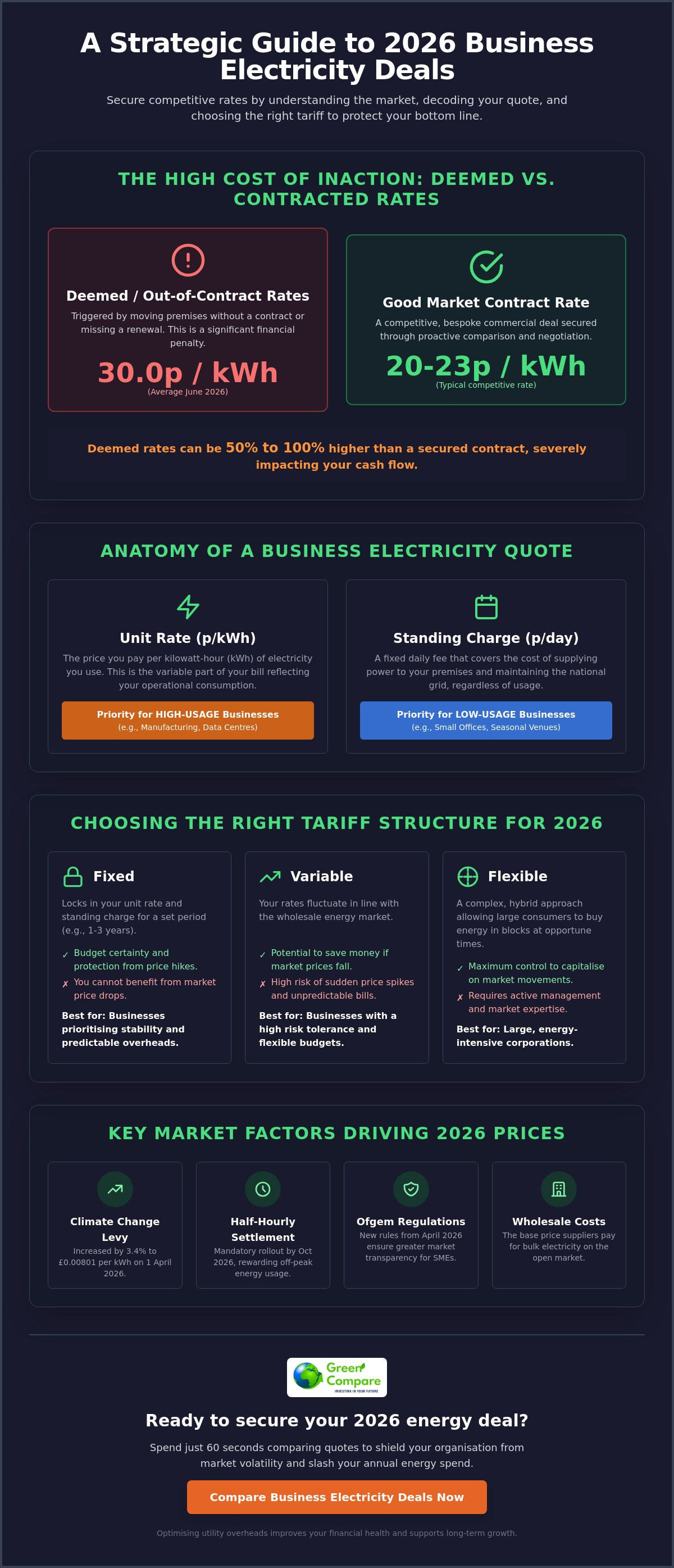
Suppliers charge a substantial premium when you don't have a formal agreement in place. These deemed rates often represent a 50% to 100% increase over standard fixed-term contracts, acting as a heavy financial penalty for administrative oversight. You'll typically trigger these expensive rates if you move into new premises without arranging a contract or if you simply miss your renewal window. With typical microbusiness unit rates currently averaging 30.0p per kWh as of June 2026, rolling onto deemed rates can quickly become a liquidity crisis for a small firm compared to a "good" market rate of 20.0p to 23.0p per kWh.
Market Volatility in 2026: What is Driving Prices?
Several factors are influencing the current cost of power. Domestic infrastructure levies and the 3.4% increase in the Climate Change Levy (CCL) to £0.00801 per kWh on 1 April 2026 have shifted the balance between standing charges and unit rates. The rollout of mandatory half-hourly settlement by October 2026 is also changing how suppliers calculate your quote, rewarding businesses that can shift their usage to off-peak times. Wholesale energy costs in 2026 are defined as the price suppliers pay to purchase bulk electricity on the open market before adding their own operational margins, delivery fees, and environmental obligations. Staying informed about these shifts ensures you don't get caught out by sudden price spikes that could otherwise be mitigated with a well-timed fixed-rate agreement.
Analysing the Components of a Business Electricity Quote
Understanding the anatomy of your energy bill is the first step toward total cost control. When you begin to compare business electricity deals, you'll encounter technical jargon that can seem intentionally confusing. However, most commercial quotes boil down to two primary costs: the unit rate and the standing charge. By breaking these down into transparent categories, you can identify where your money is actually going and where you can start saving. This clarity allows you to treat energy procurement as a precise financial exercise rather than a guessing game.
The unit rate is the price you pay per kilowatt-hour (kWh) of electricity used. It is the variable part of your bill that directly reflects your daily operational behaviour. In contrast, the standing charge is a fixed daily fee that covers the cost of supplying power to your premises and maintaining the national grid. Don't overlook this figure. A low unit rate can easily be offset by a high standing charge, especially for businesses with modest energy needs. For more detailed support on contract terms and your rights as a consumer, you can consult Ofgem's business energy advice.
Unit Rates vs. Standing Charges: The Balancing Act
Your choice of tariff should mirror your specific operational requirements. High-usage businesses, such as manufacturers or commercial bakeries, should prioritise securing the lowest possible unit rate. For these firms, even a fraction of a penny difference can save thousands of pounds annually. Conversely, small offices or seasonal businesses should focus on a lower standing charge. A favourite strategy amongst savvy SMEs is to model their annual usage against three different quote structures to see which one delivers the lowest total cost. It is about finding the right equilibrium for your specific growth trajectory. If you want to compare business electricity prices quickly, focus on your annual consumption data first.
Taxes, Levies, and Hidden Costs
Beyond the core supply costs, your bill includes statutory taxes and environmental levies. Most UK businesses pay the standard 20% VAT rate, but you might qualify for a reduced rate of 5% if your usage falls below the "de minimis" threshold or if you're a charity. The Climate Change Levy (CCL) is another significant component, currently set at £0.00801 per kWh as of April 2026. If your business operates within an energy-intensive sector and holds a Climate Change Agreement (CCA), you could receive a 92% discount on this levy. Green levies also appear on your bill to fund the UK's transition to net-zero. Understanding these exemptions ensures you aren't overpaying on your statutory obligations and keeps your margins protected.
Fixed, Variable, or Flexible: Choosing the Right Tariff Structure
Choosing the right structure is about aligning your energy procurement with your specific risk appetite. In a 2026 market shaped by the recent Ofgem regulatory overhaul, your choice determines how much wholesale volatility you absorb. Most business electricity deals fall into three distinct categories, each offering a different balance of protection and potential savings. By October 2026, all electricity settlement will move to half-hourly consumption data, making your tariff structure even more critical as suppliers begin to reward businesses with flexible usage patterns.
Before you sign a new contract, evaluate these three primary pillars of commercial energy:
- Fixed-Rate Tariffs: These lock in your unit rate and standing charge for a set duration, usually between one and five years.
- Variable-Rate Tariffs: Your prices fluctuate in line with the wholesale market, offering flexibility but zero protection against price spikes.
- Flexible/Pass-Through Contracts: Typically favoured by large enterprises, these allow you to buy energy in "tranches" throughout the year to capitalise on market lows.
While variable rates might seem attractive during a market dip, they leave your margins vulnerable to overnight surges. Flexible contracts require a high degree of internal expertise or a dedicated partner to manage the buying strategy effectively. For the vast majority of UK SMEs, the goal is to find a middle ground that provides both competitive pricing and long-term stability.
Fixed-Rate Deals: The Safe Haven for SMEs
Fixing your prices provides a reliable anchor for your financial forecasts. In 2026, where the "cost of doing nothing" is higher than ever, a fixed agreement ensures you won't be hit by the heavy premiums often seen on out-of-contract rates. It's about peace of mind. You pay a slight premium for the certainty that even if the global market surges, your operating costs remain static. This allows you to focus on scaling your operations and securing business loans for expansion rather than monitoring daily grid fluctuations.
Green and Renewable Tariffs: The Future of Procurement
Modern corporate values are now inextricably tied to environmental responsibility. Renewable Energy Guarantees of Origin (REGO) backed tariffs ensure that every unit of electricity you consume is matched by generation from renewable sources. By June 2026, the price gap between standard "brown" energy and green deals has narrowed, making sustainability a pragmatic financial choice. If your firm generates its own power through solar or wind, the Smart Export Guarantee (SEG) provides a transparent framework to sell excess electricity back to the grid. This turns your sustainability efforts into a tangible revenue stream whilst future-proofing your business against future carbon-related levies.
How to Organise Your Switch: A Practical 5-Step Checklist
Switching your supply is a decisive step toward operational excellence. It replaces administrative uncertainty with a clear, linear path to savings. By following this streamlined framework, you can secure the best business electricity deals without the typical headache associated with utility management. Efficiency is our priority; your time is better spent growing your company than chasing suppliers.
Follow these five steps to take control of your energy procurement:
- Step 1: Gather your current contract data. Locate your most recent bill to find your MPAN, contract end date, and annual consumption figures.
- Step 2: Compare the market using a professional partner. Use a specialist procurement ally to scan the 2026 market for bespoke quotes tailored to your usage profile.
- Step 3: Evaluate the real cost of each offer. Look beyond the headline rate to ensure the quote includes all levies, standing charges, and the 2026 Climate Change Levy adjustments.
- Step 4: Terminate your existing contract. Submit a formal termination notice to your current supplier within your specific notice window to prevent an expensive rollover.
- Step 5: Confirm your new deal and submit a final meter reading. Once your new contract is live, provide a final reading to your old supplier to ensure your closing bill is accurate.
The Information You Need to Get a Quote
Precision is the foundation of a great deal. Your Meter Point Administration Number (MPAN) is a unique 21-digit code found on your electricity bill that identifies your specific connection to the grid. Alongside this, having your accurate annual consumption data in kWh is vital. If you haven't already, ensure you have a smart meter installed. These devices simplify data collection by providing real-time usage stats, removing the need for estimated billing and ensuring your new quotes are based on reality rather than guesswork.
Managing the Termination Window
The "rollover trap" is a common pitfall where suppliers automatically move you onto expensive "out-of-contract" rates if you fail to act. Most commercial contracts require a formal termination notice between 30 and 90 days before the renewal date. Don't wait for the deadline to approach. You can compare business electricity deals in as little as 30 seconds to establish a baseline for your next agreement. Starting early gives you the leverage needed to negotiate better terms and ensures a seamless transition that protects your business margins from day one.
Optimising Your Business Overheads with Green Compare
Reframing your utilities as a strategic asset is a hallmark of a forward-thinking organisation. When you secure the most competitive business electricity deals, you aren't just saving pennies; you're actively strengthening your company's financial foundation. We view energy procurement as the opening chapter in a broader growth narrative. By stripping away unnecessary costs, you liberate capital that can be reinvested into your team, your technology, and your future. Those looking to reinvest these savings into a high-quality digital presence can check out Webexpand for bespoke web design. Our role is to act as your proactive partner, monitoring the market shifts of 2026 so you can focus on the work that truly matters. This isn't just about switching suppliers; it's about claiming the financial freedom to pursue your next big milestone.
The Synergy Between Utilities and Finance
A leaner balance sheet is a powerful tool for any SME. Reducing your overheads directly increases your "serviceability", a key metric used by lenders to assess your eligibility for business loans. Every pound saved on your unit rate is a pound that improves your debt-to-income ratio, making your organisation a more attractive prospect for commercial funding. It creates a virtuous cycle where lower costs lead to better credit terms, which in turn fuels further expansion. This strategic alignment between your utility spend and your financing options is often the missing piece in a successful scale-up strategy.
There's also significant logistical efficiency in managing your business gas and electricity through a single, streamlined platform. Consolidating your procurement reduces administrative friction and ensures you never miss a renewal window again. This holistic approach transforms mundane administrative tasks into a cohesive strategy for professional advancement. By centralising your utility management, you gain a clearer view of your total operational spend, allowing for more accurate forecasting and more confident decision-making amongst your leadership team.
Expert Guidance You Can Trust
Transparency is the bedrock of our service. We replace the cold, clinical feel of traditional brokerage with a supportive stance that prioritises your long-term development. Our professional guides alleviate the stress of renewal by providing rapid, reliable results that match our specific 60-second efficiency benchmark. You deserve a partner who values your time and possesses the regional pragmatism to navigate complex regulatory shifts. We're more than a platform; we are a knowledgeable ally dedicated to finding the best business electricity deals for your unique needs.
Get your bespoke business electricity quote in seconds and take the first step toward a more sustainable, profitable future. Advance your business by securing a better deal today and watch your margins grow alongside your ambitions.
Empower Your Business Growth Through Smarter Energy Choices
Securing the right business electricity deals is a decisive act of leadership that protects your margins and fuels long-term expansion. You now have the framework to decode complex quotes, navigate the October 2026 half-hourly settlement shift, and avoid the heavy premiums of deemed rates. A leaner balance sheet doesn't just save money; it actively improves your serviceability for future investment. It's about turning a mundane administrative task into a strategic advantage for your organisation.
Founded in 2019 with a dedicated focus on SME growth, we provide the expert guidance needed to navigate the UK energy market with confidence. Our rapid, transparent comparison process is designed to match your pace, delivering results in as little as 30 seconds. We're more than a utility platform; we're a proactive ally committed to your professional advancement and financial stability.
Secure your 2026 business electricity deal now and join the forward-thinking UK firms turning their overheads into opportunities. We're ready to help your business thrive.
Frequently Asked Questions
How do I find the best business electricity deals in 2026?
You find the best rates by using a professional comparison framework that accounts for the latest 2026 regulatory shifts. Avoid searching manually; instead, leverage a partner who understands the new October 2026 half-hourly settlement rules. This proactive approach ensures you capture bespoke rates that reflect your specific consumption patterns rather than settling for generic, off-the-shelf tariffs that don't account for your growth.
Can I switch my business electricity if I am in a contract?
You cannot usually switch your supply whilst you are still tied into a fixed-term agreement. Most commercial contracts are legally binding for their full duration, but you can secure your next deal up to 12 months in advance. Start by identifying your renewal window and submitting a formal termination notice to your current supplier. This prevents an expensive automatic rollover and allows you to transition seamlessly to a more competitive rate the moment your current term ends.
What information do I need to compare commercial electricity rates?
You need your Meter Point Administration Number (MPAN), your current contract end date, and your annual consumption figures in kWh. These details are found on your most recent bill and are essential for generating a precise quote. Providing accurate data allows procurement specialists to scan the market for business electricity deals that match your operational reality. Smart meter data is particularly helpful here, as it removes the risk of estimates skewing your potential savings.
Are green energy deals more expensive for UK businesses?
Green energy deals are no longer significantly more expensive than standard "brown" electricity in the 2026 market. Many suppliers now offer REGO-backed renewable tariffs as their default commercial option to help firms meet sustainability goals. Choosing a green tariff is a pragmatic way to future-proof your business against upcoming carbon levies whilst aligning your brand with modern, ethically conscious corporate values. It's an investment in both your balance sheet and the planet.
What happens if I don’t renew my business electricity contract?
You will be rolled onto "deemed" or "out-of-contract" rates if you fail to renew or switch before your deadline. These rates are often 50% to 100% higher than contracted prices, creating an immediate liquidity strain on your business. Suppliers charge this premium because you aren't locked into a term, making it the most expensive way to purchase power. Avoid this financial penalty by setting an alert for your renewal window at least six months in advance.
How long does it actually take to switch business electricity suppliers?
The actual transition between suppliers typically takes around five working days, provided your current account is clear of debt. However, the preparation phase, including comparing rates and submitting termination notices, should begin much earlier. Using an efficient comparison service can reduce the administrative burden to just 60 seconds of your time. This streamlined approach ensures your switch happens in the background whilst you focus on your core business growth.
What is the Climate Change Levy (CCL) on my bill?
The Climate Change Levy (CCL) is a government-imposed tax on energy used by businesses to encourage efficiency and reduce carbon emissions. As of 1 April 2026, the rate for electricity is £0.00801 per kWh. You'll see this as a separate line item on your bill unless your business is exempt or qualifies for a reduction through a Climate Change Agreement. Understanding these levies is vital for accurately calculating the total cost of any new energy agreement.
Can I get a business electricity deal as a sole trader?
You can certainly secure business electricity deals as a sole trader if you operate from a dedicated commercial premises. Even if you work from home, you may be eligible for a microbusiness contract if your energy usage exceeds certain thresholds. These contracts often provide better value than domestic tariffs because they are tailored to professional usage profiles. Consult a guide to see if your turnover or energy consumption qualifies you for the extra protections offered by Ofgem's microbusiness regulations.