Consolidate Debt in 2026: A Strategic Guide for UK Business Owners
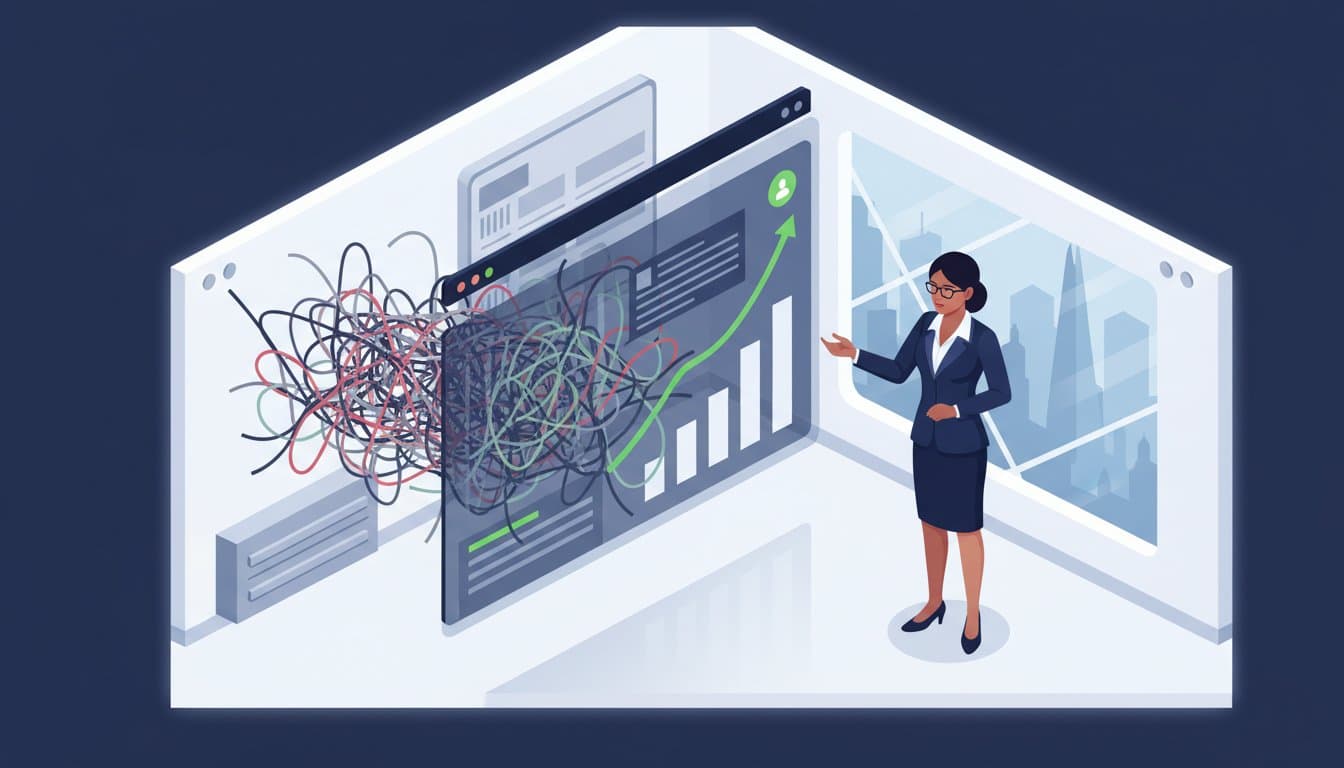
Did you know that 2,296 UK businesses entered insolvency in April 2026 alone? With business failures rising by 7% this year, the pressure of a 4.75% Bank of England base rate is felt in every boardroom across the country. If you're currently juggling multiple high-interest loans and utility arrears, the decision to consolidate debt is a powerful way to protect your profit margins and simplify your monthly outgoings.
We understand that managing complex finances can feel like a distraction from your true passion. You deserve a financial structure that supports your vision rather than hindering it. This guide will show you how to streamline your repayments and unlock vital cash flow for your business growth. We'll explore how to replace administrative stress with a clear, manageable path forward. Read on to discover how you can regain focus and continue your journey to success with confidence.
Key Takeaways
- Replace multiple high-interest liabilities with a single, streamlined agreement to protect your cash flow in the current 2026 economic climate.
- Discover how to consolidate debt from business credit cards and emergency bridging loans to regain control of your administrative schedule.
- Weigh up the speed of unsecured loans against the affordability of asset-backed finance to find the right balance for your business.
- Learn the essential steps to audit your creditors and verify your credit scores to ensure a smoother, faster application process.
- Unlock your potential for growth by simplifying your financial structure and focusing on your company's journey to success.
What Does it Mean to Consolidate Debt for Your Business?
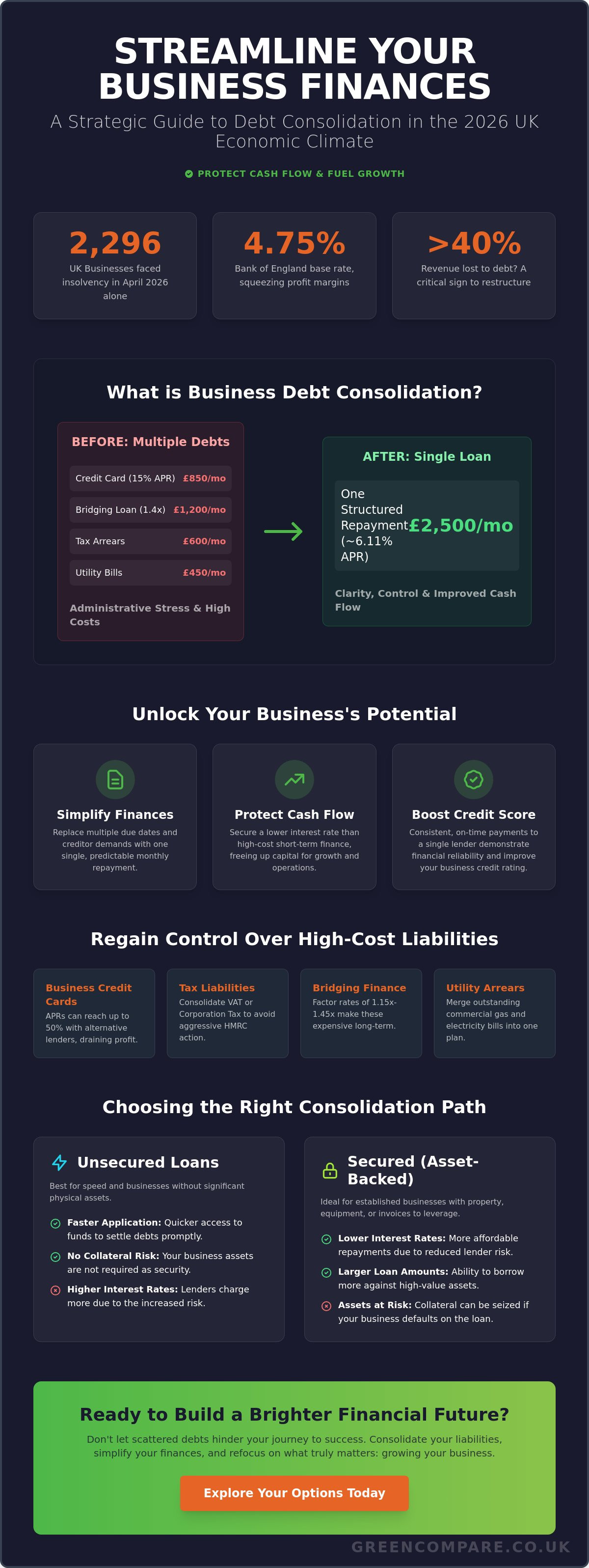
At its core, the decision to consolidate debt involves taking out a single new loan to settle multiple outstanding liabilities. This isn't merely a way to move numbers around a spreadsheet; it's a strategic capital restructure designed to simplify your financial life. To understand the fundamental mechanics, you can explore the question: What is debt consolidation? In a commercial context, it means replacing high-interest "quick" capital with a structured agreement that respects your business's long-term health.
The economic environment of 2026 makes this strategy more relevant than ever. With the Bank of England base rate holding at 4.75% as of March 2026, many SMEs find their profit margins squeezed by existing borrowing. In April 2026 alone, 2,296 UK businesses entered insolvency. Many of these firms struggled with the administrative weight of multiple creditors. By merging your debts, you move away from survival mode and start your journey to success with a clearer perspective.
There is a vital distinction between personal and commercial debt consolidation. Whilst personal versions focus on credit cards or store debt, business consolidation handles complex overheads like commercial gas arrears, high-interest overdrafts, and short-term bridging finance. This protects your cash flow from being drained by revenue-based finance, which often carries factor rates between 1.15x and 1.45x. Choosing a structured business loan allows you to reclaim your revenue for growth instead of just servicing old costs.
The Core Benefits of Streamlining Your Repayments
Managing five different creditors with five different due dates is an administrative nightmare. It drains your time and increases the risk of late payment penalties. Switching to a single repayment schedule reduces this mental load instantly. You gain clarity. Beyond the headspace, there's a clear financial win. If you secure a rate closer to the 6.11% average for new SME loans recorded in March 2026, your monthly outgoings will drop significantly. Consistent, organised payments also signal reliability to future lenders. This builds your business credit score and helps us build a brighter future together.
Is Debt Consolidation Right for Your Current Situation?
Analyze your total debt-to-income ratio before you make a move. If more than 40% of your monthly revenue vanishes into interest payments, it's time to restructure. Look for the warning signs. Are you relying on an overdraft to cover basic electricity bills? Did you enter 2026 with more liabilities than you had in 2025? If the answer is yes, you're ready for a change. Debt consolidation is a proactive tool for UK business empowerment that transforms scattered liabilities into a focused engine for future expansion.
Common Types of Debt Business Owners Consolidate
Business credit cards often feel like a safety net until the interest rates climb. In early 2026, high-street bank rates for these products typically sit between 7% and 15% APR. However, if you've relied on alternative lenders during a tight month, you might be facing APRs as high as 50%. These costs eat into your profit margins and stall your progress. When you choose to consolidate debt, you're effectively trading these expensive, fragmented liabilities for a single, manageable payment that respects your bottom line.
Tax liabilities are another growing concern for SMEs. HMRC has increased its enforcement action recently, contributing to the 2,296 business insolvencies recorded in April 2026. If you're struggling with VAT or Corporation Tax, there are specific finance products designed to help you stay compliant. You can research various UK government debt solutions to understand your rights before restructuring. If you decide to consolidate debt involving tax obligations, you can prevent aggressive creditor action and keep your doors open.
Bridging loans and "emergency" capital often carry heavy costs. These short-term fixes are useful during rapid growth spurts, but they shouldn't become permanent fixtures on your balance sheet. Factor rates on revenue-based finance, which often range from 1.15x to 1.45x, can quickly spiral out of control. Moving these balances into a standard business loan with a rate closer to the 6.11% SME average recorded in March 2026 can save your organisation thousands of pounds in interest.
Bridging the Gap Between Personal and Business Liability
Sole traders often struggle with the overlap of personal and professional debt. It's vital to separate these for financial clarity. Identify which debts are costing your organisation the most. This allows you to prioritise the most expensive liabilities first. Our team can help you find a tailored business loan that fits your specific needs. Separating your accounts whilst consolidating ensures you have a clear view of your company's true profitability.
Commercial Utility Arrears: A Hidden Growth Killer
Commercial utility arrears are a significant warning sign. In 2025, the accommodation and food services sector saw 3,353 insolvencies, often driven by rising overheads. Energy debt is frequently the first sign of a deeper cash-flow crisis. Green Compare empowers you to reorganise these costs. We believe in a greener, more affordable future. Switching to a more efficient tariff whilst restructuring your debt can provide the breathing room you need to thrive. Let us help you build a better future by streamlining your business gas and electricity alongside your finance.
Comparing Secured vs Unsecured Consolidation Options
Deciding how to consolidate debt requires a clear-eyed look at your balance sheet and your appetite for risk. Unsecured loans are a favourite amongst fast-moving SMEs because they don't require collateral. You won't need to hand over the deeds to your warehouse or provide a charge over your vehicle fleet. This lack of security means lenders mitigate their risk with higher interest rates. In March 2026, unsecured rates from high-street banks typically ranged from 7% to 15% APR. If your priority is speed and you want to avoid tying up your assets, this is the most efficient route.
Secured lending offers a different path for established firms. By using business assets like commercial property or heavy machinery as security, you can access significantly lower rates. For strong businesses in early 2026, secured loan rates are approximately 6% APR. This is a powerful way to reduce monthly pressure and protect your profit margins. It also allows for longer repayment terms, which frees up vital cash for day-to-day operations. However, you must consider the risk profile. If your sector faces a downturn, your core assets are on the line. With administrations increasing by 41% in Q1 2026, choosing a secured path requires a robust plan for the future.
The Pros and Cons of Unsecured Business Finance
Accessing capital quickly is vital during rapid growth spurts. Unsecured options are often approved in hours rather than weeks, making them ideal for urgent restructuring. There are no expensive asset valuations or complex legal charges to navigate. This flexibility allows you to act fast when an opportunity arises. You pay for this speed through the interest rate, but for many entrepreneurs, the agility is worth the extra cost. It keeps your business lean and responsive whilst you focus on your journey to success.
Secured Lending: Unlocking Lower Rates via Assets
If you have significant equity in your premises or equipment, secured lending can transform your financial structure. It’s about using what you’ve already built to fuel your next stage of growth. These loans provide a stable, long-term foundation. Repayments are spread over a longer period, making them much more affordable than high-interest bridging finance or credit card debt. We always recommend seeking expert advice when securing debt against your assets. It’s about balance. You want to lower your costs whilst protecting the foundation of your company. Together, we can help you build a brighter future by finding the right fit for your 2026 projections.
5 Steps to Consolidate Your Debt and Boost Cash Flow
Taking control of your finances requires a logical, step-by-step approach. You cannot manage what you haven't measured. With business insolvencies rising by 7% in early 2026, a proactive strategy is your best defence against market volatility. Follow these five linear steps to consolidate debt and reclaim your company's momentum.
- Audit your current liabilities: Create a comprehensive list of every creditor. Include your commercial electricity arrears, high-interest overdrafts, and any merchant cash advances. Note down the exact interest rate and the final due date for each.
- Check your credit health: Ensure your business and personal credit scores are accurate. Errors can lead to higher interest rates or rejected applications. A clean record is vital as SME borrowing growth hit 3.7% in March 2026.
- Determine your borrowing needs: Calculate the precise amount required to clear your existing debts. Don't guess. If you owe £45,000 across three lenders, ensure your new loan covers the full balance plus any early repayment fees.
- Compare the market: Don't settle for the first offer from your high-street bank. Use an expert partner like Green Compare to compare business loans and find the most competitive UK rates for your specific sector.
- Execute and clear: Once your new capital arrives, pay off your old creditors immediately. Close those high-interest accounts to prevent future "creep" and ensure your financial structure remains lean and focused.
Preparing Your Business Documentation
Speed is a competitive advantage. To move faster, gather your latest bank statements and management accounts before you start the process. Lenders in 2026 value transparency, and having your data ready allows for a more accurate risk assessment. When you provide clear information, it helps us build a better future for your company by matching you with the right funding partner. Proper preparation can reduce your application time to under 60 seconds, moving you from a problem to a solution almost instantly.
Switching and Saving Beyond the Loan
A debt restructure is the perfect time to evaluate your entire overhead structure. This is where you can achieve a "double win" for your cash flow. Whilst you consolidate debt, look at your current business gas and electricity contracts. Many firms are overpaying on outdated tariffs that drain profit margins just as much as high-interest loans. Switch to a greener, more affordable energy plan alongside your finance restructure. Set up automated payments for your new, single monthly repayment. This ensures you never miss a deadline and keeps your journey to success on track.
Partner with Green Compare for a Brighter Financial Future
Choosing the right partner to consolidate debt is a pivotal moment in your company's story. In an era where 2,296 UK businesses faced insolvency in April 2026, you need more than just a broker. You need an ally. Our expert team simplifies the complex world of commercial finance by stripping away the jargon. We replace the cold, clinical feel of traditional lending with a visionary approach that prioritises your growth. We're here to help you navigate the 4.75% base rate environment with absolute clarity and confidence.
The Green Compare difference is built on three pillars: speed, transparency, and a relentless focus on SME success. We don't believe in waiting weeks for a decision whilst your profit margins suffer. Our platform is designed for the modern entrepreneur who values time as much as capital. Beyond finding you a better loan, we take a holistic view of your business overheads. By reviewing your business gas and electricity alongside your debt, we help you build a brighter future where every pound works harder for you.
Why Thousands of UK Businesses Trust Us
Our commitment to finding greener and more affordable solutions is what sets us apart from the crowd. We understand that a truly successful business is one that is sustainable in every sense of the word. Efficiency is our signature. Our platform allows you to compare business loans in seconds, not weeks. This speed was vital for the construction and retail sectors in 2025, which saw over 7,600 insolvencies combined. Directors who moved quickly to restructure their liabilities were able to protect their operations whilst others stalled. Our testimonials speak of entrepreneurs who regained their focus and transformed their financial structure through our simple, linear process.
Ready to Build a Better Future Together?
Starting your journey to success is straightforward. Our secure portal allows you to input your requirements and receive a quote without the stress of traditional paperwork. You'll gain immediate access to our network of trusted UK lenders, each selected for their ability to support SME growth. We tailor every solution to your specific needs, ensuring the fit is perfect for your 2026 projections. Don't let high interest rates drain your potential any longer. Take the first step toward a more organised and profitable organisation. Compare business finance options and consolidate your debt today and let's grow together.
Empower Your Business Growth for 2026
Managing a business in 2026 requires agility and financial foresight. You now understand the steps to audit your liabilities and the vital differences between secured and unsecured finance. By choosing to consolidate debt, you aren't just simplifying your admin; you're actively protecting your profit margins from high interest rates. It's time to move away from the stress of multiple creditors and focus on what you do best. Your journey to success starts with a clear, manageable financial structure that supports expansion rather than hindering it.
Green Compare offers expert UK-based support to help you navigate these complex choices. We're trusted by thousands of SMEs and provide access to competitive commercial rates that traditional high-street banks often overlook. Our goal is to make your financial restructuring as fast and transparent as possible. Whether you're dealing with loan repayments or commercial utility arrears, we provide the tools to streamline your overheads in one place. Start your journey to success and compare business loans in 60 seconds. Let's build a brighter future together. Your business deserves a clear path to sustainable growth.
Frequently Asked Questions
Can I consolidate debt if my business has a poor credit score?
Yes, you can still access finance even with a less than perfect credit history. Many specialist lenders in 2026 prioritise your current cash flow and future turnover over historical credit blips. Whilst your interest rate might sit above the 6.11% SME average recorded in March 2026, restructuring your liabilities is often cheaper than staying with high-interest alternative lenders. We'll help you find a partner that supports your journey to success.
Will taking out a consolidation loan affect my ability to get a mortgage?
Consolidating your business debt can actually improve your mortgage prospects by lowering your monthly debt-to-income ratio. Mortgage lenders look for financial stability and manageable outgoings. By replacing multiple high-interest payments with one affordable monthly sum, you demonstrate better control over your finances. Consistent, on-time repayments on your new loan will also strengthen your overall credit profile over time.
How much can a UK business borrow to consolidate debt in 2026?
Borrowing limits depend on your company's turnover and whether you choose a secured or unsecured loan. In 2025, high street bank lending to SMEs rose to £17.5 billion, with individual loans typically ranging from £1,000 to over £500,000. Your specific capacity to consolidate debt is determined by your ability to service the new repayment plan. We help you calculate the exact amount needed to clear your creditors and unlock vital cash flow.
What is the difference between debt consolidation and debt management?
Debt consolidation involves taking out a new loan to pay off your existing creditors in full. This leaves you with a single, lower-interest agreement and full control over your finances. Debt management is usually a formal or informal arrangement where you pay back your original creditors over a longer period. Consolidation is a proactive strategy to reduce interest costs, whilst management is often a reactive step to avoid insolvency.
Can I include my business energy arrears in a consolidation loan?
Yes, you can include commercial gas and electricity arrears in your total consolidation amount. Clearing these debts prevents service disconnection and protects your daily operations. We recommend a holistic approach by switching to a greener, more affordable tariff at the same time. This "double win" reduces your monthly overheads and ensures your utility costs remain manageable as you build a better future.
How long does the application process take with Green Compare?
Our comparison platform is built for maximum speed and efficiency. You can view tailored quotes in under 60 seconds through our secure portal. Once you select a lender and provide your documentation, funds are often released within 24 to 48 hours. We value your time and aim to move you from a financial problem to a growth solution as quickly as possible.
Are there any hidden fees when I consolidate my business debt?
Transparency is our priority, so we ensure all arrangement fees are clearly disclosed before you commit. The most common "hidden" costs are actually the early repayment charges from your original lenders. Always check your existing contracts for these fees before you consolidate debt. We'll help you factor these costs into your new loan to ensure the restructure remains financially beneficial for your organisation.
What happens if I want to pay off my consolidation loan early?
Most modern business lenders offer the flexibility to settle your balance ahead of schedule. Paying off your loan early can save you a significant amount in interest, though some agreements may include a small early settlement fee. We focus on finding you flexible financing that adapts to your changing needs. Clearing your debt faster is a great way to accelerate your company's journey to success.