Business Energy Comparison UK 2026
Business Energy Comparison UK 2026 | Compare & Save
In 2026, managing business electricity and gas requires a sharp strategy. Commercial electricity and gas contracts work differently from household energy. They don't have the same safety net. So, renewing on time is your best way to avoid high out-of-contract penalty rates. Wholesale gas prices are influenced by global events. Top UK suppliers are competing hard for commercial contracts.
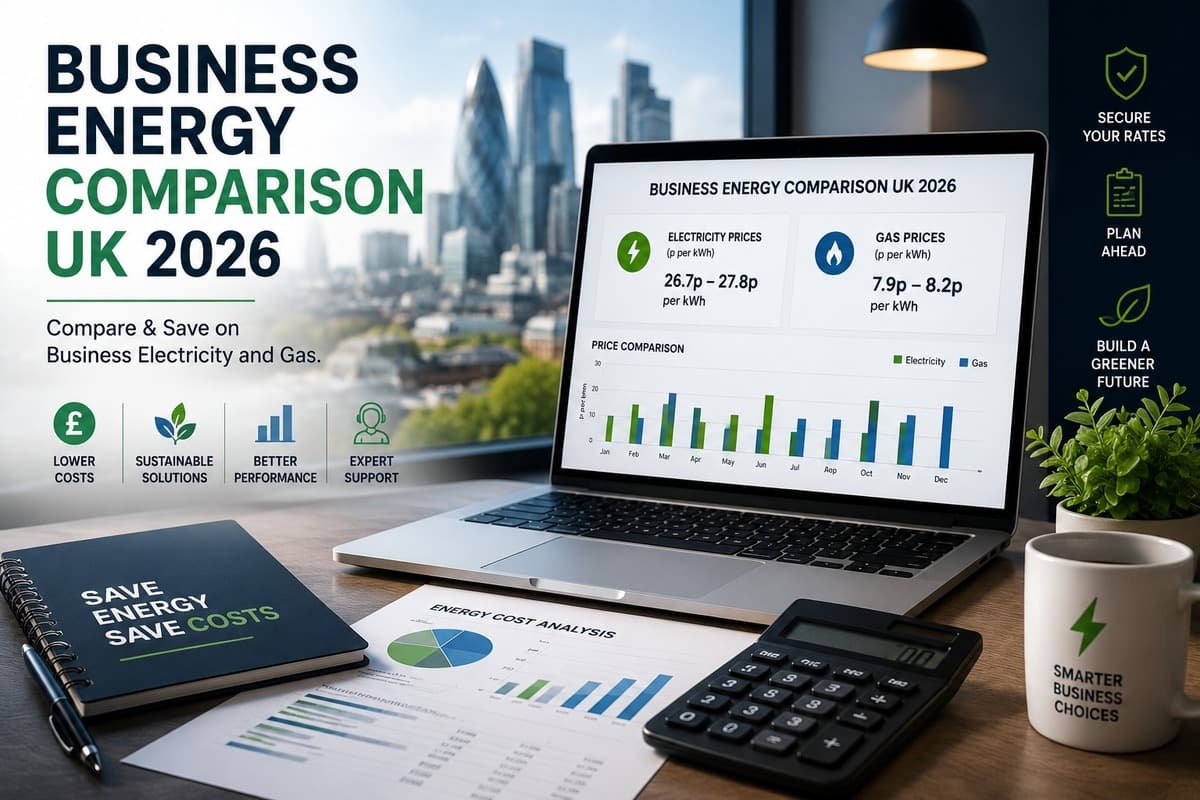
Average business electricity rates are 26.7p–27.8p per kWh and gas is 7.9p–8.2p per kWh. By managing your energy procurement, you can quickly lower costs. Use our Business Energy Comparison UK 2026 framework to check your usage. Evaluate fixed and variable options. Choosing the right tariff matters. It affects your bottom line. Understanding market structures is also key.
Why compare business energy prices?
Evaluating commercial tariffs ensures your enterprise remains financially resilient and operationally efficient.
Reduce commercial costs
Electricity and gas represent major overhead expenses for UK companies. Securing competitive unit rates (p/kWh) and standing charges allows you to preserve operating margins.
Avoid out-of-contract business rates
When a fixed deal expires without a renewal or transition in place, suppliers move the connection to default, deemed, or out-of-contract rates. These rollover penalties can run 40% to 100% higher than standard market agreements.
Be more sustainable
Switching to 100% renewable tariffs, Power Purchase Agreements (PPAs), or REGO-backed (Renewable Energy Guarantees of Origin) power helps achieve ESG targets. Sustainable options now frequently match traditional fossil-fuel pricing.
Adapt to business changes
Changing operating hours, adding EV charging points, or installing high-demand equipment alters your load profile. Comparing plans ensures your tariff reflects your current usage patterns.
Get better customer service
Energy management relies on smooth administrative processes. Switching enables you to partner with providers offering real-time account dashboards, accurate automated billing, and fast service response times.
The Best UK Business Energy Comparison Platforms in 2026
1. Uswitch
Facilities & Features: Uses your business postcode and MPAN (electricity meter) or MPRN (gas meter) to pull live profile classes and historical consumption directly from central databases.
How to Compare: Enter your postcode and meter info online; the platform automatically estimates annual consumption and generates side-by-side quotes.
Why They Are the Best: Known for maximum market transparency and turning complex wholesale formulas into clear, side-by-side cost projections for SMEs.
Customize Deals: Choose between 1 to 5-year fixed terms, variable tariffs, or 100% REGO-backed green energy plans.
Expert Advice: Access dedicated business energy specialists who guide you through market fluctuations and contract rollover risks.
2. Green Compare
Facilities & Features: Access to 30+ UK suppliers combined with integrated business financing (commercial loans, merchant cash advances) and half-hourly (HH) metering support.
How to Compare: Compare business energy rates in simple steps: enter your postcode, submit your profile for a free audit, Green Compare team cross-analyzes quotes from over 30 providers.
Why They Are the Best: The premier choice for ESG/Net-Zero compliance, offering 100% green gas (biomethane), carbon-neutral electricity, free bill audits, and combined financial growth services.
Customize Deals: Tailor contracts around carbon-offsetting targets, 1–5 year fixed rates, and integrated commercial funding options.
Expert Advice: Every business is assigned a dedicated personal account manager who conducts free bill audits and manages end-to-end admin.
3. Bionic
Facilities & Features: Smart-data tech lookup paired with exclusive partner perks—such as a £100 Love2shop voucher per meter when switching eligible meters to ScottishPower.
How to Compare: Provide your postcode via web or phone; Bionic’s smart system pulls meter details and usage history automatically.
Why They Are the Best: High speed, automated renewal monitoring, and strong direct supplier partner incentives.
Customize Deals: Custom end-date alignment across multi-meter sites and access to promotional supplier offers.
Expert Advice: A hybrid model using AI meter matching supported by high-touch phone specialists for direct supplier negotiation.
4. MoneySuperMarket
Facilities & Features: Offers rapid comparisons for micro-businesses up to large enterprises, complete with automated price alerts and VAT reduction assistance (down to 5% for qualifying non-profits).
How to Compare: Input your postcode and business setup (sole trader, SME, or multi-site) to filter quotes by supplier rating and contract length.
Why They Are the Best: Versatile purchasing options tailored for off-peak/weekend operations, home-based businesses, and multi-site groups.
Customize Deals: Offers specialized tariffs for off-peak load profiles, consolidated multi-meter renewals, and flexible pass-through structures.
Expert Advice: Load-profile analysts guide you through energy tenders and prevent expensive out-of-contract default rates.
Key Feature & Performance Comparison
<div style="width:100%; overflow-x:auto; margin:24px 0;">
<table style="width:100%; min-width:750px; border-collapse:collapse; border:1px solid #d9d9d9; font-family:Arial, sans-serif; font-size:15px; line-height:1.5;">
<thead>
<tr>
<th style="border:1px solid #d9d9d9; padding:14px 12px; text-align:left; background:#f4f7f4; font-weight:700;">
Provider
</th>
<th style="border:1px solid #d9d9d9; padding:14px 12px; text-align:left; background:#f4f7f4; font-weight:700;">
Main Advantage
</th>
<th style="border:1px solid #d9d9d9; padding:14px 12px; text-align:left; background:#f4f7f4; font-weight:700;">
Top Facility
</th>
<th style="border:1px solid #d9d9d9; padding:14px 12px; text-align:left; background:#f4f7f4; font-weight:700;">
Advisory Model
</th>
</tr>
</thead>
<tbody>
<tr>
<td style="border:1px solid #d9d9d9; padding:14px 12px; font-weight:700;">
Uswitch
</td>
<td style="border:1px solid #d9d9d9; padding:14px 12px;">
Simple SME procurement
</td>
<td style="border:1px solid #d9d9d9; padding:14px 12px;">
Central MPAN/MPRN database lookup
</td>
<td style="border:1px solid #d9d9d9; padding:14px 12px;">
Dedicated energy specialists
</td>
</tr>
<tr>
<td style="border:1px solid #d9d9d9; padding:14px 12px; font-weight:700;">
Green Compare
</td>
<td style="border:1px solid #d9d9d9; padding:14px 12px; font-weight:700;">
Best for ESG & finance
</td>
<td style="border:1px solid #d9d9d9; padding:14px 12px; font-weight:700;">
30+ suppliers + business loans
</td>
<td style="border:1px solid #d9d9d9; padding:14px 12px; font-weight:700;">
1-on-1 account manager
</td>
</tr>
<tr>
<td style="border:1px solid #d9d9d9; padding:14px 12px; font-weight:700;">
Bionic
</td>
<td style="border:1px solid #d9d9d9; padding:14px 12px;">
Fast digital switching & rewards
</td>
<td style="border:1px solid #d9d9d9; padding:14px 12px;">
£100 Love2shop voucher incentives
</td>
<td style="border:1px solid #d9d9d9; padding:14px 12px;">
Hybrid AI + phone agents
</td>
</tr>
<tr>
<td style="border:1px solid #d9d9d9; padding:14px 12px; font-weight:700;">
MoneySuperMarket
</td>
<td style="border:1px solid #d9d9d9; padding:14px 12px;">
Multi-site & off-peak tariffs
</td>
<td style="border:1px solid #d9d9d9; padding:14px 12px;">
Bulk purchasing & VAT optimization guidance
</td>
<td style="border:1px solid #d9d9d9; padding:14px 12px;">
Tender & load-profile analysts
</td>
</tr>
</tbody>
</table>
</div>
Can I compare business energy on business gas and electricity comparison sites?
Yes! You can check out specialized business energy comparison websites like Green Compare, MoneySuperMarket, Uswitch and broker services to find the best commercial gas and electricity deals. These platforms operate a bit differently than those for homes. To finalize your custom contract terms, you might need to have a quick phone call with an energy expert or broker. It needs because business rates don’t have standard price caps or cooling-off periods.
Business energy prices explained
Commercial rates depend on your meter type, total usage, location, credit rating, and current wholesale market conditions.
Average 2026 Business Electricity & Gas Rates
<div style="width:100%; overflow-x:auto; margin:24px 0;">

  <table style="width:100%; min-width:850px; border-collapse:collapse; font-family:Arial, sans-serif; font-size:15px; line-height:1.5; border:1px solid #d9d9d9;">

    <thead>
      <tr>
        <th style="border:1px solid #d9d9d9; padding:14px 12px; text-align:left; background:#f4f7f4; font-weight:700;">
          Business Size
        </th>

        <th style="border:1px solid #d9d9d9; padding:14px 12px; text-align:left; background:#f4f7f4; font-weight:700;">
          Annual Usage (kWh)
        </th>

        <th style="border:1px solid #d9d9d9; padding:14px 12px; text-align:left; background:#f4f7f4; font-weight:700;">
          Avg. Electricity Rate (p/kWh)
        </th>

        <th style="border:1px solid #d9d9d9; padding:14px 12px; text-align:left; background:#f4f7f4; font-weight:700;">
          Avg. Gas Rate (p/kWh)
        </th>

        <th style="border:1px solid #d9d9d9; padding:14px 12px; text-align:left; background:#f4f7f4; font-weight:700;">
          Avg. Daily Standing Charge
        </th>
      </tr>
    </thead>

    <tbody>

      <tr>
        <td style="border:1px solid #d9d9d9; padding:14px 12px; font-weight:700;">
          Small
        </td>

        <td style="border:1px solid #d9d9d9; padding:14px 12px;">
          5,000–15,000
        </td>

        <td style="border:1px solid #d9d9d9; padding:14px 12px;">
          28.0p – 29.5p
        </td>

        <td style="border:1px solid #d9d9d9; padding:14px 12px;">
          7.0p – 7.6p
        </td>

        <td style="border:1px solid #d9d9d9; padding:14px 12px;">
          50p – 65p
        </td>
      </tr>

      <tr>
        <td style="border:1px solid #d9d9d9; padding:14px 12px; font-weight:700;">
          Medium
        </td>

        <td style="border:1px solid #d9d9d9; padding:14px 12px;">
          50,000 – 500,000
        </td>

        <td style="border:1px solid #d9d9d9; padding:14px 12px;">
          24.5p – 26.5p
        </td>

        <td style="border:1px solid #d9d9d9; padding:14px 12px;">
          6.5p – 8.2p
        </td>

        <td style="border:1px solid #d9d9d9; padding:14px 12px;">
          60p – 125p
        </td>
      </tr>

      <tr>
        <td style="border:1px solid #d9d9d9; padding:14px 12px; font-weight:700;">
          Large / Industrial
        </td>

        <td style="border:1px solid #d9d9d9; padding:14px 12px;">
          500,000+
        </td>

        <td style="border:1px solid #d9d9d9; padding:14px 12px;">
          20.5p – 23.5p
        </td>

        <td style="border:1px solid #d9d9d9; padding:14px 12px;">
          3.7p – 6.4p
        </td>

        <td style="border:1px solid #d9d9d9; padding:14px 12px;">
          Bespoke
        </td>
      </tr>

    </tbody>

  </table>

</div>
Business energy tariff types explained
Fixed-Rate Tariffs: Lock in unit rates (p/kWh) and daily standing charges for 1 to 5 years. Provides complete budget stability against wholesale volatility.
Variable-Rate Tariffs: Rates rise and fall based on wholesale market fluctuations. Offers flexibility without long-term commitment, but exposes you to price spikes.
Deemed / Out-of-Contract Tariffs: Applied when you move into new premises without signing a contract, or when an existing agreement expires without a replacement. These are among the market's highest rates.
Flexible / Pass-Through Tariffs: Typically used by large enterprises using over 500 MWh/year. Energy is bought in blocks on the wholesale market, passing wholesale wholesale movements and non-commodity charges directly to the customer.
Green / Renewable Tariffs: Electricity matched 100% with renewable generation certificates (REGOs) or backed by direct hydro, wind, or solar Power Purchase Agreements (PPAs).
Switching business energy: what you need to know
Switching requires checking your current contract's end date and notice window. Most providers allow you to negotiate and lock in a new rate up to 6 to 12 months before your existing agreement expires. When switching, no physical pipework or cabling changes are made; the transition is purely administrative.
Can I compare business electricity and business gas separately?
Yes. Because commercial energy does not offer unified domestic-style "dual fuel" discounts, procuring gas and electricity separately often yields better pricing. You can choose different specialized suppliers for each utility based on where you find the strongest unit rates.
Business energy vs. domestic – what's the difference?
<div style="width:100%; overflow-x:auto; margin:24px 0;">
<table style="width:100%; min-width:700px; border-collapse:collapse; font-family:Arial, sans-serif; font-size:15px; line-height:1.5; border:1px solid #d9d9d9;">
<thead>
<tr>
<th style="border:1px solid #d9d9d9; padding:14px 12px; text-align:left; background:#f4f7f4; font-weight:700;">
Feature
</th>
<th style="border:1px solid #d9d9d9; padding:14px 12px; text-align:left; background:#f4f7f4; font-weight:700;">
Domestic Energy
</th>
<th style="border:1px solid #d9d9d9; padding:14px 12px; text-align:left; background:#f4f7f4; font-weight:700;">
Business Energy
</th>
</tr>
</thead>
<tbody>
<tr>
<td style="border:1px solid #d9d9d9; padding:14px 12px; font-weight:700;">
Price Cap
</td>
<td style="border:1px solid #d9d9d9; padding:14px 12px;">
Protected by Ofgem Price Cap
</td>
<td style="border:1px solid #d9d9d9; padding:14px 12px;">
NO Price Cap (Rates negotiated)
</td>
</tr>
<tr>
<td style="border:1px solid #d9d9d9; padding:14px 12px; font-weight:700;">
Contract Structure
</td>
<td style="border:1px solid #d9d9d9; padding:14px 12px;">
Dual-fuel bundled deals common
</td>
<td style="border:1px solid #d9d9d9; padding:14px 12px;">
Separate gas & power contracts
</td>
</tr>
<tr>
<td style="border:1px solid #d9d9d9; padding:14px 12px; font-weight:700;">
Cooling-Off Period
</td>
<td style="border:1px solid #d9d9d9; padding:14px 12px;">
14-day cooling-off period
</td>
<td style="border:1px solid #d9d9d9; padding:14px 12px;">
NO cooling-off period once signed
</td>
</tr>
<tr>
<td style="border:1px solid #d9d9d9; padding:14px 12px; font-weight:700;">
VAT Rate
</td>
<td style="border:1px solid #d9d9d9; padding:14px 12px;">
Standard 5% VAT rate
</td>
<td style="border:1px solid #d9d9d9; padding:14px 12px;">
20% Standard VAT (5% de-minimis)
</td>
</tr>
<tr>
<td style="border:1px solid #d9d9d9; padding:14px 12px; font-weight:700;">
Climate Change Levy (CCL)
</td>
<td style="border:1px solid #d9d9d9; padding:14px 12px;">
Exempt from Climate Change Levy
</td>
<td style="border:1px solid #d9d9d9; padding:14px 12px;">
Subject to CCL tax charges
</td>
</tr>
</tbody>
</table>
</div>What if You run a large business?
Large enterprises or multi-site corporations require bespoke portfolio management. If your operations use Half-Hourly (HH) metering (Profile Classes 05–08) or consume significant volume, static online quotes are insufficient. Large businesses use flexible purchasing, aggregated demand management, peak-shaving tactics, and tailored supplier panels to manage non-commodity cost additions (such as TNUoS and DUoS network charges).
How can You cut my business energy bills?
Beyond securing a low unit rate, operational changes help lower energy costs:
Upgrade to Smart / AMR Meters: Automated Meter Reading eliminates estimated bills and tracks consumption spikes.
Reduce Standby Loads: Equip commercial refrigeration, HVAC systems, and kitchen lines with automated controls to limit power draw during off-peak hours.
Capitalize on Tax Exemptions: Verify if your usage qualifies for reduced VAT or Climate Change Levy exemptions.
Evaluate On-Site Solar & Storage: Installing commercial solar PV reduces reliance on grid power during expensive peak daytime hours.
Sector-Specific Sector Consumption Profiles
Different commercial sectors face distinct energy usage demands:
Supermarkets & Supershops: Operating heavy continuous refrigeration 24/7 creates a high, steady baseload. Supermarkets typically utilize Half-Hourly (HH) metering to monitor daytime peak usage against night-time operations.
Restaurants & Commercial Kitchens: Characterized by steep gas usage spikes during meal preparation alongside high HVAC and extraction demands. Balancing kitchen gas tariffs with competitive electricity rates is critical for maintaining margins.
Retail Shops & Boutiques: Energy usage is driven primarily by display lighting, heating, and cooling during standard trading hours. Aligning tariff structures with operating hours helps keep unit costs down.
Compare UK business energy suppliers with Green Compare
While platforms like Uswitch and Bionic offer general comparison services, Green Compare specializes in helping UK businesses find competitive commercial energy deals with an emphasis on sustainability and price transparency.
Why Work with Green Compare?
Zero Hidden Broker Markup: Full disclosure on commission structures and unit costs.
100% Renewable Focus: Fast access to verified green tariffs, REGO-backed power, and corporate PPAs that match standard fossil-fuel price points.
Audit & Letter of Authority (LOA) Protection: Green Compare acts under a clear Letter of Authority to audit your bill history, manage termination notices, and prevent default rates without taking over account control.
Tax Rules: VAT & Climate Change Levy (CCL)
Standard vs. Reduced VAT: Most commercial energy bills incur 20% VAT. However, micro-businesses tax breaks depend strictly on usage (<33 kWh/day power, <145 kWh/day gas)
Climate Change Levy (CCL): From 1 April 2026, the main CCL rate for both electricity and natural gas is £0.00801 per kWh (0.801p/kWh), while the rate for LPG remains frozen at £0.02175 per kg and solid fuels increase to £0.06264 per kg. Businesses that qualify for the 5% reduced VAT threshold are automatically exempt from the CCL. Energy-intensive industries can also cut CCL costs by entering into Climate Change Agreements (CCAs).
FAQs
1. Are business energy prices capped by Ofgem in 2026?
No, Ofgem does not cap commercial energy rates. Prices are negotiated based on wholesale market conditions, location, and total usage.
2. How early can I compare and switch suppliers?
You can lock in a new rate 6 to 12 months before your contract expires. Green Compare can help monitor market trends and manage your renewal window early.
3. What happens if my contract expires without a renewal?
Your provider will move you to default or out-of-contract rates, which can run 40% to 100% higher than negotiated fixed deals.
4. How does the Climate Change Levy (CCL) affect my bill?
The CCL is an environmental tax added per kWh. Green Compare can conduct bill audits to see if you qualify for exemptions or discounts.
5. How can small businesses cut CCL and VAT costs?
Sites using under 33 kWh/day of power or 145 kWh/day of gas automatically qualify for a reduced 5% VAT rate and full CCL exemption.
6. Is it better to go direct or use a comparison platform?
Comparison platforms like Green Compare access wholesale pricing across 30+ UK suppliers with zero hidden markups, often beating direct supplier quotes.
Conclusion
Managing UK commercial energy in 2026 ultimately comes down to proactive timing and choosing the right setup for your business. Commercial energy contracts lack Ofgem price caps and cooling-off periods. So, if an agreement expires, you’ll be switched to expensive out-of-contract default rates automatically. The most effective way to protect your operating margins is to begin comparing options 6 to 12 months before your contract ends, allowing you to lock in favorable unit rates early. Using specialized comparison platforms like Green Compare, Uswitch can make this process easy. You can analyze top UK suppliers without worrying about hidden markups, understand complex switch notices, and explore potential tax savings, such as reduced VAT or CCL exemptions.